
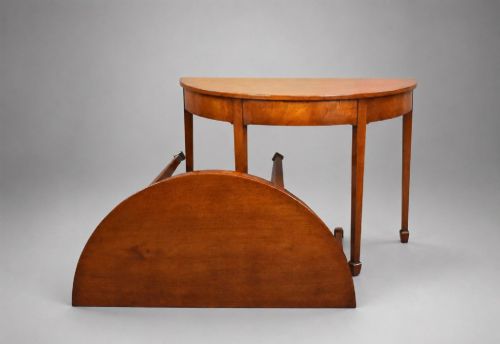
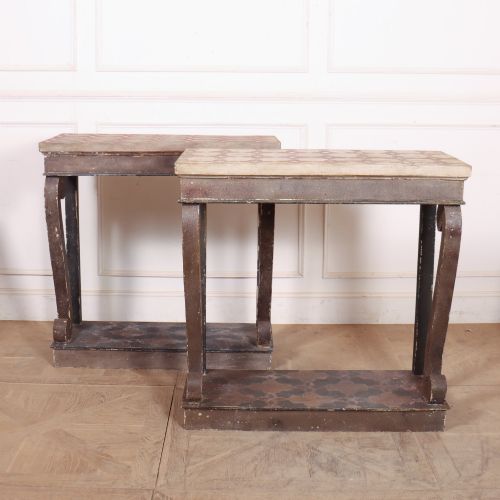

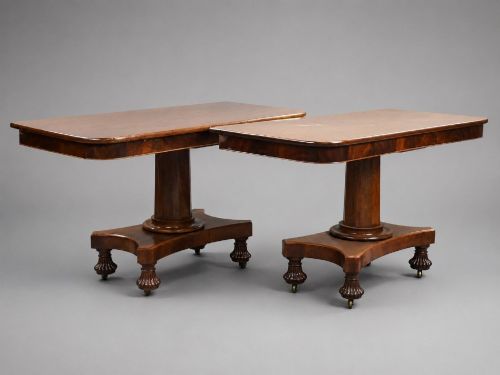
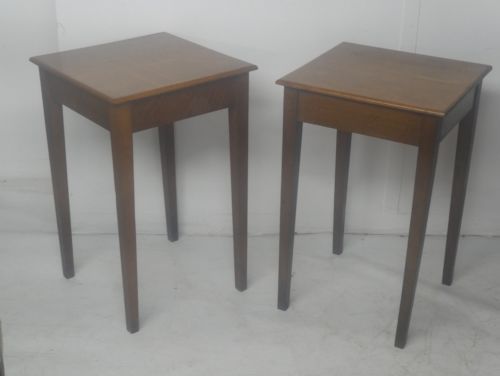




Pair of Hallway Tables
A pair of hallway tables brings symmetry and balance to an entrance, offering a surface for lamps and correspondence.
Pair of Hallway Tables
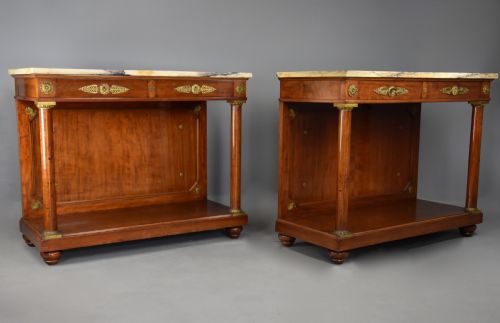
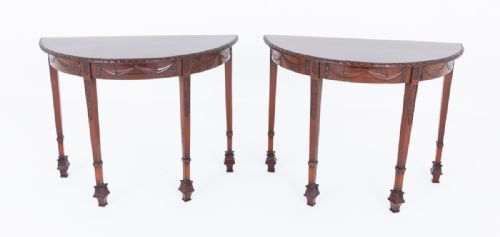
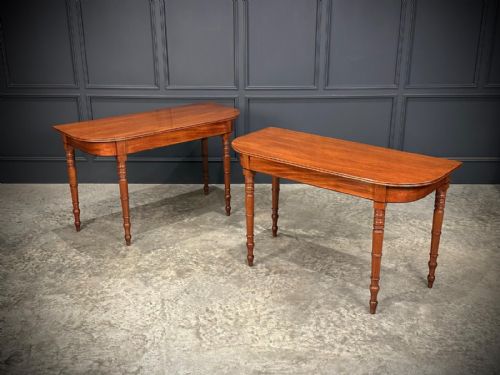
A pair of hallway tables typically takes the form of console tables, serving tables, or side tables designed to stand against a wall in an entrance or narrow room. The selection spans formal Georgian and Regency mahogany pieces to painted Swedish and French designs from the nineteenth century.
Makers produced these matching sets in various configurations, including demi-lune shapes and bowfronts, utilising timber such as oak, walnut, and rosewood alongside marble tops.
Examples range from early nineteenth-century George III pieces to later interpretations in the Art Deco and Victorian styles, providing dual surfaces for domestic display.
Materials and construction
Cabinet makers utilised dense hardwoods such as mahogany and walnut, often employing figured veneers and brass or ormolu mounts to enhance the visual weight of the console.
Surface decoration frequently involved hand-painting on timber or incorporating marble inserts into the tops, alongside parcel gilt highlights and inlaid details.
The listings span from the seventeenth century through to Art Deco and 1920s production, demonstrating enduring popularity for matched furniture pairs.
Assessing quality and execution
The standard of a pair of hallway tables rests upon the selection of timber and the precision of the carving, particularly around legs, aprons, and applied mouldings.
Superior execution shows in the matching of grain across both tables in the pair, the integrity of structural joins, and the quality of integrated marble or brass elements.
Krieger Paris·Gillows
The Pair of Hallway Tables Glossary
- Console table
- A table designed to stand against a wall, frequently fixed with brackets or standing on front legs with the rear supported by the structure.
- Demi-lune
- A half-moon shape characteristic of many side and console tables produced during the Georgian and nineteenth-century periods.
- Serving table
- A large side table often utilised in dining spaces or grand hallways for the placement of dishes or decorative objects.
- Ormolu
- Gilt bronze mounts applied as decorative ornaments to furniture, common in French Empire and nineteenth-century designs.
- Bowfront
- A convex curved front contour seen on specific side and console tables from the Georgian era onwards.
Pair of Hallway Tables: Frequently Asked Questions
Where should I place a pair of hallway tables?
These pieces fit naturally against a long hallway wall or flanking an entrance doorway to create a balanced focal point.
They also function effectively in reception rooms where symmetry requires matching side or console furniture.
How do I identify a Georgian pair?
Georgian pieces typically feature solid mahogany construction, precise joinery, and restrained classical proportions dating from the eighteenth or early nineteenth century.
Details such as hand-cut dovetails and traditional timber framing help distinguish this period from later revivals.
What is the difference between a console and a side table?
Console tables traditionally rely partly upon the wall for physical support or mimic that architectural style, whereas side tables stand entirely on their own four legs.
Both forms serve similar functional roles in narrow spaces and hallways.
Are marble tops original to these tables?
Many nineteenth-century French and neoclassical console tables incorporate fitted marble slabs designed as an integral part of the piece.
These heavy surfaces provide durability and contrast with the timber frames beneath.