

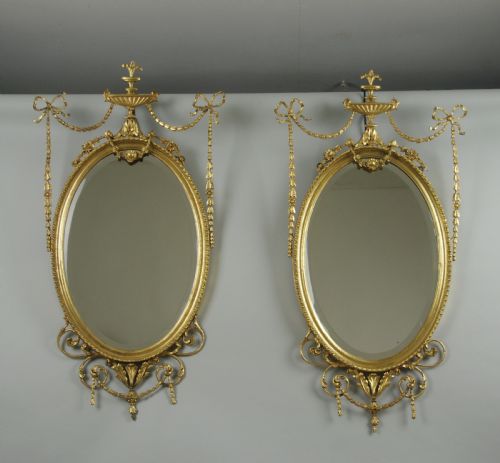


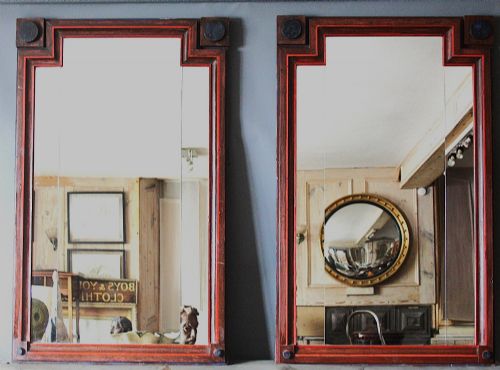


Pair of Accent Mirrors
These pair of accent mirrors bring instant symmetry and reflected light to a room, spanning styles from Georgian elegance to Art Deco geometry.
Pair of Accent Mirrors
The selection ranges across the eighteenth, nineteenth, and early twentieth centuries. Pieces from the Georgian and Victorian eras sit alongside later interpretations in the Art Deco style.
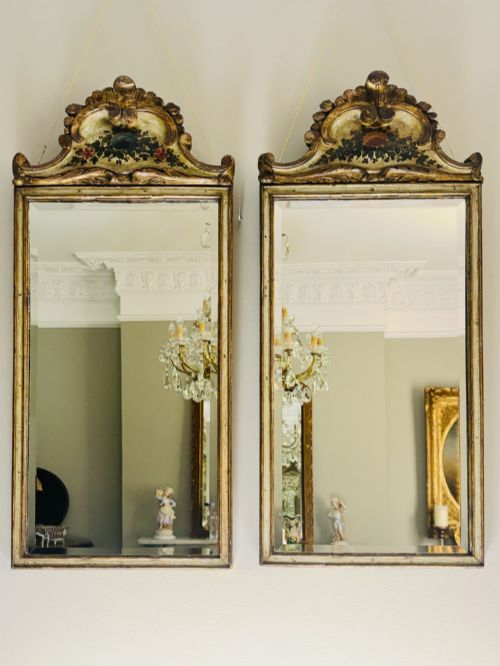
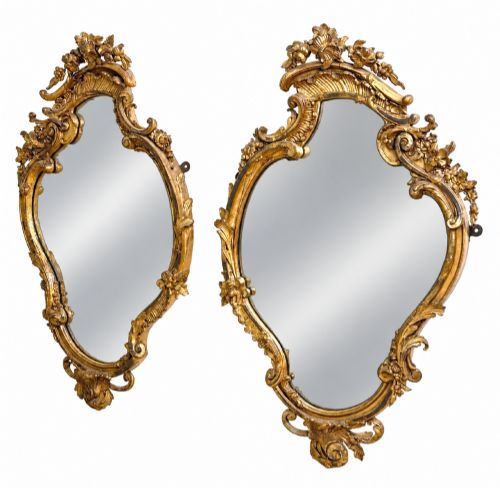
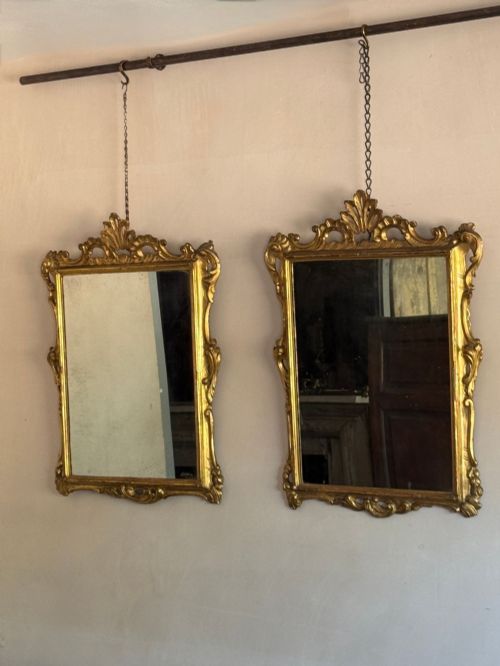
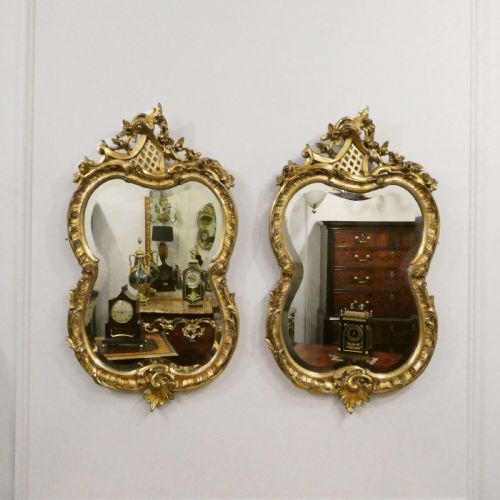
Most examples take the form of wall mirrors executed in carved wood, giltwood, and gesso. Oval formats and cartouche shapes appear frequently alongside Italian Rococo and French Rococo designs.
How they were made
Construction relies heavily on traditional woodworking techniques applied to timber frames. Carved wood and carved pine provide the foundational structure for many of these wall mirrors.
Surface finish is achieved through the application of gesso, paint, and gold leaf. Giltwood finishes involve laying gold leaf over a prepared gesso ground, creating the reflective metallic surfaces characteristic of Rococo Revival and Regency style pieces.
Pair of Accent Mirrors Retail Price Guide 2026
Typical asking prices for pair of accent mirrors among the pieces listed under this phrase on Sellingantiques today, from the lower quarter to the upper quarter. They describe what is for sale here now, not the wider market.
The listings on this site encompass periods from the eighteenth century through to Art Deco, utilising materials such as giltwood, gesso, and glass.
What varies in quality
Quality differences lie in the depth and crispness of the carving upon the wooden frames. Hand-carved details in giltwood show sharper definition and more fluid movement than later moulded ornament.
The preservation of the original surface finishes, whether paint, polychrome, or gold leaf, dictates the visual integrity of the piece. Patina accumulated over the centuries alters how the frame catches and reflects ambient light.
The Pair of Accent Mirrors Glossary
- Giltwood
- Wood that has been coated with gold leaf. This technique creates a brilliant metallic surface commonly seen on antique frames.
- Gesso
- A plaster mixture applied to wood surfaces as a smooth base for gilding or painting. It allows intricate relief ornamentation to be modelled before application.
- Cartouche
- An ornamental frame resembling a rolled-up piece of paper or parchment with an inscribed centre. It frequently defines the ornate outline of mid-nineteenth century wall mirrors.
- Rococo Revival
- A nineteenth-century design movement emulating the asymmetrical C-scrolls and natural motifs of the eighteenth-century French style. This aesthetic dominates many ornate gilt frames.
Pair of Accent Mirrors: Frequently Asked Questions
Where should I hang a pair?
These wall mirrors work best when hung opposite each other to bounce light around a room, or flanking a central piece of furniture like a fireplace or sideboard. Their matched symmetry creates a balanced focal point on any wall.
Ensure they are hung at eye level to maximise their reflective qualities and integration with surrounding interior elements.
How do I spot an 18th-century frame?
Look for hand-carved wooden construction beneath the gold leaf, showing tool marks and subtle irregularities distinct from later machine production. The gesso layers on older pieces often display fine age-related craquelure.
Italian and French Rococo examples from this period exhibit deep, organic carving styles that feel entirely integrated with the wooden structure.
Are Art Deco mirrors different?
Art Deco pieces from the early twentieth century favour clean geometric lines and minimal ornamentation over the complex curves of earlier Rococo Revival designs. They utilise simulated wood finishes and streamlined shapes.
These later mirrors suit interiors requiring a more restrained decorative presence while maintaining the paired symmetry.