
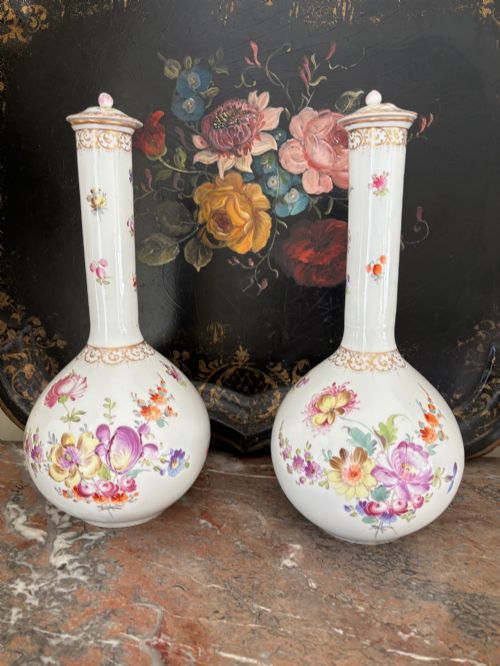
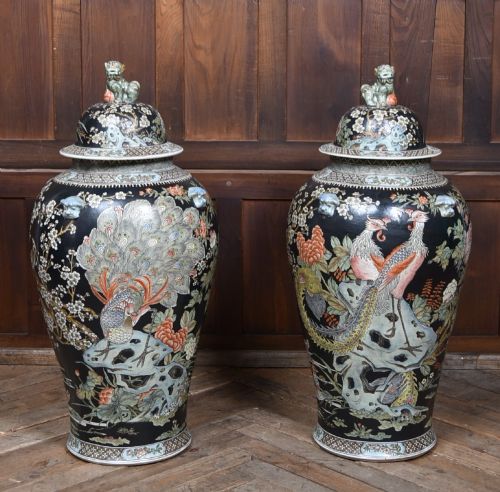
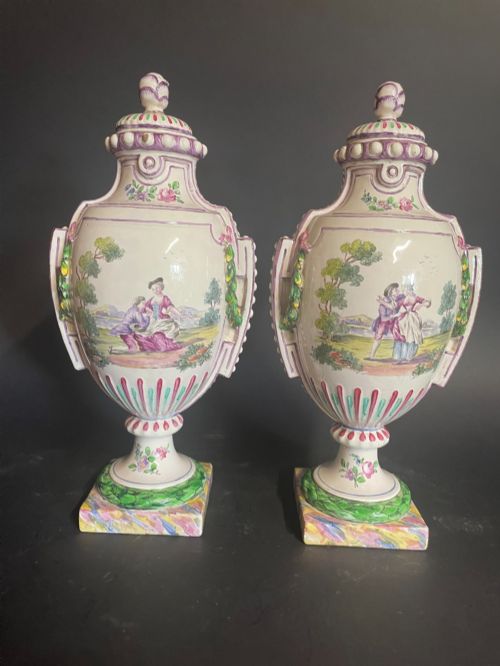
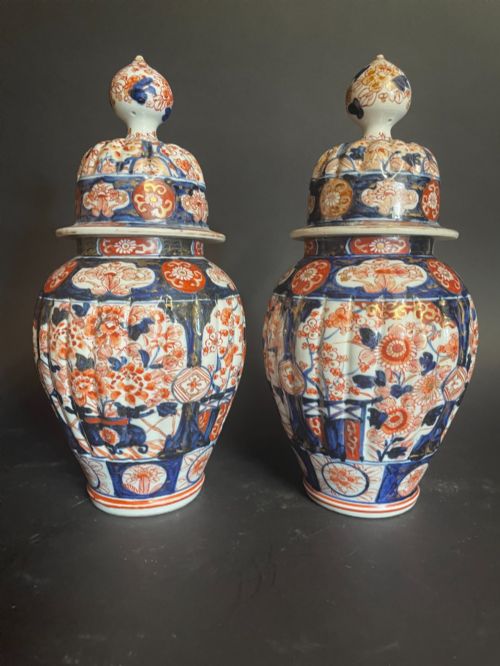
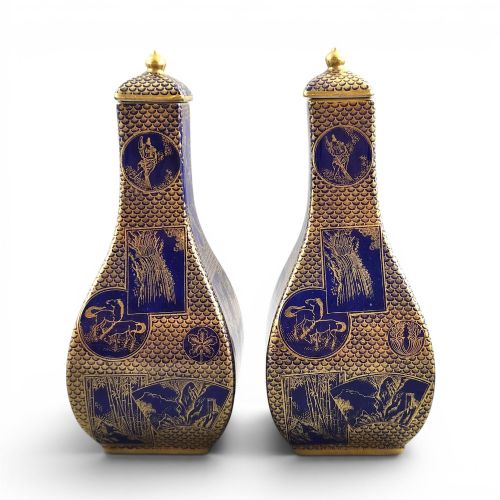
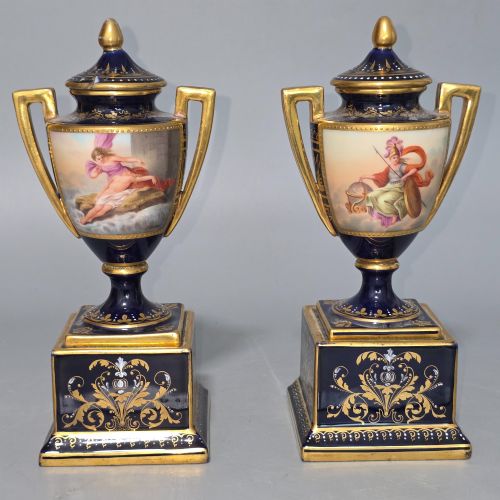


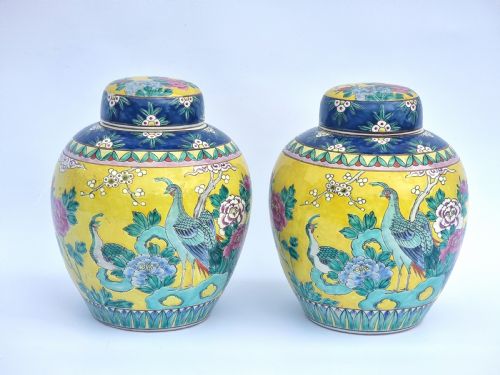


Pair Covered Porcelain Urns
These pair covered porcelain urns combine symmetry and decorative presence, bringing classic form and hand-painted detail to any room.

Pair Covered Porcelain Urns
A search for pair covered porcelain urns brings together lidded vessels spanning the seventeenth to the twentieth centuries, with nineteenth-century examples appearing most frequently. These objects take forms such as ginger jars, ovid jars, amphora vases, and palace floor jars.
Makers and factories across Britain, continental Europe, and Asia contributed to this group, utilising styles ranging from Chinoiserie and Japanese Imari to Rococo Revival and Neoclassical design.
Materials and Technique
Potters shaped the body from porcelain, ironstone, or faience, applying glazes and hand-painted decoration before firing.
Many items incorporate gilding, gold leaf, enamel, or cast ormolu mounts to accent handles, rims, and covers.
The listings encompass items in porcelain, ironstone, and faience, spanning seventeen distinct periods and styles from the seventeenth to the twentieth century.
Evaluating Quality
Quality rests in the precision of the hand painting and the crispness of the porcelain modelling, distinguishing factory production from master work.
The integration of metal mounts, such as gilt bronze or ormolu, and the preservation of original matching covers dictate the standing of the piece.
Sitzendorf·Mason's·Vienna Porcelain·Derby·Arita·Berlin·Augustas Rex·Dresden·Royal Worcester·Coalport·Flight Barr and Barr
The Pair Covered Porcelain Urns Glossary
- Ormolu
- Gilded bronze mounts applied to the base, handles, or covers of porcelain vessels. This French technique adds decorative weight and structural contrast to the ceramic body.
- Imari
- A Japanese porcelain style characterised by underglaze blue and iron red highlights, often with additional gilt details. European potteries frequently copied these distinctive patterns.
- Faience
- Tin-glazed earthenware produced in France and other European regions. It offers an opaque white surface suitable for painted decoration.
- Amphora
- A two-handled jar with a narrow neck, derived from ancient Greek forms. Nineteenth-century porcelain makers revived this classical shape for decorative display.
- Ginger jar
- A wide-shouldered container with a domed cover, originally used for spices. Later Chinese and European examples served purely ornamental purposes.
Pair Covered Porcelain Urns: Frequently Asked Questions
How were pair covered porcelain urns used?
These vessels served primarily as mantel ornaments, garniture sets on furniture, or large decorative floor jars in grand interiors.
Lidded forms also held potpourri or dry goods in domestic settings.
How do I distinguish nineteenth-century copies from earlier periods?
Examine the paste, glaze consistency, and underglaze markings for clues to the period.
Nineteenth-century European factories frequently adopted Asian or eighteenth-century styles, making stylistic context and baseline material analysis essential.
Where should I display large porcelain urns?
Place matched pairs on sturdy sideboards, mantelpieces, or dedicated pedestals where their symmetry creates visual balance.
Keep them away from direct foot traffic to protect protruding handles and removable covers.
Can these jars be cleaned safely?
Dust the surface gently with a soft, dry brush or a lint-free cloth to remove particles.
Avoid using water or chemical cleaners, particularly on pieces with delicate gilt highlights or enamel work.