
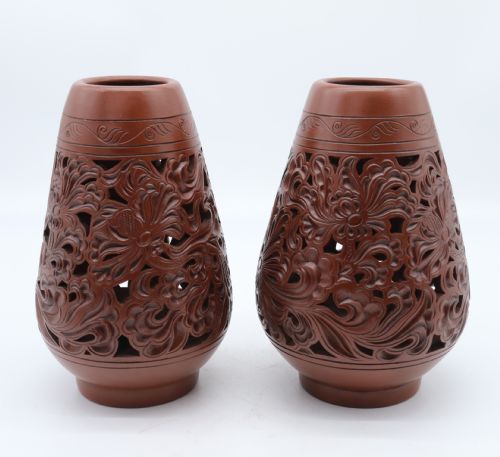


Pair Chinese Pottery Vases
These pair chinese pottery vases bring centuries of kiln mastery straight to your mantelpiece.
Pair Chinese Pottery Vases
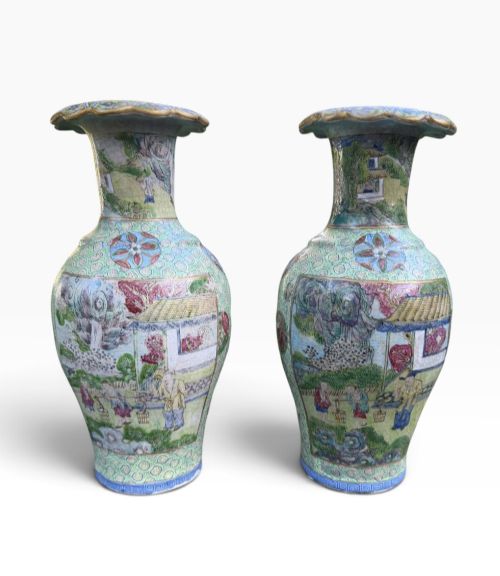
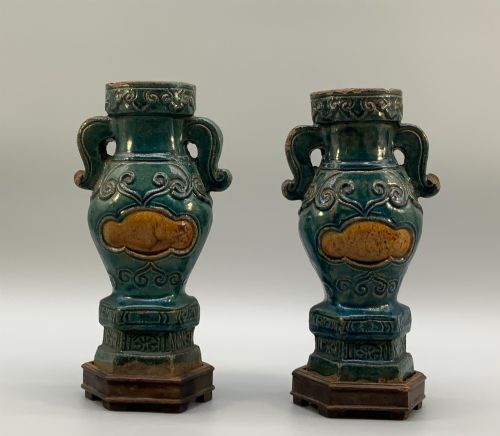
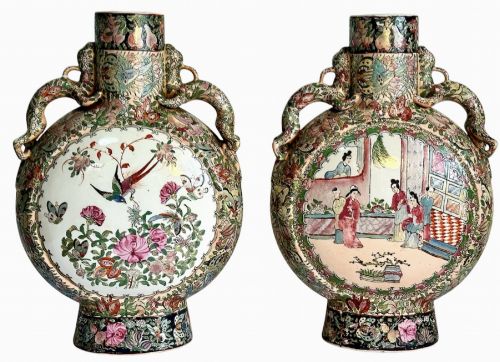
When you search for pair chinese pottery vases, you encounter symmetrical groups of vessels spanning eras from the Ming Dynasty through the Qing Dynasty and into the twentieth century. These objects include Yixing stoneware pieces, moon flasks, ovid jars, and baluster vases.
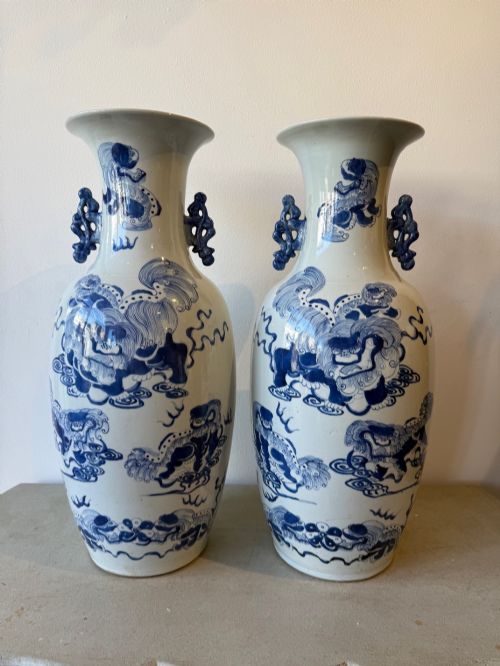
The nineteenth century provides the greatest number of examples on this page, often featuring enamel, celadon, blue and white, or famille rose palettes. Alongside standard decorative vessels, some pairings arrive converted into table lamps or mounted with brass and wood.
Forms range from globular vessels with tea dust glaze to reticulated stonewares and crackelware jars with covers. Each matching set demonstrates the historical demand for balanced ornamentation in interior decoration.
Methods and materials
Potters shaped these bodies from earthenware, porcelain, and Yixing stoneware, employing manual techniques to throw or mould each vessel. Artisans then applied liquid mineral slips, cobalt glaze, or red cinnabar lacquer before firing.
Decoration relied heavily on hand-painted enamel work, including famille rose and famille verte palettes, alongside specialised finishes like tea dust and turquoise or amber glazes. Certain Yixing stoneware examples incorporate intricate reticulated piercing through the clay body.
Current listings span from the 17th Century to the 1930s, featuring porcelain, earthenware, stoneware, and red cinnabar lacquer.
Assessing quality
Quality rests in the precision of the potter's throw and the depth of the glaze, whether dealing with subtle celadon surfaces or densely painted famille rose motifs. Hand-painted brushwork shows variation in control, where confident, crisp lines distinguish superior workshop output.
The uniformity of the pair matters significantly, as matching vessels require careful synchronisation during high-temperature kiln firings where warping commonly occurs. Additional elements such as original covers or specialised lacquered surfaces elevate the overall integrity of the set.
The Pair Chinese Pottery Vases Glossary
- Famille Rose
- A prominent palette of opaque pink and rose enamels introduced during the Qing Dynasty. It allows for delicate shading on floral and figural designs.
- Moon Flask
- A flattened circular vessel with a narrow neck and small loop handles, designed to stand upright on a base. This traditional shape offers a broad canvas for painted scenes.
- Celadon
- A transparent green glaze over a pale body, creating a subtle jade-like appearance through iron oxide interactions. It requires a reducing atmosphere in the kiln.
- Baluster
- A vase form with a rounded lower body that tapers towards the neck, resembling a traditional architectural baluster. This silhouette provides strong visual stability.
Pair Chinese Pottery Vases: Frequently Asked Questions
How are these pairs displayed in a room?
Symmetrical pairs traditionally anchor mantelpieces, sideboards, or console tables, creating a balanced focal point within a room's interior scheme. Placing them at equal distances from a central mirror or painting enhances their visual symmetry.
Some examples arrive fitted as table lamps, allowing them to provide functional illumination while retaining their historical ceramic forms on side tables or desks.
What periods do these vessels come from?
The selection encompasses pieces ranging from the early seventeenth century under the Ming Dynasty through various phases of the Qing Dynasty and into the early twentieth century. Nineteenth-century examples form the majority of the current items.
Specific groupings reference earlier imperial periods like the Kangxi reign, reflecting stylistic revivals and continuous traditional making methods employed by later potteries.
Can I use these vases with water?
Many antique ceramic and stoneware vessels function primarily as decorative objects rather than practical containers for cut flowers. Unglazed bodies like Yixing stoneware or pieces with historic drilled lamp fittings require careful consideration before holding liquids.
Inspecting the interior of each vessel helps determine whether its glaze remains intact and watertight or if it is better suited for dry display.
What is the difference between porcelain and stoneware?
Porcelain utilises refined kaolin clay fired at extremely high temperatures to produce a white, vitreous, and resonant body. It frequently accepts bright enamel and cobalt blue painting under clear glazes.
Stonerware uses coarser, denser clays fired at high heats to create robust, non-porous vessels, often seen in earthy Yixing creations and utilitarian jars.