


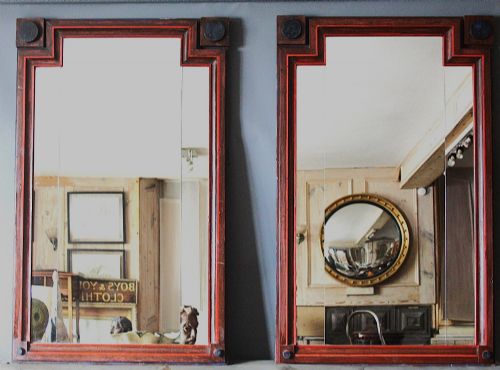


Painted Accent Mirror
These painted accent mirror pieces bring colour and historical texture to a room, offering immediate visual focal points for walls and halls.
Painted Accent Mirror
A painted accent mirror serves primarily as a decorative wall piece, often utilising carved wood or gesso frames enriched with coloured pigments. Buyers seeking a painted accent mirror will encounter various historical forms, ranging from Italian pier glasses to French provincial wall mirrors.
The selections available span multiple centuries, with nineteenth-century examples and twentieth-century interpretations appearing frequently. Forms include overmantel mirrors, oval wall mirrors, and marginal mirrors alongside pedestal stands.
Origin styles lean heavily towards continental European aesthetics, particularly Italian Rococo and French Chateau designs. These pieces function well to brighten darker spaces by reflecting ambient light while introducing distinct period character.
How they were made
Makers utilised timber substrates such as walnut and carved wood, applying gesso preparations to create smooth surfaces for subsequent decoration. Paint, gilt, and vernis martin finishes were then applied by hand to achieve rich surface textures and tonal depth.
Gold leaf and giltwood treatments often accompanied the paintwork, particularly on Italian and French frames from the eighteenth and nineteenth centuries. Glass plates were cut to fit shaped frames, including arched tops and marginal sections.
Listings feature periods spanning from the eighteenth century through the 1930s, utilising materials such as walnut, giltwood, gesso, and painted glass.
What varies in quality
The standard of carving and the finesse of the hand-painted details largely determine the distinction between simpler domestic items and high-end pieces. Original gilt and paint surfaces retain a patina that differs significantly from later repainting efforts.
The complexity of the frame design, such as shaped carved wood versus basic moulded timber, indicates the level of craftsmanship involved. Integrated decorative elements like inset hand-painted foliate panels elevate the overall execution of the work.
The Painted Accent Mirror Glossary
- Pier glass
- A tall mirror designed specifically to hang on the pier, the section of wall space between two windows. These pieces often feature painted or gilt wooden frames.
- Overmantel mirror
- A wide mirror designed to be positioned directly above a fireplace mantel. They frequently incorporate painted finishes and carved wooden details.
- Gesso
- A plaster-like mixture applied to wood frames to provide a smooth base for gilding and painting. It allows intricate relief work to be formed prior to decoration.
- Vernis martin
- A type of simulated Japanese lacquer developed in France during the eighteenth century. It employs successive layers of varnish and paint to produce a glossy, decorative surface.
- Marginal mirror
- A mirror design featuring a central glass plate surrounded by smaller, angled marginal plates within the main frame. These border sections are often bevelled or painted.
Painted Accent Mirror: Frequently Asked Questions
Where should I hang a painted accent mirror?
These mirrors suit hallways, living rooms, and bedrooms where they can reflect natural light and enhance the sense of space. Placing one above a mantelpiece or a console table creates a traditional focal point.
Consider the surrounding wall colour and room proportions when selecting a piece, as ornate frames require adequate clearance to stand out properly.
How do I identify a nineteenth-century mirror?
Nineteenth-century examples often display specific stylistic traits associated with Victorian, Regency, or French provincial movements. Examine the construction methods of the wooden frame and the characteristics of the paint or gilt finish.
Wear patterns on the glass plate and the backing materials also offer clues to the age of the piece. Comparing the stylistic markers with documented period pieces helps confirm the era.
Are these mirrors suitable for daily use?
Most antique wall mirrors function effectively for daily checks, though older glass plates may show minor foxing or distortion. They serve primarily as decorative accents while fulfilling their original practical purpose.
Care should be taken when cleaning the painted and gilt surfaces to preserve the original finish over time.
What styles are common in these mirrors?
Italian Rococo, French Chateau, Art Deco, and Neoclassical styles appear frequently among the available pieces. Each style brings distinct decorative motifs, from carved foliate patterns to clean geometric lines.
Matching the style of the mirror to existing room decor helps integrate the piece harmoniously into an interior scheme.