


Ornate Pendulum Clock
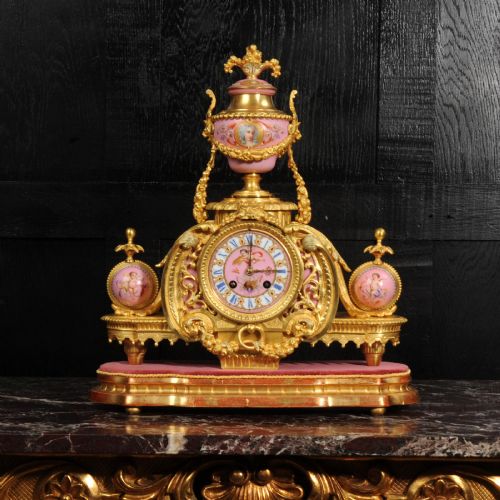
An ornate pendulum clock brings heavy French gilt bronze, marble and glass into a room, driven by a visible swinging bob that marks the hours.
Ornate Pendulum Clock
An ornate pendulum clock sits primarily as a mantel or wall piece, drawing on Victorian and nineteenth century French designs. The selection here leans heavily towards French production from the middle to the late decades of the nineteenth century, spanning various revival styles.
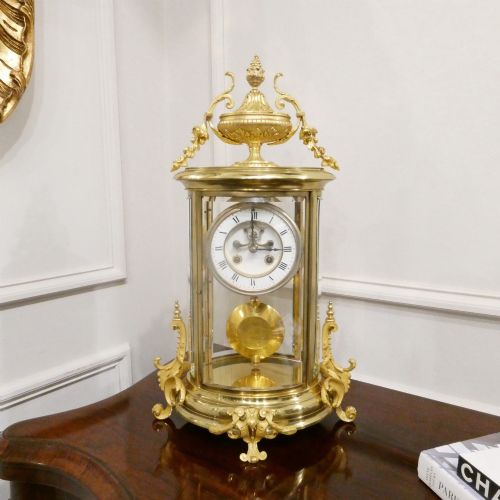
Buyers encounter mantel clocks housed in ormolu, brass and porcelain, alongside four glass crystal regulators and wall hanging cartel clocks. Architectural forms such as portico clocks and bracket clocks appear frequently among the pieces.
Maker signatures frequently connect these objects to established French workshops and horologists from the 1800s through to the end of the century. Alongside these, occasional Dutch and English wall clocks provide alternative regional formats.
What varies in quality
The crispness of the cast brass and ormolu decoration dictates visual hierarchy, distinguishing deeply chiselled gilt bronze from softer, shallower stampings. Better examples retain heavier fire gilding that maintains a warm lustre across intricate scrollwork.
Movement sophistication and signed dial work separate standard production from master pieces, particularly those bearing maker names like Samuel Marti or Achille Brocot. The integration of high fired porcelain panels and flawless glass side panels completes the upper tier.
Ornate Pendulum Clock Retail Price Guide 2026
Typical asking prices for ornate pendulum clock among the pieces listed under this phrase on Sellingantiques today, from the lower quarter to the upper quarter. They describe what is for sale here now, not the wider market.
Some models feature glass panels on all four sides, letting you watch the tiny brass wheels turn while the pendulum swings in plain sight.
Achille Brocot·Samuel Marti·Japy Freres·Henri Jacot·Perivale of England
The Ornate Pendulum Clock Glossary
- Ormolu
- Gilded bronze produced by applying a mixture of mercury and gold to a metal base and heating it. This technique creates a durable, rich golden surface typical of nineteenth century French decorative arts.
- Boulle
- Marquetry technique utilising tortoiseshell and brass inlay developed in France. It decorates the wooden carcases of bracket and mantel clocks.
- Crystal Regulator
- A clock enclosed in bevelled glass panels held within a brass or gilt metal frame. This design allows light to pass through the housing and exposes the internal movement.
- Cartel Clock
- A wall-mounted clock featuring an ornate frame made of gilt bronze, brass or carved wood. These pieces project outward from the wall surface.
- Portico Clock
- A architectural mantel clock designed with columns supporting a lintel structure above the dial. The pendulum swings freely within the central opening between the pillars.
Ornate Pendulum Clock: Frequently Asked Questions
How do I wind an antique pendulum clock?
Most mechanical models rely on a key inserted into holes on the dial face to tension the internal springs. Turning the key clockwise winds the going train and the striking train.
Care must be taken not to overwind the springs. Stopping as soon as resistance increases protects the antique mechanism from damage.
Where should I place a heavy marble mantel clock?
These pieces require a sturdy, level surface such as a heavy sideboard or a secure mantelpiece. Weight distribution matters given the combination of marble, bronze and glass.
Placing the clock away from direct heat sources and damp walls prevents timber warping and preserves internal steel components.
How do I set the correct time on a striking clock?
The minute hand is gently moved clockwise to the correct hour, allowing the strike train to finish its sequence at each interval. Moving hands backwards can jam the striking gears.
Allowing the pendulum to settle into a steady beat after adjustment ensures the clock keeps accurate time.
What distinguishes Louis XV style from Louis XVI style?
Louis XV style embraces asymmetrical rococo curves, flowing scrollwork and naturalistic floral motifs. Gilt bronze mounts curve organically around the clock body.
Louis XVI style shifts toward neoclassical symmetry, featuring straight architectural lines, urns, columns and formal geometric borders.