






Ormolu Marble Cassolettes
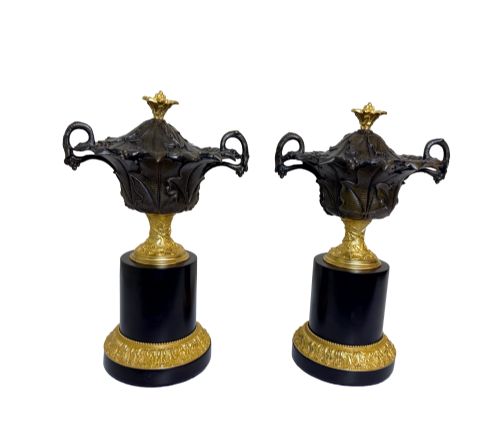
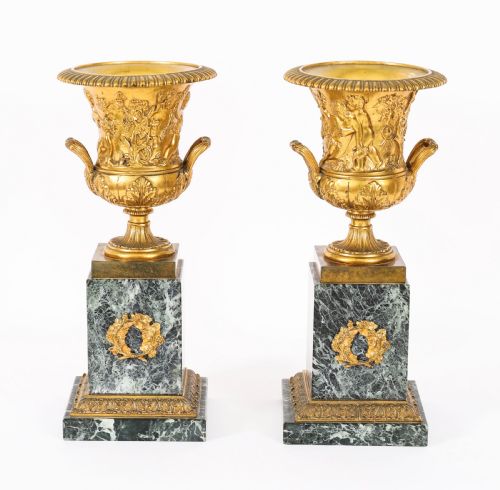
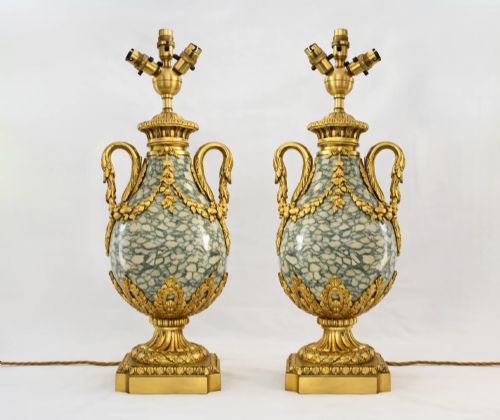
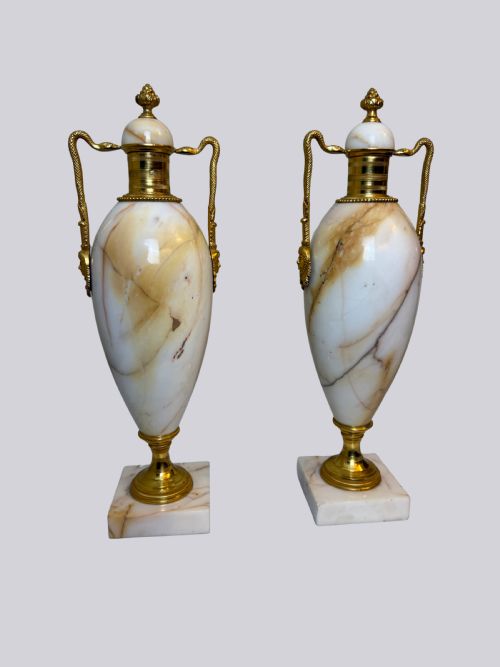
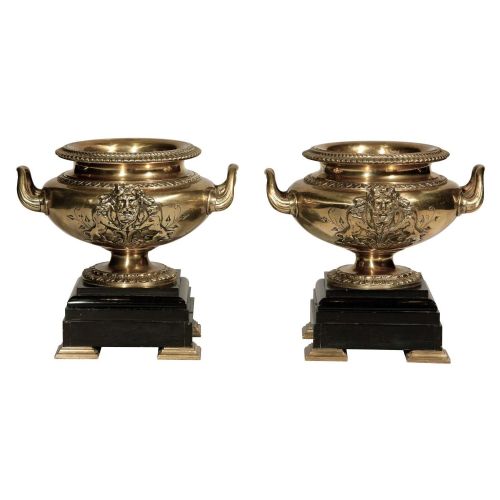
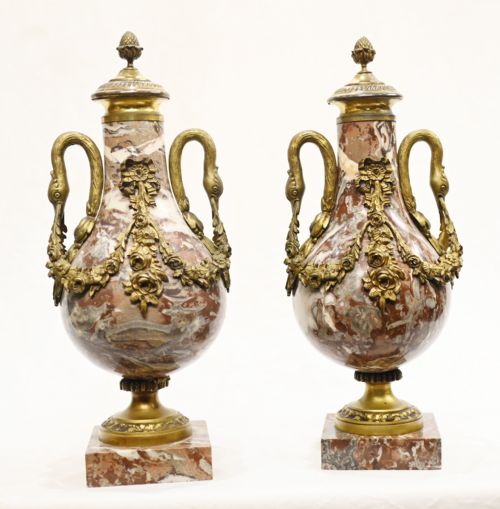
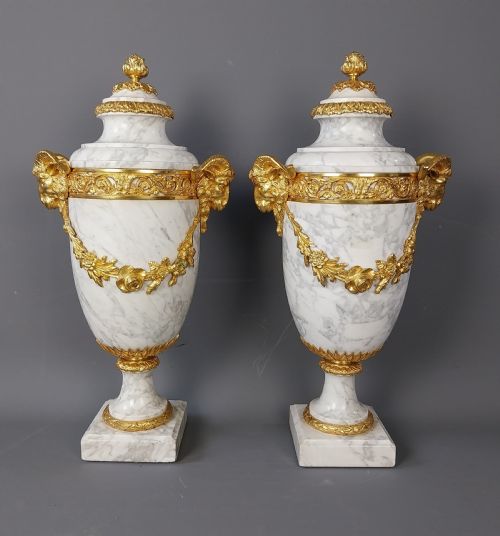
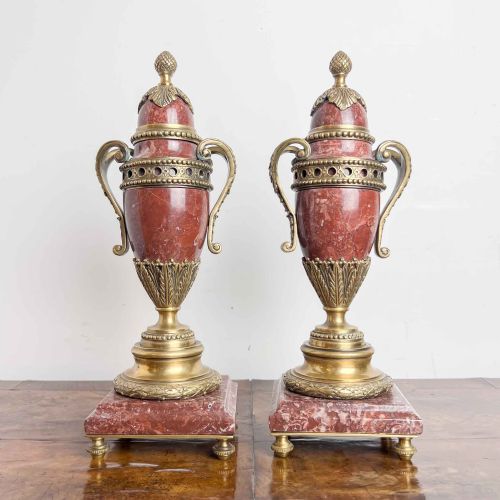
Ormolu marble cassolettes combine stone bodies with gilt metal mounts, offering a reversible function that serves as both a decorative urn and a candlestick.
Ormolu Marble Cassolettes
When you search for ormolu marble cassolettes, you encounter decorative lidded vessels designed primarily during the nineteenth century. These ornamental objects draw heavily on French Neoclassical, Louis XVI, and Empire design traditions, often produced during revival periods and the Grand Tour.
The form most frequently seen on this page is a paired set of decorative vases featuring a reversible lid. One side displays a solid stone finial, while turning the lid exposes a candle socket, transforming the vessel into a candlestick.
Originating predominantly from French workshops, these pieces combine classical architectural proportions with decorative metal mounts. Collectors value them for their dual utility and their striking presence on mantelpieces and side tables.
Materials and Construction
The bodies of these objects utilise turned and polished stone, including white marble, green marble, rouge marble, quartz, and white onyx. This stone is shaped into classical urn, amphora, and coupe profiles, often mounted on square or plinth bases.
Gilt bronze, commonly known as ormolu, provides the decorative mounts, handles, collars, and bases. This metal is cast and chased to achieve sharp detail before receiving a fine application of gold gilding.
Listings feature white, green, and rouge marble alongside gilt bronze, patinated bronze, and white onyx.
Assessing Quality and Execution
The distinction between standard examples and superior pieces rests heavily on the crispness of the bronze chasing and the depth of the mercury gilding. Finer mounts display sharp acanthus leaves, bead reels, and cast details without soft edges or smoothing from wear.
The choice and turning of the marble body also separate grades of manufacture. Dense, richly coloured stones with precise lathe work and well-fitted bronze mounts represent the upper end of nineteenth-century production.
The Ormolu Marble Cassolettes Glossary
- Cassolette
- A decorative vessel with a reversible lid that functions as either a closed urn or a candlestick. This dual purpose defined much nineteenth-century mantel ornamentation.
- Ormolu
- Gilt bronze created by applying a gold and mercury amalgam to cast bronze before heating. The process yields a warm, durable golden surface.
- Grand Tour
- A cultural journey undertaken by wealthy Europeans through France and Italy during the eighteenth and nineteenth centuries. Travellers collected classical art and decorative objects such as marble urns as souvenirs.
- Neoclassical
- A revival style drawing inspiration from the classical art and architecture of ancient Greece and Rome. It prioritises symmetry, proportion, and restrained ornamentation.
- Regency
- An English design period spanning the early nineteenth century noted for classical revivalism. Pieces from this era frequently incorporate bronze and marble mounts.
Ormolu Marble Cassolettes: Frequently Asked Questions
How do you use a cassolette?
The lid lifts off and reverses to change the function of the object. One side shows a decorative finial for display as an urn, while the reverse reveals a socket to hold a taper.
This clever mechanism allows a single mantelpiece ornament to serve two distinct purposes depending on the room setting.
What is ormolu?
Ormolu refers to gilt bronze metalwork produced by fusing finely ground gold to a bronze base using mercury. The technique creates a rich, lasting metallic lustre.
Makers utilised this process to highlight handles, rims, and bases on marble vessels.
Where were these pieces made?
Most surviving examples originate from French workshops active during the nineteenth century. Paris served as the primary hub for producing gilt bronze mounts and turning decorative marble.
Many pieces were also acquired by travellers journeying through Europe on the Grand Tour.
How do you clean marble and ormolu?
Dust marble gently with a dry microfibre cloth and avoid harsh chemical cleaners that can etch the polished stone surface. Ormolu mounts require equal care to preserve the thin layer of gold gilding.
Water and abrasive materials should be kept away from both the stone and the metal to prevent permanent damage.