

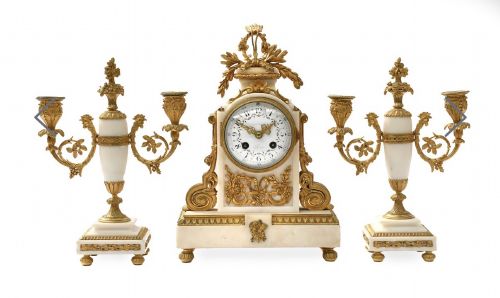
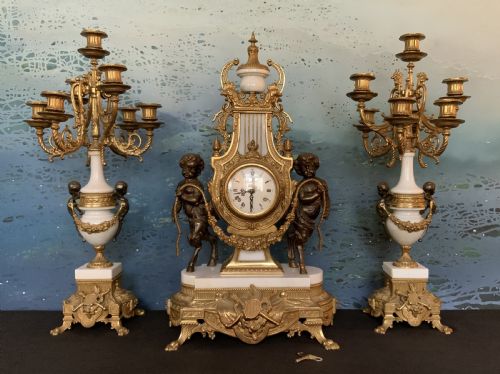


Ormolu Mantel Clock Set
An ormolu mantel clock set brings together a central timepiece and matching side pieces, anchored in the ornamental traditions of nineteenth-century France.
Ormolu Mantel Clock Set
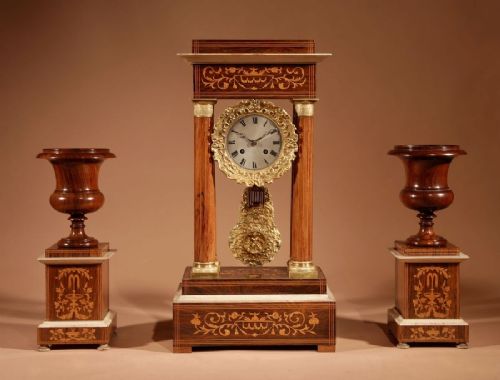
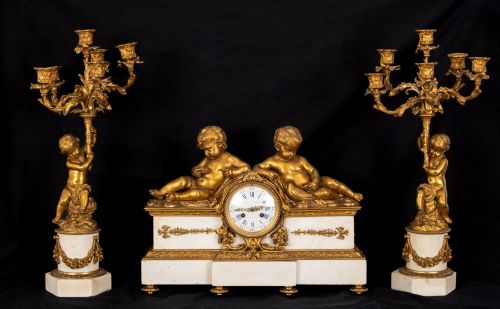
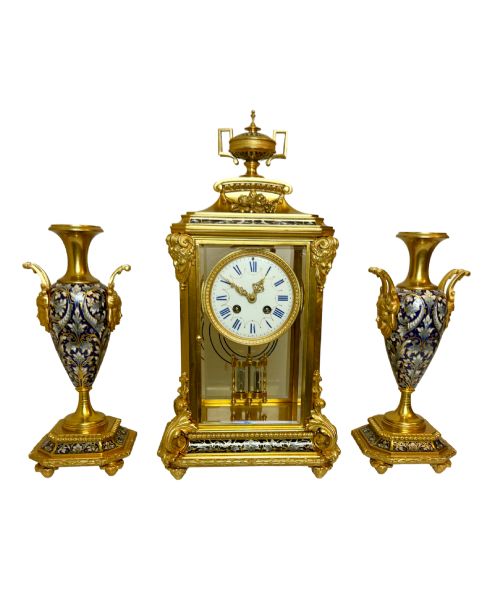
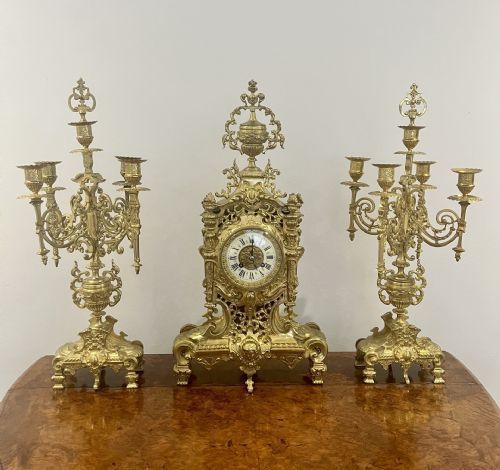
When you search for an ormolu mantel clock set, you encounter multi-piece decorative ensembles designed to anchor a formal interior scheme. These compositions typically pair a central striking clock with matching side garnitures such as candelabra or urns.
The examples recorded here belong predominantly to the nineteenth century, spanning Victorian decades and the various revivals of Louis XVI and Rococo aesthetics. French ateliers produced the vast majority of these elaborate sets, frequently combining architectural stone bases with sculptural metalwork.
Buyers meet varied configurations ranging from compact porcelain lyre clocks to massive multi-light candelabra sets housed beneath glass domes. Marble, onyx and gilt bronze dominate the physical footprint of these domestic centerpieces.
Materials and Method
Maker workshops built these objects using mercury gilding or electroplating on bronze and brass substrates, creating the characteristic warm metallic finish known as ormolu. This metalwork was cast in sections, chased by hand to sharpen the detail of foliage and figures, and assembled with threaded pins.
Natural stones including white marble, black marble and onyx form the substantial plinths and column bodies that support the heavy metal mounts. Enamel dials, porcelain panels painted in the Sevres manner, and hand-blown glass domes complete the composite structures.
Ormolu Mantel Clock Set Retail Price Guide 2026
Typical asking prices for ormolu mantel clock set among the pieces listed under this phrase on Sellingantiques today, from the lower quarter to the upper quarter. They describe what is for sale here now, not the wider market.
Listings feature materials spanning gilt bronze, ormolu, white marble, brass, onyx, enamel and Sevres style porcelain across the nineteenth century.
Quality and Execution
The distinction between ordinary and exceptional sets lies in the crispness of the bronze chasing and the harmony of the matched garniture components. Superior examples display deeply sculpted figures and foliage with hand-finished detail that remains sharp across every piece in the set.
Movement quality and maker attribution elevate certain assemblies above standard production pieces, particularly when signed by known Paris clockmakers or housed in bespoke architectural marble cases. The integration of porcelain panels and the weight of the cast metal determine the overall standard.
Henry Dasson·A.D Mougin·H Luppens Paris·VINcenti of PARIS
The Ormolu Mantel Clock Set Glossary
- Ormolu
- Gilded bronze produced by applying a gold amalgam to a bronze base and heating it to drive off the mercury. This technique creates a durable, warm metallic lustre characteristic of fine decorative objects.
- Garniture
- A set of matching decorative ornaments, typically comprising a central clock flanked by two matching vases, urns or candelabra. These pieces were designed to be displayed together on a mantelpiece.
- Champleve
- An enamelling technique where troughs or cells are hollowed out of the metal surface and filled with vitreous enamel before firing. It frequently decorates the bezels and dials of nineteenth-century clock sets.
- Candelabra
- Branched candlestick holders designed to match the central clock in a garniture set. They provide balanced symmetry when arranged on either side of the timepiece.
Ormolu Mantel Clock Set: Frequently Asked Questions
What is included in a clock set?
A complete set consists of a central mantel clock accompanied by two matching side pieces, which commonly take the form of candelabra, urns or vases. These accompanying pieces share the materials and decorative motifs of the main timepiece.
Together they create a balanced decorative arrangement designed specifically for display on a fireplace mantel or large sideboard.
Where were these clock sets made?
The vast majority of these decorative ensembles originated in France during the nineteenth century, particularly within the workshops and foundries of Paris. French makers dominated the production of gilt bronze and marble garnitures during the Victorian era.
Regional variations occasionally appear, but Parisian craftsmanship defined the dominant styles of the period.
How do I identify Louis XVI style?
Louis XVI style pieces are defined by a return to classical symmetry, featuring straight architectural lines, urn motifs, laurel wreaths and refined geometric mounts. This aesthetic contrasts sharply with the asymmetrical curves of earlier Rococo designs.
In clock sets, this translates to white marble columns, crisp gilt bronze friezes and formal rectangular or portico silhouettes.
How do these clocks function?
Most nineteenth-century examples utilise an eight-day mechanical movement driven by a spring or pendulum, requiring a key winding at regular intervals. These movements typically strike on the hour and half-hour using a bell or gong.
Professional setup and occasional servicing ensure the striking trains and escapements maintain accurate timekeeping in a modern home.