


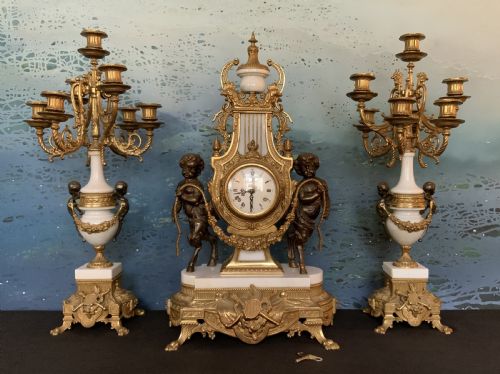


French Ormolu Clock Set
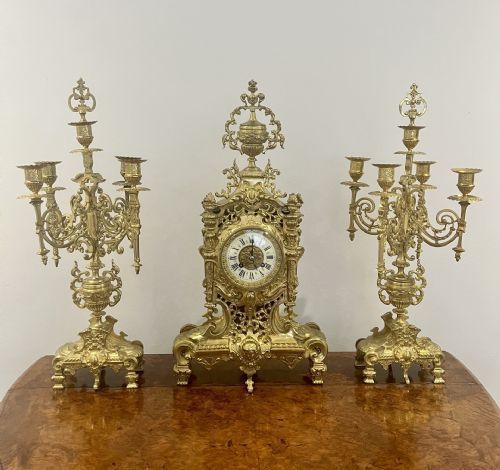
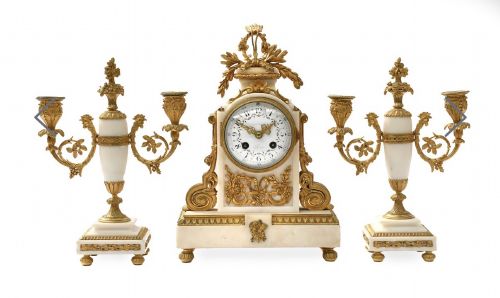
A french ormolu clock set brings commanding presence to a mantelpiece, pairing gilt bronze centrepieces with matched candelabras for a unified decorative scheme.
How they were made
Foundry work relies on cast bronze finished with mercury gilding or modern electroplating to achieve the distinctive ormolu surface. This metalwork combines with carved natural stones including white marble, red marble, sienna marble, onyx, and green marble.
Many examples incorporate porcelain elements, notably Sevres panels and Imari porcelain, alongside enamel dials and patinated bronze details. Glass components feature prominently in crystal regulator sets, allowing visibility of the mechanical movements housed within.
What varies in quality
The refinement of the bronze chasing dictates the visual sharpness of foliate scrolls, figural drapery, and cast ornamentation. Crisp hand-chiselling after casting separates superior ensembles from softer, mass-produced commercial variants.
The choice and integration of secondary materials drive the tier of the piece. Solid coloured marbles, hand-painted porcelain plaques signed by the factory or artist, and fully matched garniture components elevate the overall execution.
Retail Price Guide 2026
Typical UK retail prices for french ormolu clock set, calculated from the Sellingantiques database of over a million retail prices indexed since 2003. This retail price guide relies exclusively on Sellingantiques data; no external sources or auction records are used, so the figures do not describe the wider market.
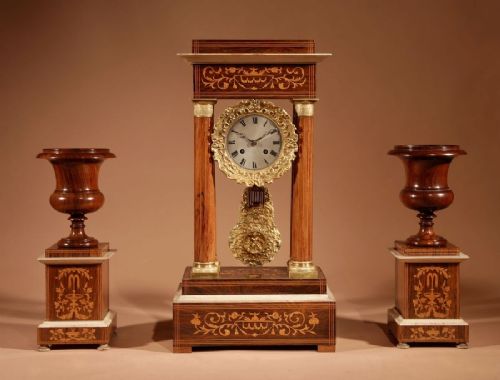
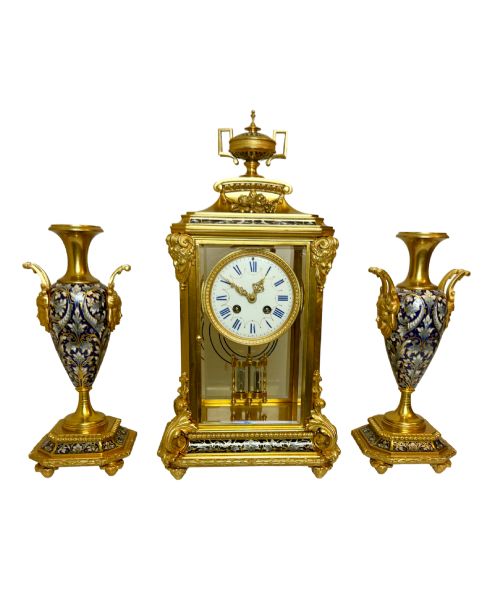
The archive reveals frequent appearances of architectural portico clocks and four-glass crystal regulators mounted in onyx and ormolu.
Louis Japy·Japy Freres·Maison Bagues·Louis Boname·Charles Hour·A D Mougin
The French Ormolu Clock Set Glossary
- Ormolu
- Gilt bronze produced by applying a gold amalgam to a bronze base and heating it to vaporise the mercury. This technique creates a durable, warm golden finish characteristic of fine decorative metalwork.
- Garniture
- A set of matched decorative objects designed to be displayed together on a mantelpiece or sideboard. Typically consists of a central clock flanked by two matching candelabras, urns, or vases.
- Portico Clock
- A clock housed within an architectural frame supported by columns, reminiscent of classical portico structures. Often constructed from contrasting marbles and mounted with gilt bronze details.
- Crystal Regulator
- A mantel clock enclosed by glass panels on four sides, exposing the mechanical movement and swinging pendulum. These pieces frequently feature onyx or marble bases combined with ormolu mounts.
- Sevres
- Porcelain produced by the royal French manufactory, recognisable by painted pastoral scenes or exotic birds within jewelled borders. These plaques are frequently set into the clock bases and garniture bodies.
Frequently Asked Questions
What is included in a clock garniture?
A standard garniture includes a main mantel clock accompanied by two matching side pieces, which are usually candelabras or decorative urns.
These matched sets were designed to create a balanced, symmetrical arrangement on a fireplace mantel or large console table.
How do I identify a Louis XVI style set?
Louis XVI style sets display neoclassical restraint, featuring straight architectural lines, symmetrical proportions, and classical motifs such as urns, ribbons, and fluted columns.
This contrasts with the earlier Rococo style, which favours asymmetrical scrolls, naturalistic foliage, and exuberant, flowing curves.
What materials are used in these clock sets?
The primary structural metal is bronze, finished with a bright gilt ormolu surface or patinated to a darker tone. This metal is frequently paired with decorative stones like white marble, red marble, and onyx.
Many examples also incorporate ceramic elements, including painted porcelain panels from Sevres and Imari porcelain bodies.
How should I care for ormolu metalwork?
Ormolu surfaces require gentle dusting with a soft, dry brush to prevent the accumulation of dirt in the recesses of the cast ornamentation. Aoid using metal polishes, abrasive cloths, or chemical cleaners, as these can strip the fragile gold layer from the bronze beneath.