
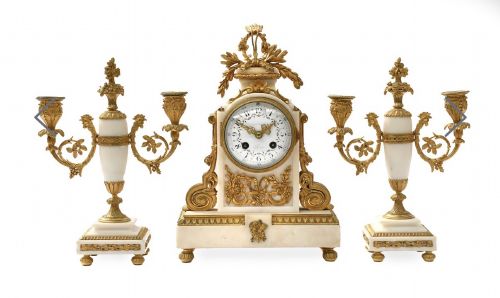


Louis XVI Garniture
A louis xvi garniture brings symmetry and classical French decoration to a mantel, pairing a central clock with matching urns or candelabras.
Louis XVI Garniture
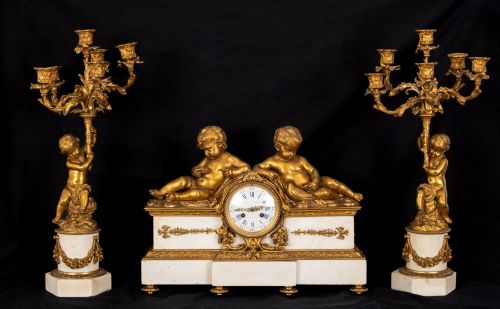
A louis xvi garniture comprises a matched set designed to sit together on a mantelpiece or console, usually consisting of a central clock flanked by two matching vases, cassolettes, or candelabras. These sets emerge primarily in the nineteenth century, reflecting a sustained Victorian taste for French revival design and classical proportions.
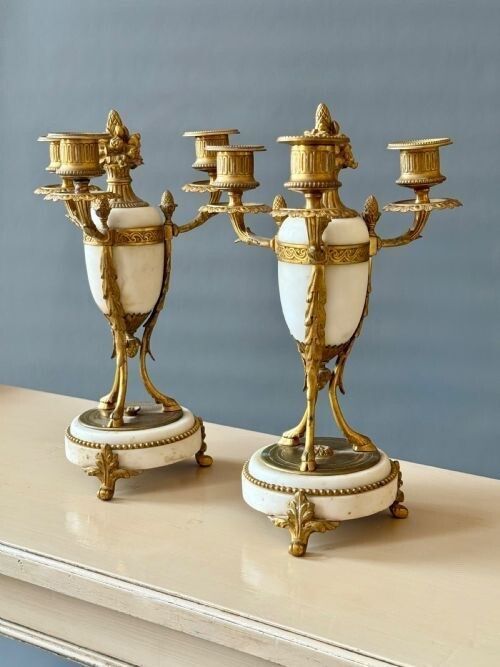
The most common configurations on this page combine marble and gilt bronze or ormolu, often incorporating cherubs, urns, or porcelain elements. Buyers encounter everything from compact boudoir clock sets to large three-piece arrangements bearing candelabras or multi-light branches.
Materials and Construction
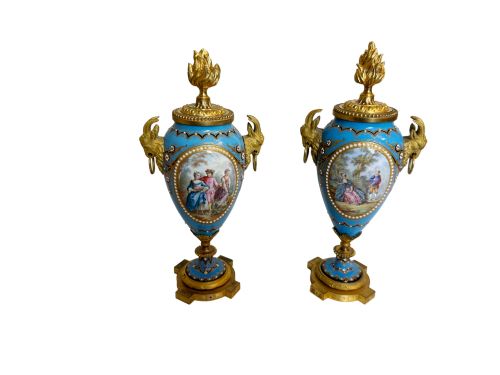
Maker workshops built these sets using cast ormolu and gilt bronze mounted onto white, red, or black marble bases, occasionally integrating onyx, brass, and glass. Foundational elements frequently include hand-painted Sevres style porcelain panels or dials, alongside enamelled chapter rings.
Metal components undergo detailed chasing and gilding to achieve crisp architectural ornamentation, while stone elements are turned and polished to form urn bodies, columns, and clock housings.
Listings feature works utilising white marble, red marble, gilt bronze, ormolu, and Sevres porcelain across the nineteenth century.
Assessing Quality
Quality rests in the crispness of the bronze chasing and the weight and selection of the marble or porcelain. Superior examples display depth in the gilding and finely articulated figural work, such as cherubs or classical mounts, rather than soft or repetitive casting.
The integration of the set matters equally, where matching marble colours, uniform patination, and harmonious proportions across the clock and its flanking pieces indicate a cohesive original manufacture.
Henry Dasson·H Luppens Paris·AD Mougin Paris·Ferdinand Berthoud·Vincenti
The Louis XVI Garniture Glossary
- Cassolette
- A decorative vessel with a reversible lid that functions either as a closed vase or an incense burner. These often form the flanking pieces in a garniture set.
- Ormolu
- Gilding technique applying finely ground high-carat gold to a bronze base. This finish provides the characteristic golden lustre seen across French clock mounts.
- Garniture
- A set of ornamental objects designed to be displayed together as a matched group. In this context, they balance a central mantel clock with twin vases or candelabras.
- Bleu de Roi
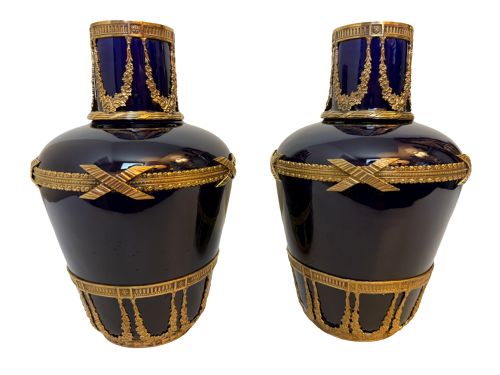
- A deep rich cobalt blue ceramic glaze developed at the Sevres porcelain factory. It appears frequently on clock dials and ceramic vase bodies within these sets.
Louis XVI Garniture: Frequently Asked Questions
What pieces make up a complete garniture?
A standard garniture consists of three matching pieces designed for display in a symmetrical arrangement. The central element is typically a mantel clock, flanked by a pair of matching decorative urns, cassolettes, or candelabras.
These sets were manufactured to create a unified decorative scheme on large fireplaces or console tables, maintaining consistent materials and stylistic motifs across all items.
How do I identify Louis XVI style?
Louis XVI style relies on classical antiquity, straight architectural lines, and symmetrical arrangements rather than the asymmetrical curves of the preceding Rococo period. Look for urns, fluted columns, laurel wreaths, ribbons, and classical drapery.
Most pieces found on this market date from the nineteenth century revival periods, adopting these eighteenth-century neoclassical design principles.
Were these sets made in France?
The vast majority of these garnitures originate from French workshops and Parisian clockmakers active during the nineteenth century. They cater to both domestic and international demand for ornate French interior decoration.
Maker signatures on movements or bronze mounts frequently point to workshops operating in Paris during the Victorian era.
How should I care for marble and ormolu?
Gilt bronze and ormolu require gentle dusting with a soft dry cloth to prevent the accumulation of grit that can damage the delicate gold surface. Avoid chemical polishes, which strip the historic gilding.
Marble surfaces tolerate a damp cloth followed by immediate drying, keeping moisture away from any exposed metal movements or clock dials.