
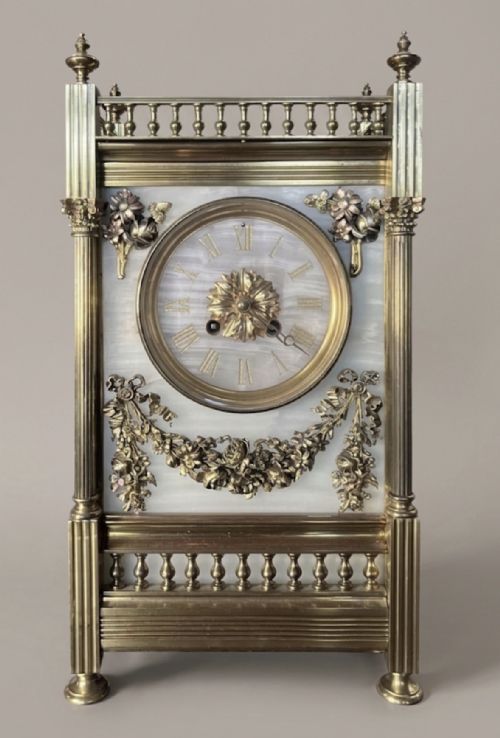


French Alabaster Clock
A french alabaster clock brings pale stone and gleaming gilt bronze together, offering an elegant centrepiece for a mantelpiece.
French Alabaster Clock
When searching for a french alabaster clock, buyers encounter nineteenth-century decorative timepieces originating from France, spanning periods from the Victorian era into the early twentieth century. These objects frequently appear as mantel clocks or larger clock garniture sets accompanied by matching candelabras or urns.
The material combination typically unites soft white alabaster or marble bodies with gilt bronze, ormolu, and brass mounts, often featuring enamel dials. Forms range from simple portico designs and drum clocks to ornate figural compositions referencing classical subjects.
Art Deco examples from the nineteen-twenties sit alongside earlier Neoclassical, Louis XVI revival, and Rococo styles, showing how makers adapted classical architecture and sculpture into domestic timekeepers.
How they were made
Craftsmen shaped soft alabaster and marble into columns, porticos, and plinths, sometimes combining the pale stone with contrasting white marble. Metalwork components involved casting and gilding bronze or brass to create decorative ormolu mounts, bezels, and figural ornaments.
Mechanical movements were housed within the stone and metal structures, featuring eight-day mechanisms and enamel dials marked with numerals. Glass domes frequently protected delicate figural scenes and intricate clockwork from dust.
Pieces range from compact single-fusee portico clocks and drum timekeepers to large three-piece garniture sets complete with matching candelabras.
What varies in quality
The refinement of the carved stone and the precision of the gilt bronze mounts set finer examples apart from simpler pieces. Crisp architectural details, heavier metal castings, and well-executed figural sculptures indicate higher workshop standards.
The integration of the French movement within the stone housing and the presence of matching garniture pieces or original glass domes influence the overall coherence and desirability of the object.
James Ritchie And Son·Farcot·Japy Freres·Mourey
The French Alabaster Clock Glossary
- Alabaster
- A fine-grained, translucent stone used for carving clock bodies and architectural columns. Its pale surface absorbs light and provides a soft contrast to gilt metal mounts.
- Ormolu
- Finely ground high-carat gold applied to a bronze base using a mercury amalgamation technique. This treatment creates a rich, durable metallic lustre on decorative mounts.
- Garniture
- A set of matching decorative objects, typically comprising a central clock flanked by two candelabras or urns. These sets were designed to display symmetrically on a mantelpiece.
- Portico clock
- A clock design featuring a lintel supported by four columns, resembling a classical temple facade. The pendulum often swings visibly within the open central space.
- Fusee
- A conical pulley used in clock movements to maintain even driving force as the mainspring unwinds. This mechanism improves timekeeping accuracy across the duration of the wind.
French Alabaster Clock: Frequently Asked Questions
How do I wind my French alabaster clock?
Use the appropriate key on the winding squares located on the enamel dial, turning gently until resistance is felt. Care must be taken not to overwind the mainspring.
Ensure the clock is standing level on the mantelpiece to keep the pendulum beating evenly and the movement running reliably.
Why does my clock have a glass dome?
Glass domes protected delicate alabaster surfaces, exposed pendulums, and fine ormolu mounts from dust and atmospheric grime in nineteenth-century interiors. They were often manufactured to fit specific figural or portico clock designs.
Keeping the dome in place helps preserve the soft finish of the stone and the gilding on the metal components over time.
What is a clock garniture?
A clock garniture consists of a central timepiece accompanied by a matching pair of side ornaments, such as candelabras, vases, or urns. These matching sets were created to decorate a mantelpiece as a unified decorative scheme.
Materials usually match across the set, combining alabaster or marble with gilt bronze mounts.
How do I date an alabaster clock?
Dating relies on stylistic clues such as Neoclassical, Louis XVI revival, or Art Deco design elements, alongside the construction of the brass movement. Nineteenth-century pieces frequently display maker stamps or serial numbers on the backplate.
Comparing the dial typography, hand shapes, and mounting techniques against known production periods helps narrow down the decade of manufacture.