


Garniture De Cheminee
These garniture de cheminee sets bring matching harmony to a mantelpiece, pairing a central clock with flanking vases or candelabras.
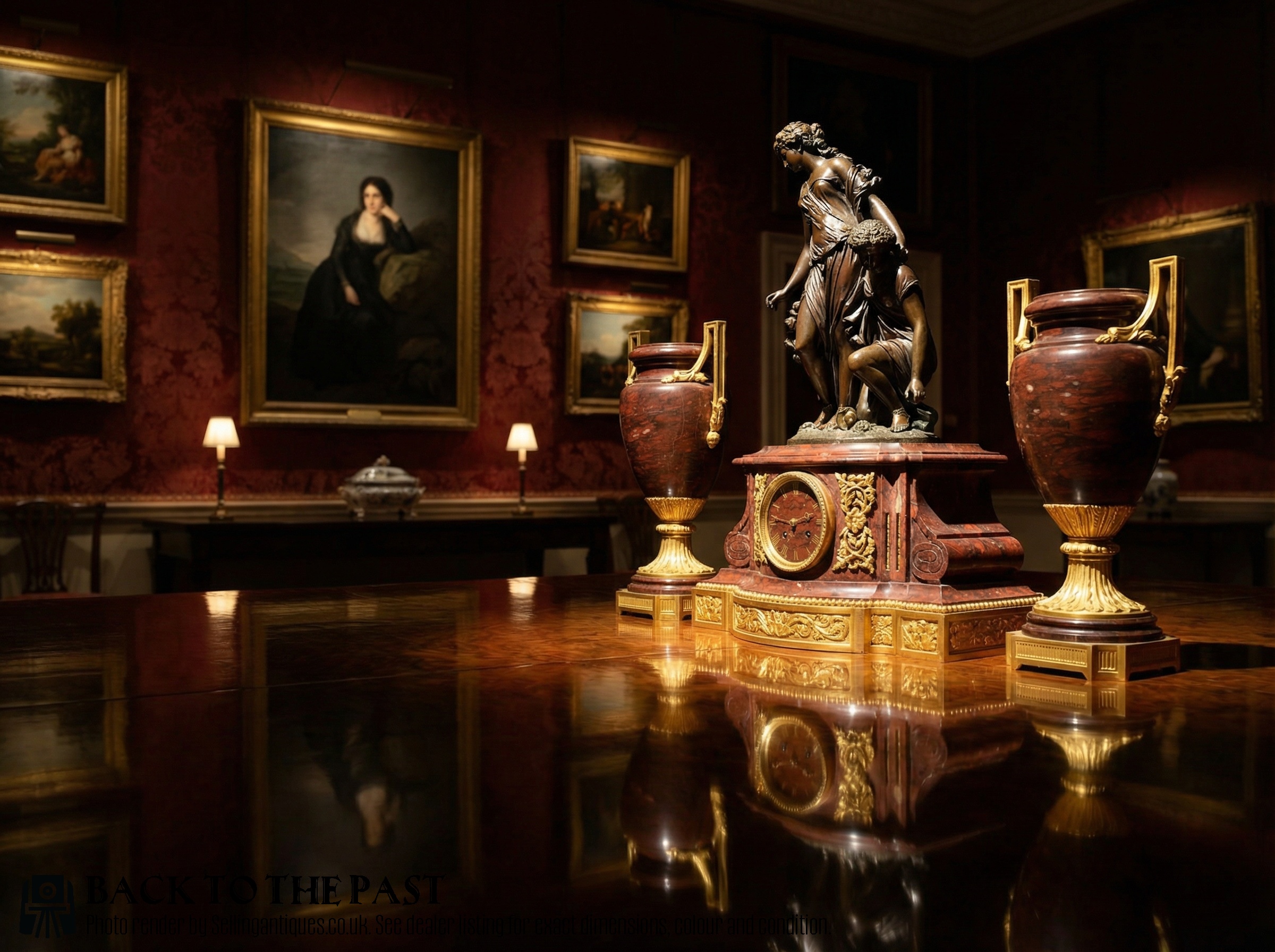
Garniture De Cheminee
A garniture de cheminee is a matched display set designed specifically for the mantelpiece, combining a central clock with coordinating sidepieces such as candelabras, urns or vases. The pieces you meet most often on this page date from the nineteenth century, reflecting French tastes in styles like Louis XVI and Rococo Revival. These sets create a balanced, symmetrical arrangement that defined period interior decoration.
Most sets comprise three pieces, though five-piece configurations occasionally appear, bringing together functional timekeeping and sculptural ornament. The materials span from classic white marble and polished bronze to gilt bronze and enamel, often shaped into architectural or figurative forms. Each component shares distinct decorative motifs, uniting the clock and its flanking ornaments into a single visual composition.
Materials and methods
The construction of these sets relies heavily on cast metals like ormolu, gilt bronze and brass, which form the structural mounts and decorative framing. Artisans combined these metallic elements with carved white marble or glass, anchoring heavier stone bodies with intricate metal feet and bezels. Enamel dials and painted porcelain panels frequently provide contrasting colour and fine detail against the polished metalwork.
Foundries employed lost-wax and sand-casting techniques to shape the bronze and brass components before applying mercury gilding or surface patination. Stonemasons turned and polished the marble bases to precise geometric or architectural profiles, ready to receive the metal mounts. Assembly involved mechanical fitting with threaded pins and screws, uniting diverse media into sturdy domestic ornaments.
Garniture De Cheminee Retail Price Guide 2026
Typical asking prices for garniture de cheminee among the pieces listed under this phrase on Sellingantiques today, from the lower quarter to the upper quarter. They describe what is for sale here now, not the wider market.
Cherubs frequently loiter among the ormolu branches, apparently unconcerned with the passage of time.
Distinguishing quality
Superior sets reveal themselves in the crispness of the bronze chasing and the depth of the ormolu gilding, where human hands have refined the raw casting. Finer pieces use heavy, unblemished marble and hand-painted enamel details rather than mass-produced transfers or flawed stone. The harmony of the design ensures that the clock and its flanking pieces share identical detailing and weight of manufacture.
The reputation of the maker, whether an established Paris foundry or a known clockmaker, adds a distinct layer of distinction to the object. Precision in the mechanical movement and the robustness of the structural assembly separate ordinary decorative sets from those of high artistic ambition. Every element, from the mount fixings to the proportion of the sidepieces, demonstrates deliberate artisanal choices.
H Luppens Paris·Raingo Fres Paris·Ferdinand Berthoud·Samson of Paris
The Garniture De Cheminee Glossary
- Garniture de cheminee
- A matching set of decorative objects for the fireplace mantel, typically comprising a clock and two flanking ornaments. This French term translates literally to fireplace furniture.
- Ormolu
- Finely ground high-carat gold mercury-gilded to a bronze base, creating a rich golden finish that resists tarnishing. It defines the luxurious highlights of nineteenth-century French metalwork.
- Candelabra
- A branched candlestick designed to hold multiple taper candles simultaneously. In these sets, they are scaled to match the height and style of the central clock.
- Louis XVI Style
- A neoclassical design vocabulary characterised by straight lines, symmetry, classical motifs like urns and swags, and restrained proportions. It proved exceptionally popular among nineteenth-century French makers.
- Rococo Revival
- An exuberant nineteenth-century style drawing on eighteenth-century motifs, featuring asymmetrical scrolls, naturalistic foliage and shellwork. It brings a dynamic, curving movement to mantelpiece displays.
Garniture De Cheminee: Frequently Asked Questions
What pieces belong in a garniture de cheminee?
A standard set includes a central mantel clock accompanied by two matching sidepieces, which usually take the form of candelabras, urns or vases. Some larger arrangements expand to five matching elements to fill wider fireplace surrounds.
Every component shares identical decorative motifs, materials and stylistic signatures to maintain complete visual harmony across the mantel.
How do I care for marble and ormolu?
Dust the marble and metal surfaces gently with a soft, dry cloth to prevent the accumulation of grit in crevices and carved details. Avoid commercial liquid cleaners, abrasive pads or water, as moisture can damage delicate gilding and stain porous stone.
For the metal mounts, a light application of microcrystalline wax can help protect the surface if handled frequently, though undisturbed display requires little intervention.
Are these clock movements still operational?
Many nineteenth-century movements retain their original mechanical workings, though operational status varies from piece to piece. Some mechanisms require professional servicing or adjustment by a horologist to keep accurate time.
Even when un-serviced, the clock houses traditional spring-driven or weight-driven architecture typical of the period's clockmaking traditions.
Where were these sets manufactured?
The vast majority of these decorative sets originated in France, particularly in the workshops and foundries of Paris. Master clockmakers and bronze-casters collaborated to produce these unified ensembles for domestic interiors.
Occasional pieces reflect English or other European interpretations, but French craftsmanship dominates the surviving material.