
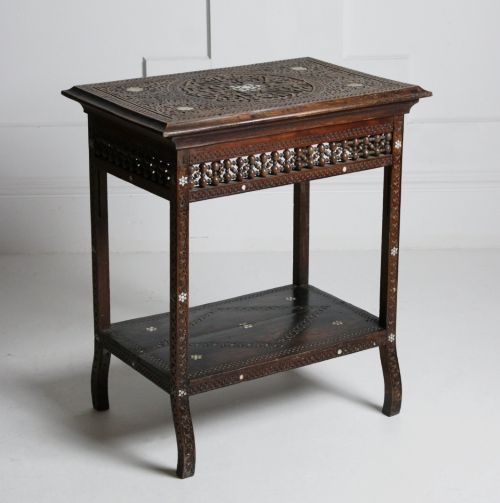

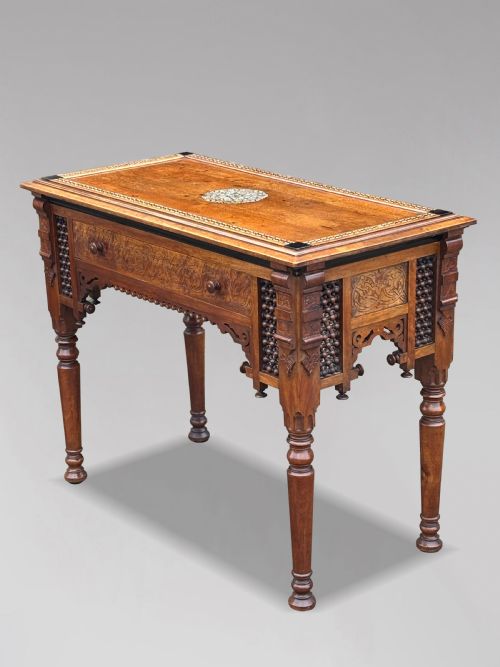
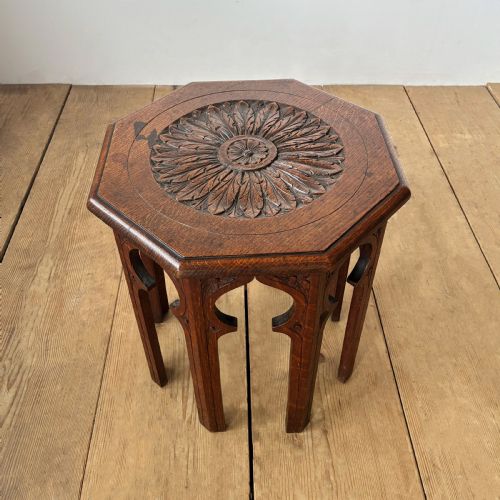


Orientalist Wooden Side Table
An orientalist wooden side table brings intricate geometric patterns and exotic craftsmanship into a room, offering a striking surface for daily use.
Orientalist Wooden Side Table
When you search for an orientalist wooden side table, you encounter decorative furnishings rooted in nineteenth and early twentieth-century design movements. These pieces encompass Moorish Revival, Aesthetic Movement, and Anglo-Indian styles, reflecting a Victorian fascination with Middle Eastern and North African aesthetics.
The most common formats on this page are octagonal occasional tables, folding coffee tables, and two-tier Syrian tables. Forms range from North African centre tables to camel tables and games tables, predominantly originating from the nineteenth century.
Makers and retailers such as Liberty & Co. and Carlo Bugatti interpreted these exotic regional traditions for British interiors. The resulting furniture merges domestic utility with complex architectural detailing.
Materials and construction
Makers constructed these tables from hardwoods, walnut, oak, and ebonised wood, providing a dark and stable structural base. Black lacquered finishes also appear on early twentieth-century examples.
Surface ornamentation relies heavily on hand-carved woodwork combined with intricate inlays of mother-of-pearl and bone. Brass detailing and geometric mosaic work further enhance the decorative surfaces of Syrian and Moorish pieces.
Camel tables earned their colloquial name from folding wooden frames traditionally designed to be easily packed across desert routes.
Judging quality and execution
The distinction between standard production and exceptional work rests on the precision and density of the inlay. Finer examples display tightly fitted mother-of-pearl and bone elements that form continuous geometric patterns without gaps.
Depth and crispness of the hand carving separate simpler tables from ambitious artisan output. Structural integrity in folding mechanisms and the stability of multi-tiered frames also indicate superior craftsmanship.
Liberty & Co.·Carlo Bugatti
The Orientalist Wooden Side Table Glossary
- Moorish Revival
- A nineteenth-century architectural and decorative style inspired by North African and Spanish Islamic design. It utilises horseshoe arches, intricate fretwork, and complex geometric motifs.
- Aesthetic Movement
- A late nineteenth-century British movement that promoted art for art's sake in interior design. It embraced Japanese and Middle Eastern decorative influences.
- Inlay
- A technique where pieces of contrasting material such as bone or mother-of-pearl are inserted into recesses in a wooden base. This creates a flush, ornamental surface.
- Octagonal
- Having eight sides and eight angles. This geometric plan is characteristic of many Moorish and North African occasional tables.
- Ebonised
- Wood treated with a chemical stain or finish to imitate the appearance of ebony. It was widely used in Victorian and Aesthetic Movement furniture to create a stark contrast with inlaid materials.
Orientalist Wooden Side Table: Frequently Asked Questions
How do I clean an inlaid table?
Dust gently with a dry, soft cloth to prevent moisture from damaging the delicate bone or mother-of-pearl inlays.
Avoid commercial liquid polishes, which can seep into microscopic gaps and loosen the adhesive holding the decorative pieces.
Are these tables sturdy enough for daily use?
Most occasional and side tables function well for holding books or lamps under normal household conditions. Folding coffee tables require careful handling to protect their hinged joints and complex lower frames.
Heavier items should be kept off delicate folding structures to prevent undue strain on the carved wooden members.
How do I date a Moorish style table?
Examine the timber species, the condition of the inlay materials, and the construction methods visible underneath. Nineteenth-century pieces often show hand-cut joinery and aged patina on the walnut or hardwood.
Compare the decorative motifs with documented examples from retailers like Liberty & Co. or designer outputs from around nineteen hundred.
Where should I place this table in a room?
These pieces work effectively as standalone accents beside a sofa or chair where their detailed surfaces can be appreciated. Their compact footprint also suits hallways or corners as display stands for lamps and decorative objects.