

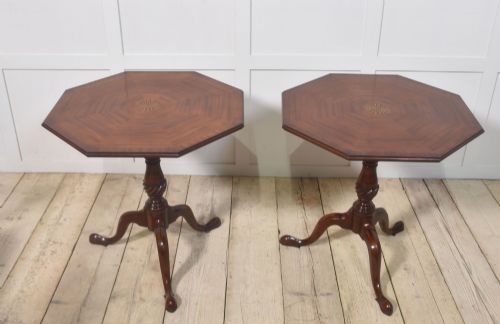


Pair of Octagonal Tables
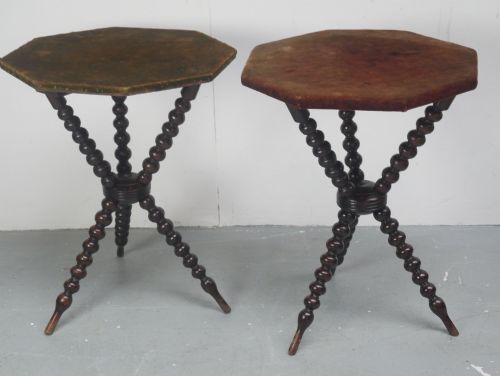
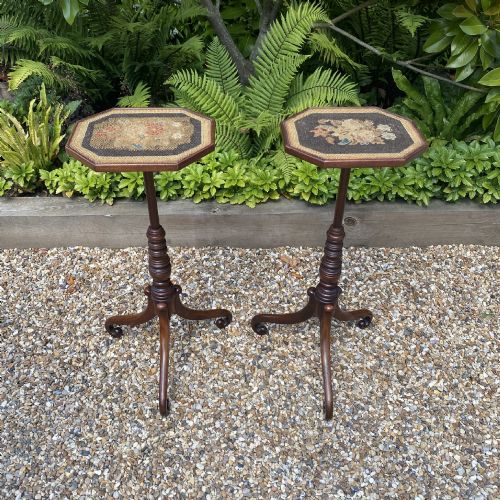
These pair of octagonal tables bring balanced geometry and rich timbers into a room, offering matched surfaces designed for display.
Pair of Octagonal Tables
A pair of octagonal tables provides two multi-sided surfaces shaped with eight distinct edges, originating primarily across Georgian, Victorian, and later periods. The selection on this page ranges from compact occasional stands to wine tables and folding pieces, reflecting diverse regional workshops.
Makers working in Britain drew upon classic cabinet-making traditions, while craftsmen in locations such as Hoshiarpur and Damascus produced intricate inlaid folding versions using exotic hardwoods.
Buyers encounter matched pairs intended to stand symmetrically in a room, utilising shapes that soften corners while adding distinct geometric planes to an interior scheme.
Materials and Construction
Makers constructed these tables from dense timbers such as mahogany, walnut, satinwood, and various regional hardwoods, frequently applying fine stringing, banding, or elaborate surface inlay.
Working methods combined traditional joinery for pillar and tripod supports with folding mechanisms and relief carving, particularly seen in Anglo-Indian and Moorish examples employing bone or contrasting woods.
Surface finishing relied on hand-applied polishes that highlighted the natural grain and colour of the timber without obscuring the intricate geometric patterns formed by the eight-sided tops.
Several tables arrive with rising tops and clever folding bases designed to vanish flat against a wall when the tea service ended.
Judging Quality and Execution
Quality rests upon the precision of the eight-sided geometry and the crispness of any inlaid work, where tighter joints and well-aligned patterns separate finer workshop output from simpler production.
The choice of timber defines the upper tier, with burr walnut, figured mahogany, and carefully selected satinwood displaying superior depth and grain movement compared to plain secondary woods.
Structural integrity in folding mechanisms and tripod bases ensures that matching pieces maintain proper balance and alignment when placed together in a room.
Liberty & Co.
The Pair of Octagonal Tables Glossary
- Octagonal
- Having eight sides and eight angles. This geometric form shapes the distinctive top of each table in the pair.
- Inlay
- A technique where pieces of contrasting material are inserted into a recessed surface to form a design. It frequently incorporates bone or lighter woods on darker timbers.
- Tripod
- A three-legged support structure. Many occasional and wine tables utilise this design beneath their central pillar.
- Wine Table
- A small stand traditionally used for holding glassware or bottles. These pieces feature raised tops or delicate column supports.
- Shisham
- A durable Indian rosewood often used in regional carving and folding tables. It provides a dense base for intricate surface decoration.
Pair of Octagonal Tables: Frequently Asked Questions
Where do people place a pair of octagonal tables?
These tables find placement flanking a fireplace, beside a sofa, or serving as matched bedside surfaces where symmetrical display space is required.
Their eight-sided tops break up the straight lines of traditional furniture layouts while remaining compact enough for smaller rooms.
How do folding octagonal tables work?
Many examples feature collapsible wooden bases that interlock to support the removable top without the need for metal hinges.
This construction allowed for easy storage and transport in period homes while providing a rigid platform when assembled.
What is the difference between occasional and wine tables?
Occasional tables offer general-purpose surfaces for lamps or decorative items, whereas wine tables traditionally feature smaller tops designed for drinks.
Both forms appear frequently in octagonal configurations across various 19th-century and 20th-century periods.
How do you care for inlaid timber surfaces?
Maintenance involves dusting with a soft cloth and avoiding direct sunlight or excessive moisture that might affect the delicate woods and inlay.
Applying occasional wax preserves the finish and protects the intricate geometric patterns set into the tabletop.