

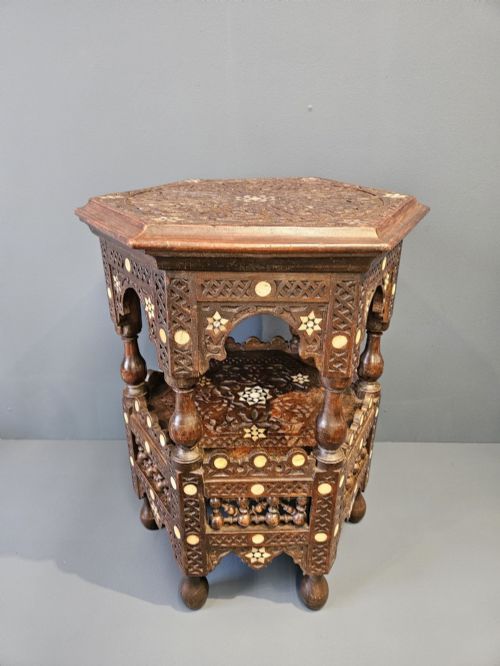


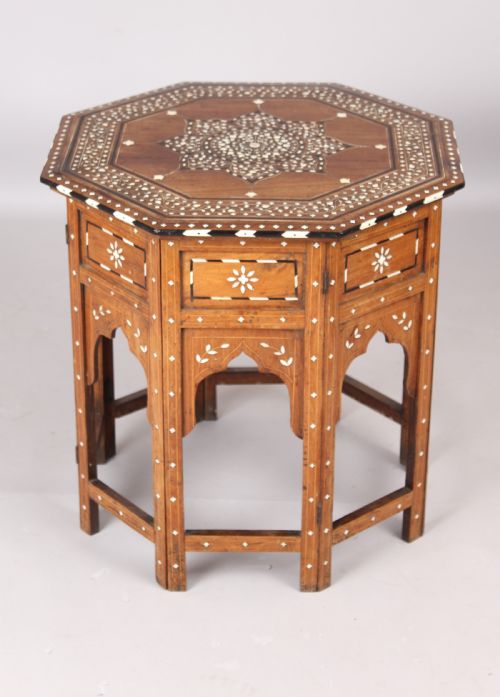


Syrian Style Inlaid Table
A syrian style inlaid table brings intricate geometric patterns and warm hardwoods into a room, offering both surface utility and rich ornamentation.
Syrian Style Inlaid Table
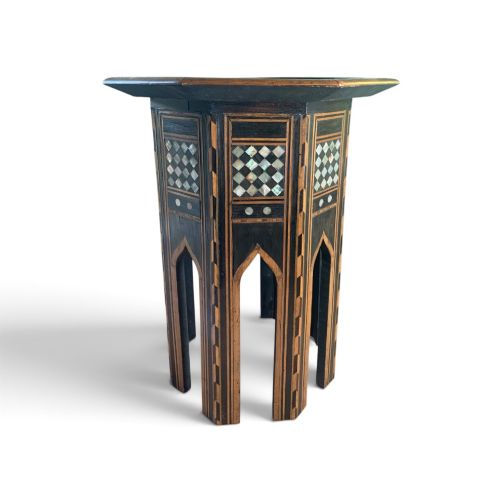
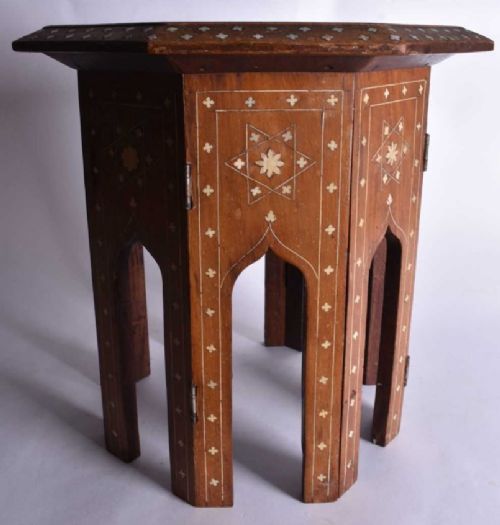
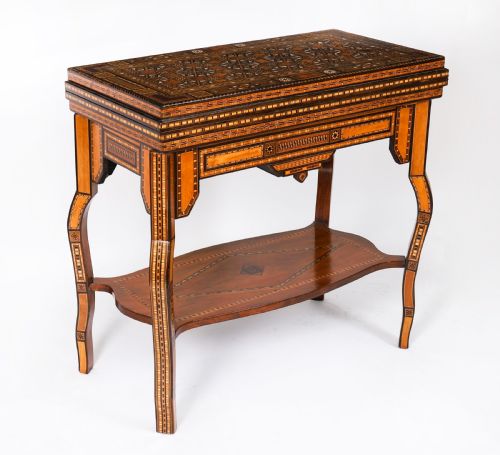
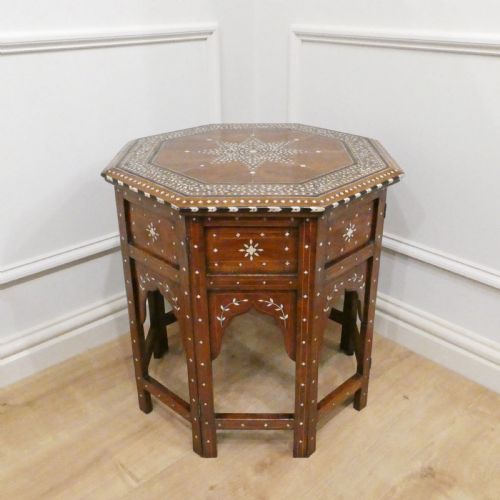
When searching for a syrian style inlaid table, you encounter pieces primarily from the nineteenth and early twentieth centuries, spanning periods such as the Victorian era and the nineteen-twenties. These works frequently manifest as octagonal side tables, occasional tables, or multi-functional games tables designed for cards, chess, and backgammon.
The prevalent forms on this page include folding Damascus tables and hexagonal lamp tables alongside larger centre and dining formats. Stylistic descriptions often blend Moorish revival, Islamic revival, and Anglo-Indian influences, reflecting the eclectic taste of late nineteenth-century interiors.
Many of these tables serve as compact occasional surfaces, while others feature integrated cupboards or elaborate octagonal tops. The origins draw upon traditions associated with Syrian Ottoman craftsmanship and Hoshiarpur production, bringing distinct regional motifs into British and European homes.
Materials and construction
Makers construct these tables using dense hardwoods such as walnut, rosewood, and ebonised wood to provide a stable structural foundation. Surfaces are then intricately worked with organic elements, utilising bone, bone inlay, and shimmering mother-of-pearl to build complex geometric tessellations.
The decorative schemes rely on meticulous hand-cutting of small tesserae, which are embedded tightly into the wooden substrate to form star patterns and strapwork borders. Carved wooden frames often support the inlaid panels, combining relief carving with flush geometric mosaic work.
Periods represented span the Victorian era through the early twentieth century, including the nineteen-twenties.
Assessing quality and execution
The standard of a syrian style inlaid table is defined by the density and precision of the mosaic work. Finer examples display tightly fitted bone and mother-of-pearl pieces with minimal filler, whereas simpler items show wider gaps and broader, less intricate patterns.
Structural integrity also separates standard productions from finer pieces, particularly in folding mechanisms and joint stability. The depth of the wood carving and the variety of contrasting materials used in the surface design indicate the ambition of the original workshop.
Liberty and Co·Alberto Pinto
The Syrian Style Inlaid Table Glossary
- Octagonal top
- A geometric table surface with eight sides. This shape is especially common among Moorish revival and Damascus occasional tables.
- Mother-of-pearl
- The iridescent inner layer of mollusc shells. Craftsmen cut this material into thin geometric slivers to catch the light within inlaid panels.
- Bone inlay
- Sourced animal bone carved into slender pieces and set into wooden channels. It provides a creamy, matte contrast to darker hardwoods.
- Moorish revival
- An architectural and decorative style popular in the nineteenth century. It borrows heavily from Islamic design traditions found across North Africa and the Middle East.
- Games table
- A specialised furniture form featuring integrated boards for activities like chess and backgammon. Many incorporate folding or rotating tops to conceal the playing surface.
Syrian Style Inlaid Table: Frequently Asked Questions
What is a syrian style inlaid table?
These pieces are decorative nineteenth and early twentieth-century wooden tables adorned with geometric mosaics made from bone and mother-of-pearl. They reflect revivalist movements that celebrated Middle Eastern and North African design traditions.
Most examples function as side tables, lamp stands, or occasional furniture. Their distinctive surface patterns make them focal points in eclectic interiors.
How do I care for inlaid surfaces?
Maintain the wood and inlay by keeping the table away from direct heat sources and sudden humidity changes. Use a soft, dry cloth for dusting rather than liquid polishes that can seep between the mosaic pieces.
Applying a very light coat of appropriate wax periodically helps nourish the hardwood frame. Take care around the edges where mother-of-pearl or bone tiles meet the wood.
Were these tables made in Britain?
Some pieces were produced by British firms like Liberty and Co during the Moorish revival of the late nineteenth century, often employing imported craftsmanship or styles. Others originated directly from workshops in regions such as Hoshiarpur or Ottoman territories.
Design characteristics and wood types often hint at whether a piece was manufactured for the European export market or created within specific regional traditions.
How are games tables used?
Games tables serve dual purposes, functioning as standard occasional tables when closed and transforming for recreation when opened. They often house surfaces for chess, checkers, cards, or backgammon.
In period homes, they stood in drawing rooms to entertain guests after dinner. Today, they remain practical for small spaces where dual-function furniture is useful.