

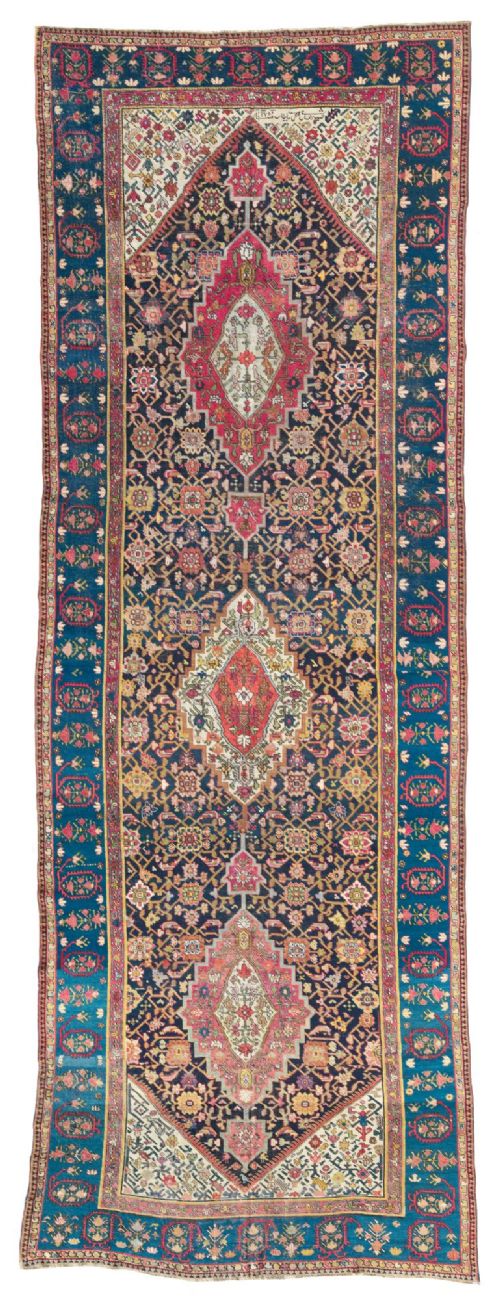

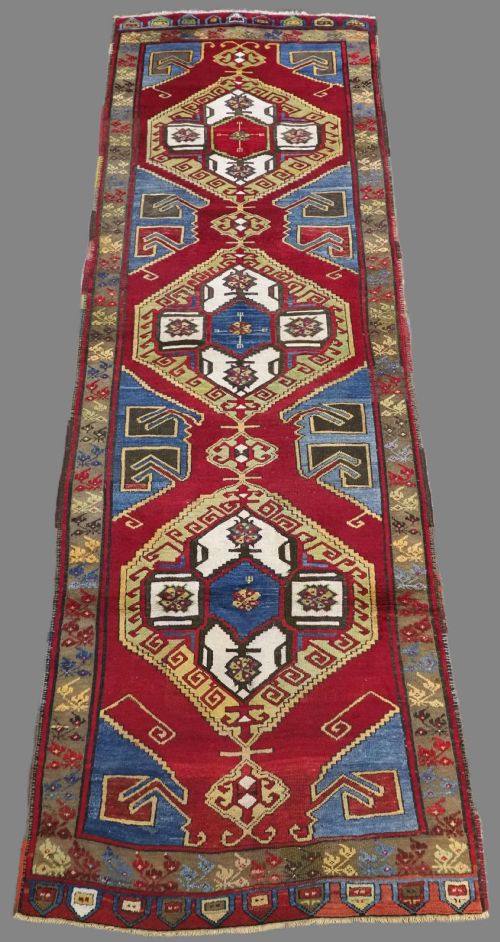

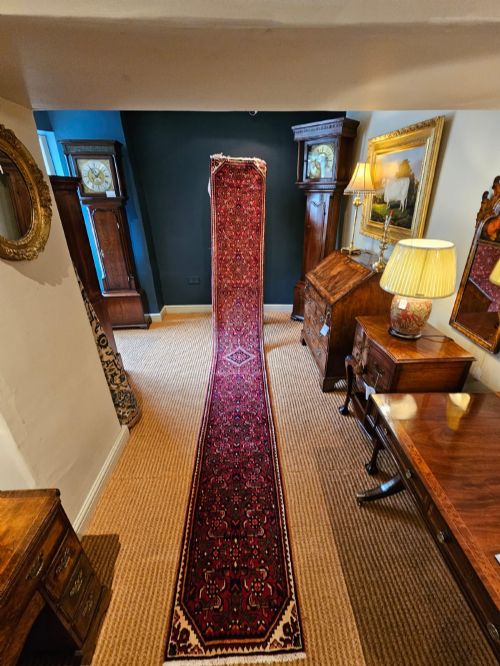


Oriental Long Floor Runner
When you search for an oriental long floor runner, you are looking for a stretched, narrow antique carpet designed to span hallways and corridors.
Oriental Long Floor Runner
An oriental long floor runner is typically found in stretched formats like gallery carpets, kellehs, and narrow corridor rugs. The examples gathered on this page stretch from the middle of the nineteenth century through the early decades of the twentieth century.
These textiles originate from Persian, Caucasian, Turkish, and Turkmen weaving traditions, encompassing tribal village works and larger town pieces. Forms vary from exceptionally narrow passage rugs to broad gallery carpets designed for substantial country house rooms.
The most common formats you will meet here are Heriz, Bidjar, Ushak, and Kurdish runners. They bring distinct regional patterns, from bold geometric medallions to intricate all-over floral shrub designs.
Materials and construction
The pieces listed here rely entirely on wool and cotton as their foundational materials. Wool provides the resilient, dense pile necessary for heavy footfall in long hallways.
Weavers utilised natural dyes and handwoven techniques, tying knots onto sturdy cotton or wool foundation warps and wefts. This construction creates a flexible yet durable structure capable of withstanding decades of use.
Some runners stretch past ten metres in length, requiring a brisk walk just to inspect the entire pattern from end to end.
Assessing quality
Quality in these runners rests on the density of the knotting and the crispness of the drawing. Finer weaves allow for sharper geometric lines and more intricate botanical details in the field.
The depth and harmony of the palette distinguish finer examples from standard production. Natural dyes mellow gracefully over time, creating subtle tonal variations across the expanse of the runner.
Karabagh·Ushak·Bidjar·Heriz·Malayer·Shirvan·Hamadan
The Oriental Long Floor Runner Glossary
- Kelleh
- A large format carpet that is longer than a standard room size but broader than a typical narrow runner.
- Soumak
- A flat-weave technique utilising supplementary wrap-faced patterning without a cut pile.
- Warps
- The vertical threads stretched across the loom that form the foundational skeleton of the rug.
- Wefts
- The horizontal threads passed between the warps to bind the knots in place.
Oriental Long Floor Runner: Frequently Asked Questions
Where should I place an oriental long floor runner?
These narrow textiles suit long hallways, corridors, and gallery spaces where length is required to anchor a room. Their proportions also work effectively alongside large pieces of furniture in reception rooms.
Ensure you measure both the width and the extended length of your passage carefully before selecting a runner to leave balanced margins of bare floor on either side.
How do I care for an antique wool runner?
Regular gentle vacuuming without a rotating power brush helps remove grit from the wool pile. Professional cleaning by a specialist in antique textiles preserves the integrity of the natural dyes.
Positioning a quality underlay beneath the runner prevents slip and cushions the foundation fibres against hard flooring. This simple step extends the active life of the weave significantly.
What distinguishes a Heriz runner from a Bidjar runner?
Heriz runners typically feature bold, large-scale geometric medallions and robust corners woven in village workshops. Their designs lean toward architectural structure and strong primary tones.
Bidjar runners are renowned for an exceptionally dense, heavy weave often called the iron rug of Persia. Their construction involves hammering the wefts down with a special comb, resulting in a remarkably rigid and durable fabric.
How can I tell the age of these runners?
Dating relies on examining the palette, wool quality, and structural characteristics visible in the foundation. Natural dyes, hand-spun wool, and minor irregularities in the geometry point toward nineteenth and early twentieth-century production.
Regional weave structures and specific tribal motifs also provide clear indicators of period. Comparing structural traits across similar village pieces helps narrow down the decade of creation.