


Oak Recording Barometer
An oak recording barometer brings together solid timber and precise meteorological movement to track atmospheric pressure over time.
Oak Recording Barometer
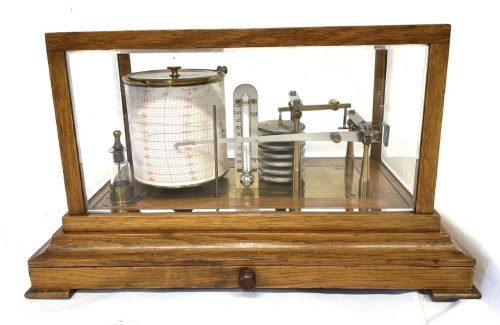
An oak recording barometer, frequently known as a barograph, records barometric pressure continuously onto a paper chart fitted to a revolving drum. Buyers searching for an oak recording barometer encounter scientific instruments spanning the Victorian, Edwardian, and 1930s periods.
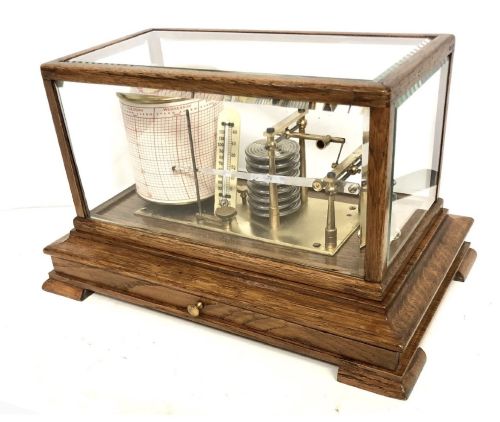
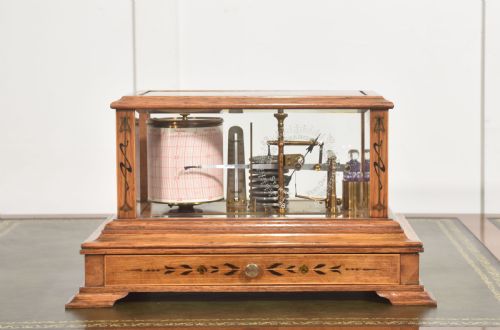
The standard form seen on this page is housed in a wooden case featuring glass panels, often containing a thermometer and a lower drawer for spare charts. These weather instruments combine mechanical clockwork with aneroid chambers to map meteorological changes over the course of a week.
Materials and construction
Cases utilise solid or veneered oak, sometimes decorated with Art Nouveau inlay or paired with brass fittings and bevelled glass panels. The internal mechanism relies on metal aneroid capsules that expand and contract with atmospheric pressure, linked to a steel nib that traces the line upon paper.
Makers housed these delicate movements inside five-glass cases or hinged wooden boxes designed to protect the brass levers and clockwork drum from dust. A paper chart is secured to the brass or metal drum, which rotates via an internal clockwork movement wound by a key.
Listings feature oak cases, brass movements, and bevelled glass across Victorian, Edwardian, and 1930s periods.
Judging quality and provenance
Quality in an oak recording barometer rests upon the precision of the mechanical linkages and the reputation of the maker inscribed on the bedplate. Signed examples by established scientific instrument makers display finer engraving and more robust cabinetry than anonymous workshop pieces.
The proportion and finish of the oak case, alongside the presence of original bevelled glass and operational chart drawers, distinguish higher-grade pieces. Cases featuring decorative inlay or combined barometer dials demonstrate greater ambition in design.
Hezzanith·Short & Mason·Negretti & Zambra·Baines Harrogate·Jules Richard·Dobbie Son And Hutton London
The Oak Recording Barometer Glossary
- Barograph
- A recording barometer that traces atmospheric pressure onto a paper chart over a set period, typically one week. It uses a rotating drum driven by clockwork.
- Aneroid capsule
- A sealed metal box that expands or contracts as air pressure changes, moving the recording arm without the use of liquid mercury. Multiple capsules increase the sensitivity of the instrument.
- Chart drawer
- A small compartment built into the base of the wooden case to store spare recording papers and winding keys. It sits directly beneath the main mechanical movement.
- Beveled glass
- Glass panes with angled edges fitted into the sides and lid of the wooden case. This technique adds depth and reflects light across the instrument.
- Thermometer
- A secondary weather glass mounted alongside the main barometer mechanism to record ambient temperature. It provides additional meteorological data within the same wooden housing.
Oak Recording Barometer: Frequently Asked Questions
How does an oak recording barometer work?
An oak recording barometer uses internal metal capsules that respond to shifts in air pressure. These movements transfer through a series of levers to a pen arm that draws a continuous line on a rotating paper chart.
The rotating drum is powered by a clockwork mechanism that requires manual winding with a key. Together, the barometer and clockwork create a seven-day visual history of local weather patterns.
What is the difference between a barometer and a barograph?
A standard barometer uses a pointer on a dial to show current air pressure at a specific moment in time. A barograph records that pressure continuously onto a paper chart, showing trends over hours and days.
Instruments on this page frequently combine both functions by placing a dial barometer alongside the recording drum inside the oak case.
How do I date an oak recording barometer?
Dating relies on the style of the oak case, the lettering on the paper charts or bedplate, and the specific design of the brass hardware. Edwardian and Victorian examples often feature heavy timber mouldings and bevelled glass.
Later pieces from the 1930s tend to use lighter oak finishes and simpler case geometry. Maker signatures also help narrow down the decade of production.
Where should I place a barograph at home?
A barograph belongs on a stable surface away from direct sunlight, radiators, and heavy vibrations that might disturb the delicate clockwork. Placing it on a desk or bookshelf allows easy observation of the chart.
Because the oak case and glass panels protect the mechanism from room dust, minimal clearance is needed beyond access for weekly winding.