


Oak Barograph Case
An oak barograph case houses a recording weather instrument in solid timber and glass, bringing mechanical science and polished grain into the study or hall.
Oak Barograph Case
When you search for an oak barograph case, you are looking at housing built to protect sensitive meteorological recording mechanisms. These pieces emerge predominantly from the nineteenth and twentieth centuries, spanning Victorian, Edwardian, and later periods.
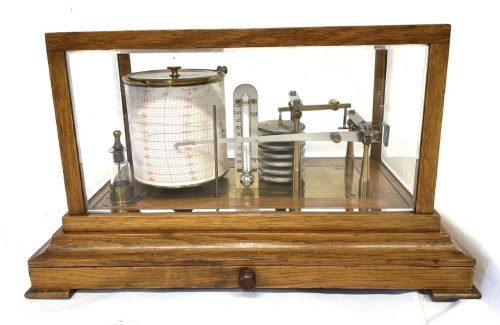
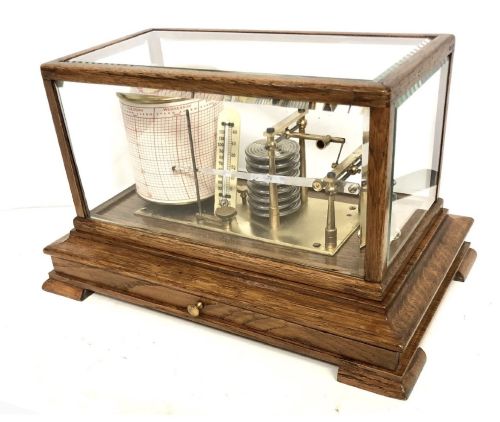
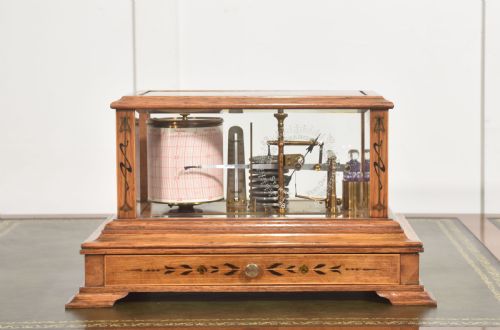
The versions you are most likely to meet on this page feature five glass panels set into solid timber frames, often incorporating a lower chart drawer for spare paper rolls. Some examples integrate supplementary instruments such as thermometers or aneroid barometer dials alongside the main drum.
Makers ranged from notable scientific instrument houses in London and provincial cities to general makers supplying scientific apparatus. The timber framework itself acts as a domestic showcase for scientific utility, blending heavy joinery with delicate brass movements inside.
Materials and construction
Makers utilised solid oak for the structural framing, choosing quartersawn timber for stability and prominent medullary rays. This wood was planed, joined at the corners with mitres or finger joints, and finished with a polished surface.
Bevelled glass panes were rebated into the timber top and sides to allow full visibility of the recording mechanism while shielding the delicate arms from drafts and dust. Brass fittings, hinges, latches, and carrying handles were screwed directly to the oak body.
Internal components combined steel spring stacks, brass levers, and paper charts affixed to clockwork rotating drums. A small ink pen connected to the barometric linkage traced continuous atmospheric pressure changes onto the paper.
Early meteorologists relied on these silent wooden boxes to catch every sudden drop in atmospheric pressure before a storm broke.
Evaluating craftsmanship and execution
The distinction between standard commercial items and finer work lies in the joinery of the oak housing and the precision of the hardware. Superior cases display tight corner joints, well-fitted chart drawers, and thick bevelled glass panes that sit flush within their rebates.
Maker signatures engraved on the brass bedplate or printed on the enamel dials elevate a piece beyond generic utility. Signed examples from established scientific instrument makers demonstrate higher tolerances in both the housing construction and the mechanical movement.
Short and Mason·Negretti and Zambra·Hezzanith·Jules Richard·John Trotter of Glasgow·Armstrong of Manchester·A J Lizars·J Hicks of London·Dobbie Son and Hutton
The Oak Barograph Case Glossary
- Barograph
- A self-recording aneroid barometer that charts atmospheric pressure over time onto a revolving paper drum. It sits inside a protective wooden and glass cover.
- Aneroid barometer
- An instrument measuring air pressure without liquid, using a flexible metal capsule that expands or contracts as pressure shifts. This mechanism sits at the heart of the instrument.
- Chart drawer
- A small storage compartment built into the base of the wooden housing to hold spare weekly recording papers. It pulls out beneath the main glazed display chamber.
- Bevelled glass
- Glass panes with angled edges ground down to fit neatly into the rebated wooden frame. This adds a decorative finish to the viewing windows.
- Thermometer
- A secondary temperature-measuring scale mounted alongside the main recording drum inside the wooden enclosure. It gives immediate readings alongside the historical pressure line.
Oak Barograph Case: Frequently Asked Questions
What is an oak barograph case?
An oak barograph case is a protective wooden housing fitted with glass panels, designed to enclose a mechanical weather recording device.
These enclosures shield the delicate brass levers and rotating drum from dust while displaying the continuous pressure chart.
How did people use barographs?
Users placed these instruments in domestic halls, libraries, or scientific offices to track local weather trends over a weekly cycle.
Every seven days, the operator would wind the clockwork drum and replace the inked paper chart to maintain a continuous record.
How do I date an oak barograph case?
Dating relies on the style of the oak housing, the bevelled glass work, and any inscribed maker signatures on the brass bedplate.
Victorian and Edwardian examples often display heavier timber mouldings and specific retailer signatures, while later twentieth-century versions feature lighter oak finishes.
Are these instruments still working?
Many surviving examples retain their functional brass movements and clockwork drums alongside the original oak housing.
Periodic servicing of the mechanical linkages and replacement of the ink arm allows these historical weather recorders to track pressure changes today.