
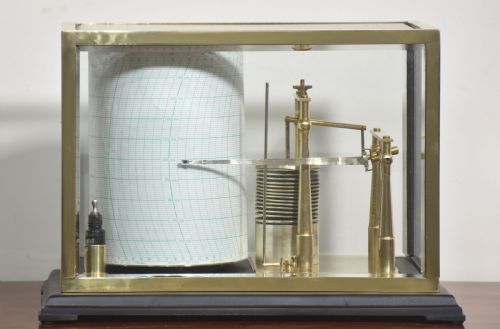
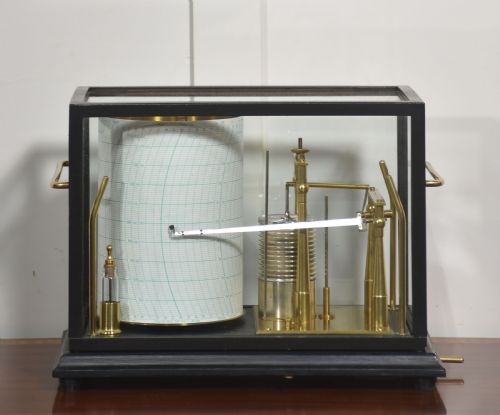


Edwardian Recording Barometer
An Edwardian recording barometer is a mechanical weather station that translates atmospheric pressure onto paper charts, combining brass machinery with polished timber cases.

Edwardian Recording Barometer
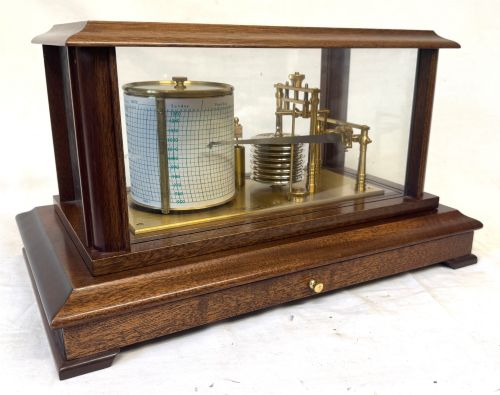
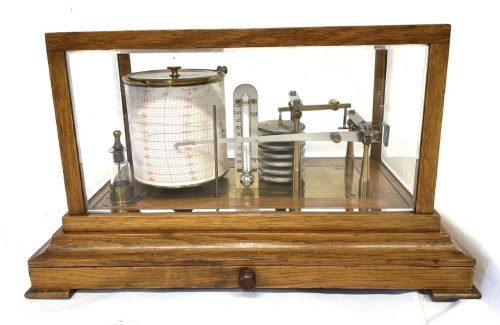
An Edwardian recording barometer, often termed a barograph, is a self-writing meteorological instrument designed to track barometric pressure continuously over the course of a week. These devices sit within glazed enclosures, allowing the user to observe the rhythmic movement of the brass drum and the ink-tipped arm without disturbing the internal vacuum chambers.
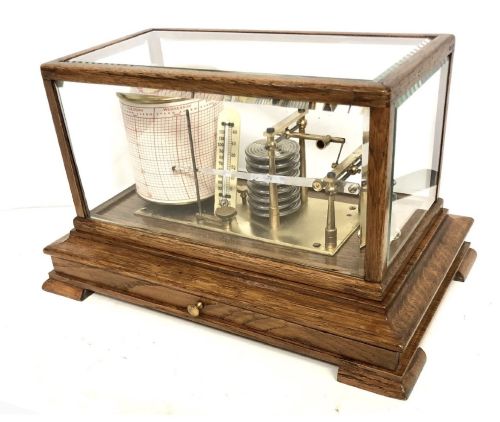
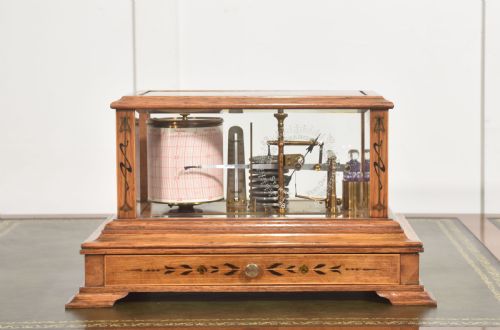
The versions most frequently met on this page are housed in mahogany or oak cases, frequently featuring bevelled glass panels and a dedicated lower drawer for storing spare paper charts. Examples span from the late Victorian and Edwardian periods into the early twentieth century, occasionally incorporating additional weather dials such as thermometers or standard barometer faces.
Makers and retailers represented across these scientific instruments range from prominent London specialists like Short & Mason and Negretti & Zambra to regional outfitters such as Russell of Norwich and Baines of Harrogate. While the majority adhere to traditional timber housing, variations include light oak finishes, walnut cabinetry, and subtle Art Nouveau inlay work.
Materials and construction
The primary structural materials utilised are mahogany and oak, shaped into glazed five-glass cases that protect the delicate mechanism while offering an unobstructed view from all angles. Solid timber or veneered boards form the base and frame, frequently accompanied by brass carry handles, levelling feet, and locking drawer pulls.
Internal mechanics rely upon a series of stacked aneroid metal capsules that expand or contract with changing atmospheric pressure, linked by fine levers to a pivoted steel arm holding an ink nib. This arm presses gently against a clockwork-driven brass drum holding a paper chart, which rotates once every seven days.
Additional components incorporate bevelled glass panes fitted securely into wooden rebates, paper charts printed with hourly gridlines, and mercury or spirit-filled thermometers mounted alongside the main recording bed.
Edwardian Recording Barometer Retail Price Guide 2026
Typical asking prices for edwardian recording barometer among the pieces listed under this phrase on Sellingantiques today, from the lower quarter to the upper quarter. They describe what is for sale here now, not the wider market.
Listings feature scientific instruments primarily dated to the Victorian, Edwardian, and early twentieth-century periods, constructed in mahogany, oak, and walnut.
Judging quality and execution
The distinction between standard commercial output and finer workshop production lies in the crispness of the brass castings, the precision of the clockwork drum movement, and the quality of the timber joinery. Premium makers employed heavier gauge brass for the bedplates and levers, ensuring the instrument maintained calibration over decades of continuous operation.
Cabinetry finish heavily influences desirability, with superior examples exhibiting carefully selected mahogany or oak grain, tight mitre joints, and unblemished bevelled glass panes held by neat wooden glazing beads. The inclusion of signed ivory scale plates, retailer plaques, and original fitted chart drawers further elevates the standing of an individual piece.
Short & Mason·Negretti & Zambra·Casella London·R Fuess·Jules Richard
The Edwardian Recording Barometer Glossary
- Barograph
- A recording barometer that uses an aneroid mechanism to plot atmospheric pressure onto a revolving paper chart.
- Aneroid
- Containing no fluid, this describes a sealed metal vacuum chamber that flexes as air pressure changes.
- Bevelled glass
- Plate glass with edges ground and polished at an angle, commonly fitted into the hinged lids and sides of quality instrument cases.
- Chart drawer
- A small compartment built into the wooden base specifically designed to hold spare recording papers and spare ink bottles.
- Thermometer
- An instrument measuring ambient temperature, frequently mounted on the bedplate alongside the recording mechanism.
Edwardian Recording Barometer: Frequently Asked Questions
How does a barograph work?
A stack of sealed metal vacuum chambers expands and contracts as air pressure rises and falls. This physical movement is magnified through a series of delicate brass levers connected to an arm that carries an ink nib across a rotating drum.
The drum itself contains a clockwork mechanism that turns the cylinder once every seven days. By replacing the paper chart weekly, the owner builds up a continuous visual history of local weather patterns.
Where should I place a barograph?
These instruments require a stable, level surface away from direct sunlight, central heating radiators, and damp draughts. Sudden temperature shifts or vibrations can interfere with the delicate aneroid capsules and upset the mechanical calibration.
A sideboard, desk, or dedicated wall shelf in a principal room provides a suitable environment where the gentle movement of the clockwork can be observed safely.
How do I read the paper chart?
The vertical axis on the printed paper chart indicates atmospheric pressure, usually measured in inches of mercury or millibars. The horizontal gridlines mark the passage of time across the seven days of rotation.
By following the ink trace from left to right, you can see whether pressure has fallen sharply to indicate approaching storms or risen steadily to suggest settled, fair weather.
Can I still buy replacement charts?
Specialist suppliers and meteorological enthusiast groups continue to print reproduction weekly charts sized to fit standard British barograph drums. Using correct period-style paper preserves the historical function of the instrument.
When fitting a new chart, ensure the starting time aligns precisely with the current day of the week and hour so the recording remains accurate.