
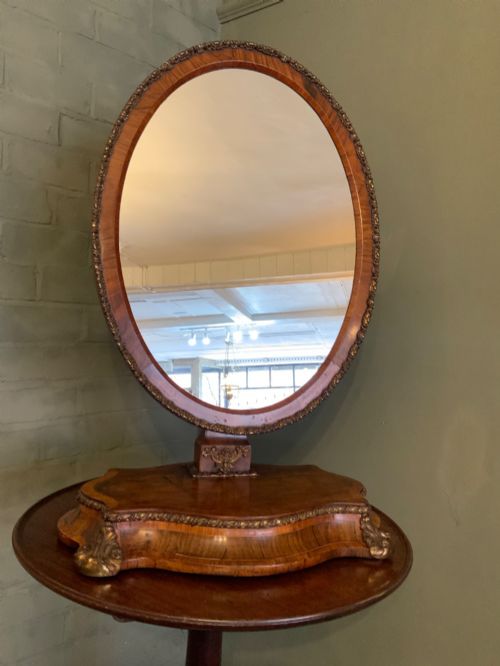

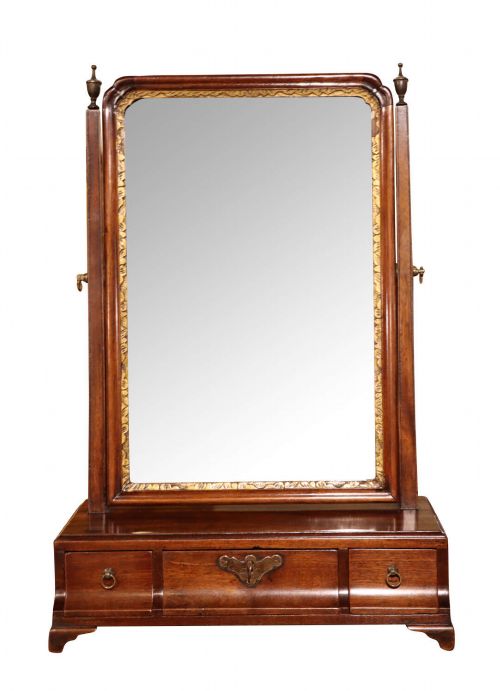


Nineteenth Century Toilet Mirror
These nineteenth century toilet mirror examples sit upon a dressing table or chest, offering a clear reflection while bringing period timber and brass into a bedroom.
Nineteenth Century Toilet Mirror
A nineteenth century toilet mirror is a tabletop or dressing table glass designed for personal grooming, pivoting between upright supports mounted on a small base. Most pieces met on this page date from the Victorian era or around eighteen hundred, taking the form of dressing mirrors, shaving mirrors, and table mirrors.
The wooden frames and boxes supporting the glass vary from simple serpentine fronts in flame mahogany to elaborate Dutch marquetry and Anglo-Indian colonial teak. Makers mounted the swinging plates on brass pivots, often incorporating small drawers beneath the glass for storage.
How they were made
Cabinetmakers constructed these frames using dense timbers like mahogany, walnut, and teak, frequently enhancing the surfaces with boxwood inlay, satinwood inlay, or ormolu mounts. The glass plates swing between sturdy uprights, secured by adjustable brass screws that allow the user to tilt the angle of reflection.
Many examples incorporate fitted bases featuring one or three small drawers constructed with traditional joinery. Gilt wood and Dutch marquetry techniques appear on continental pieces, adding decorative floral patterns directly into the timber surface.
The listings show woods including mahogany, walnut, teak, and satinwood, paired with brass and ormolu hardware across the nineteenth century.
What varies in quality
The choice of timber grain dictates much of the visual merit, with finely figured flame mahogany and richly patterned walnut standing apart from plain stock. The crispness of the boxwood and satinwood inlay also separates standard workshop output from more ambitious commissions.
Hardware contributes heavily to the overall standard, as heavy cast brass mounts and original pivoting screws indicate careful initial manufacture. The proportion between the swinging glass frame and the supporting base box governs the balance and elegance of the silhouette.
The Nineteenth Century Toilet Mirror Glossary
- Swing mirror
- A glass plate mounted on vertical pivots within a frame that tilts back and forth. This arrangement allows the user to adjust the angle during grooming.
- Flame mahogany
- A distinctive wood veneer showing a flickering, flame-like grain pattern. Cabinetmakers selected these cuts for the primary facades of superior dressing mirrors.
- Ormolu
- Gilded bronze mounts applied for decorative effect. These metal ornaments accent the timber frames of more elaborate nineteenth century examples.
- Marquetry
- Fitted pieces of wood veneer forming decorative pictures or patterns on a surface. Dutch variants often display floral or pictorial marquetry across the base.
- Shaving mirror
- A specialised tabletop glass intended for male grooming. These items frequently feature compact adjustable frames and single storage drawers.
Nineteenth Century Toilet Mirror: Frequently Asked Questions
Where should I place a toilet mirror?
These mirrors suit the top of a chest of drawers, a low sideboard, or a dedicated dressing table in a bedroom. Their compact footprints allow them to sit securely on any flat surface while providing functional height.
Ensure the supporting surface is deep enough to hold the base frame safely without overhang. The adjustable pivot mechanism then lets you tilt the glass to suit standing or seated use.
Did these mirrors always have drawers?
Many examples include one or three small drawers built into the base box, but several styles leave the base as a simple solid stand. Shaving mirrors and dressing table variants frequently utilised the drawer space for small personal items.
The presence of drawers often depends on the regional origin and the specific decade of manufacture, with Victorian and Georgian models appearing in both fitted and plain formats.
How do I adjust the swinging glass?
The glass plate hangs between two vertical arms using threaded brass screws or pins that act as pivots. Tightening or loosening these side fixtures controls the tension that holds the mirror at your chosen angle.
Over time, brass fittings may require gentle alignment to ensure the glass stays in position without slipping forward or backward.
How do I tell Victorian pieces from earlier ones?
Items from around eighteen hundred often display simpler geometric lines, Georgian proportions, or Dutch marquetry decoration. Victorian examples tend to introduce serpentine fronts, heavier flame mahogany veneers, and broader structural forms.
Examining the secondary timbers inside the drawer boxes and the style of the brass fittings helps clarify the manufacturing period.