
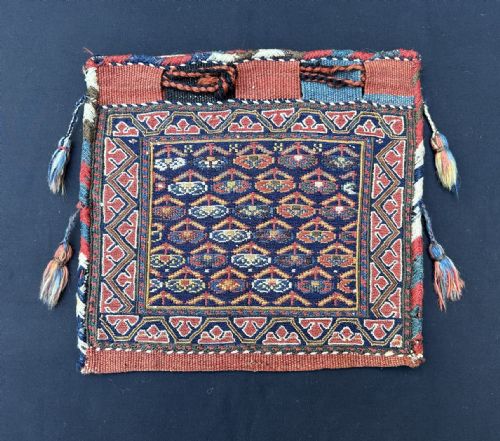


Navy Blue Saddlebag
A navy blue saddlebag brings deep indigo ground colours and nomad craftsmanship straight into your home as a striking textile wall hanging or small floor piece.
Navy Blue Saddlebag
When you search for a navy blue saddlebag, you encounter authentic tribal weavings created by nomadic groups across Persia and Central Asia. These items comprise complete bags, half faces, and single panels produced during the nineteenth century, specifically from the eighteen-sixties through to nineteen-hundred. The examples on this page hail from traditions such as the Afshar, Qashqa'i, Lori-Bakhtiari, Khamseh, and Uzbek peoples.
The most common form on this page is the saddlebag face, often preserved as a flat textile panel after the utilitarian back section was removed or worn away through decades of nomadic life. These pieces showcase regional motifs like large boteh designs, banded weft work, and geometric tribal patterns set against dark indigo grounds. They function today as compact rugs, vanity bags, and decorative wall textiles rather than working transport gear.
How they were made
The weavers of these pieces utilised hand-spun wool and cotton, combining tactile natural dyes to achieve deep navy and indigo tones that anchor each composition. Artisans worked within distinct tribal traditions, employing warp and weft techniques characteristic of Persian and Central Asian workshops.
Nomadic weavers constructed these textiles with durable pile knots and flatweave structures designed for the rigours of travel across rugged terrain. The surviving pieces demonstrate the application of lustrous wool and tight knotting that preserves the clarity of the geometric and figurative motifs over generations.
Listings span periods from eighteen-sixty to nineteen-hundred, featuring wool, cotton, and natural dyes across Persian and Central Asian tribal styles.
What varies in quality
Quality in these tribal weavings rests upon the handling of the wool and the depth achieved with natural dyes. Superior examples display lustrous, luminous wool that retains its vibrancy and tactile richness, whereas lesser items rely on duller fibres.
The fineness of the knotting and the precision of the geometric or boteh drawing further separate standard pieces from exceptional ones. Integrity of survival, such as retaining complete panels or original plain weave backs, elevates the standing of an individual weaving.
The Navy Blue Saddlebag Glossary
- Khorjin
- The traditional Persian term for a double-sided saddlebag used by nomadic peoples for transport.
- Boteh
- A stylised almond or paisley motif frequently found in tribal Persian textile designs.
- Plain weave
- A simple weaving technique with no pile, often utilised for the backs or flat portions of nomadic bags.
- Half face
- A single side of a paired saddlebag, preserved after the original textile was separated.
Navy Blue Saddlebag: Frequently Asked Questions
How were navy blue saddlebags used originally?
Nomadic tribes utilised these double pouches draped across the flanks of camels, donkeys, or horses to carry personal belongings during seasonal migrations. They served as durable storage containers woven specifically for practical transport.
Over time, individual panels became separated from their pairs or worn backs, leading to the survival of the decorative faces we collect and display today as standalone textiles.
How do I care for a antique saddlebag face?
Protect your textile from direct, strong sunlight to prevent natural dyes from fading over the years. Gentle vacuuming without a beater bar removes surface dust safely.
Keep the piece away from damp environments and consult a specialist textile conservator if professional cleaning becomes necessary.
How can I display a saddlebag in my home?
Mounting the textile flat against a wall using a non-invasive sleeve or display clips highlights the geometric patterns and indigo fields effectively. Alternatively, place smaller panels on low-traffic surfaces as decorative accent mats.
Ensure the wall or surface remains free from excessive moisture to preserve the hand-spun wool fibres.
How do I identify different tribal origins?
Study the specific design vocabulary, structural characteristics, and regional colour palettes associated with groups like the Afshar, Qashqa'i, or Bakhtiari nomads. Each tribal confederal group utilised distinct motifs, such as bold boteh arrangements or banded weft work.
Comparing the handling of the hand-spun wool and the specific shades of indigo helps narrow down the probable geographic region of production.