


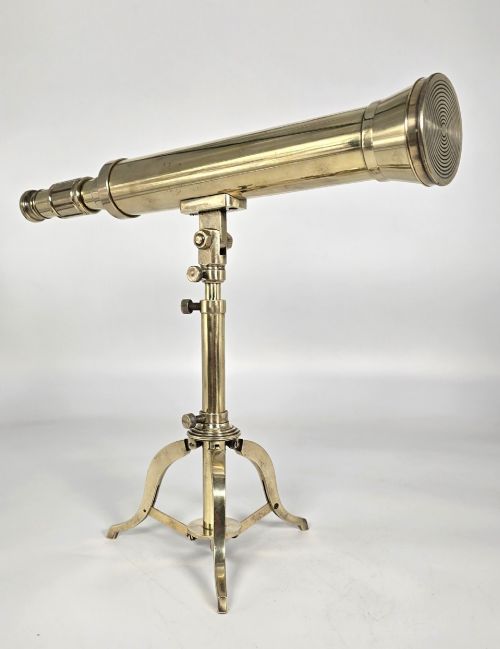


Nautical Brass Telescope
A nautical brass telescope brings the craftsmanship of maritime navigation directly to your desk or cabinet.
Nautical Brass Telescope
A nautical brass telescope represents precision optical engineering spanning the Georgian, Victorian, and Edwardian eras. Buyers searching for a nautical brass telescope will discover handheld marine spyglasses, multi-draw terrestrial tubes, and substantial library instruments on folding tripods.
The pieces on this page originate predominantly from English makers active during the nineteenth and early twentieth centuries. Common variations include single-draw hexagonal marine tubes, pocket-sized folding instruments, and large tabletop scientific pieces.
Navigational examples frequently feature protective leather or wood coverings to withstand maritime conditions. These historical instruments served officers on watch, explorers in the field, and astronomers studying the stars.
Materials and construction
Makers constructed these optical instruments primarily from polished brass tubes combined with clear glass lenses for magnification. Many barrels feature hand-stitched leather dressings, fruitwood, mahogany, or walnut jackets to provide a secure grip and protect the metal underneath.
Workshops utilised multi-draw extension sections that slide smoothly within one another to focus distant objects on land or at sea. Nickel plating and gilt brass finishes appear alongside traditional unplated brass to prevent corrosion in marine environments.
Makers represented range from Georgian scientific instrument workshops to First World War naval contractors.
Craftsmanship and optical integrity
The distinction between standard utility instruments and finer pieces lies in the precision of the draw-tubes and the clarity of the optical glass. Superior examples maintain a tight, friction-fitted slide across multiple draws without lateral play when fully extended.
Signed barrels bearing the names of esteemed London opticians indicate higher workshop standards than anonymous commercial pieces. The quality of external secondary materials, such as finely turned mahogany bodies or stitched leather casings, mirrors the internal optical precision.
Nairne and Blunt·Ross of London·Clarkson·Steward of London·Newton and Co·Broadhurst Clarkson and Co·Cary London·L Casella London·Alexander Adie of Edinburgh·Chadburn Brothers of Sheffield·Davis of London·John Gilbert
The Nautical Brass Telescope Glossary
- Draw
- An individual sliding tube section of a telescope that extends to adjust the focal length. Multi-draw instruments collapse into compact lengths for portable use.
- Spyglass
- A small, portable refracting telescope utilised by sailors and travellers for terrestrial viewing. These typically feature leather-wrapped brass barrels.
- Terrestrial
- An optical configuration designed to display right-side-up images for viewing objects on land. Most marine and pocket instruments use internal erecting lenses for this purpose.
- Library telescope
- A large, stable instrument mounted on a tabletop tripod or pillar for stationary viewing. These feature substantial objective lenses for broader magnification.
- Achromatic
- An optical lens corrected to reduce chromatic and spherical aberration. This engineering development provides sharper colour contrast in field observations.
Nautical Brass Telescope: Frequently Asked Questions
How do I focus a multi-draw telescope?
Grip the main body securely with one hand while gently pulling the smallest eyepiece tube outward until the distant subject sharpens. Continue adjusting the remaining draw sections incrementally until the image achieves maximum clarity.
Older marine instruments rely on smooth friction fits between the brass sleeves rather than modern geared rack-and-pinion wheels. Take care to extend each section fully to maintain proper alignment of the internal lenses.
Can I use these antiques for stargazing?
Terrestrial instruments feature internal erecting lenses designed specifically for viewing upright objects on land. While they resolve bright celestial bodies and the moon, they differ fundamentally from dedicated astronomical reflectors.
Large library models mounted on tripod stands offer steadier viewing frames for distant observation than handheld multi-draw pocket spyglasses. Support the barrel firmly on a surface or rest to reduce hand tremors during extended viewing.
How should I clean the brass and leather?
Dust the brass tubes gently with a soft microfiber cloth to prevent surface scratching from accumulated particles. Avoid aggressive metal polishes that remove historical patination and maker signatures etched onto the metal.
Nourish leather-dressed barrels occasionally with a specialised leather preservative to keep the material supple. Keep moisture away from the internal glass elements to protect the vintage lens coatings and interior spacers.
How do I date an English brass telescope?
Examine the barrel inscriptions for maker names, addresses, and military titles that correspond with known historical working dates. The number of draw-tubes, typeface styles, and the inclusion of specific materials like mahogany or nickel plating offer further chronological clues.
Early eighteenth and nineteenth-century examples often display simpler hand-engraved signatures compared to the stamped factory lettering found on later Edwardian and wartime instruments.