


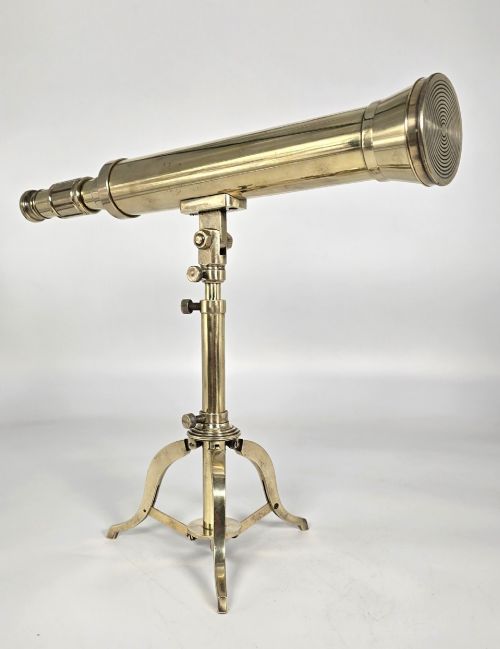


Vintage Desktop Telescope
These vintage desktop telescope pieces offer a tangible connection to early scientific observation, combining functional optics with handsome period materials.
Vintage Desktop Telescope
A vintage desktop telescope serves as both an optical instrument and a decorative object designed for study or library tables. The selection ranges from compact two-draw and three-draw versions to substantial library instruments mounted on stands.
Makers from the eighteenth century onward produced these brass and mahogany instruments for terrestrial and astronomical viewing. Pieces span Georgian, Victorian, and early twentieth-century periods, often retaining their original fitted cases or folding tripod stands.
Materials and construction
Constructed primarily from polished brass and fitted glass lenses, these instruments frequently incorporate turned mahogany or wrapped leather barrel sections. The metal components demonstrate skilled casting, turning, and engraving.
Makers mounted larger library examples on sturdy brass table stands or original folding tripods for stability during observation. Draw tubes slide smoothly within one another to adjust the focal length for different viewing distances.
Vintage Desktop Telescope Retail Price Guide 2026
Typical asking prices for vintage desktop telescope among the pieces listed under this phrase on Sellingantiques today, from the lower quarter to the upper quarter. They describe what is for sale here now, not the wider market.
Starboy astronomers of nineteen-twenty evidently needed sturdy brass optics just as much as eighteenth-century gentlemen did.
Distinctions in quality
Quality rests upon the clarity of the optical glass and the precision of the brass draw tubes, which should extend smoothly without excessive play. The crispness of maker signatures engraved upon the barrel or draw tube elevates the standing of an instrument.
The survival of original supporting hardware, such as folding brass tripod stands and fitted wooden cases, distinguishes superior pieces. Finer examples display meticulous attention to detail in the wood turning and metal finishing.
Nairne & Blunt of London·Matthew Berge London·S & B Solomons·Newton & Co·Broadhurst & Co
The Vintage Desktop Telescope Glossary
- Draw tube
- A sliding brass cylinder that extends to focus the telescope. Multiple draws allow the instrument to collapse to a compact length.
- Library telescope
- A larger optical instrument designed for interior use on a desk or table rather than portability in the field.
- Gregorian
- A type of reflecting telescope utilising a concave secondary mirror to focus light back through an aperture in the primary mirror.
- Tripod stand
- A three-legged folding mount that supports the telescope barrel for stable viewing.
Vintage Desktop Telescope: Frequently Asked Questions
How do I use a vintage desktop telescope?
Extend the brass draw tubes fully and adjust the final section while looking through the eyepiece until the distant subject comes into sharp focus. Keep the instrument supported on its stand for stable viewing.
Store the telescope in a dry environment and clean the brass gently with a soft cloth to preserve the finish without damaging any engraved maker details.
What periods do these telescopes come from?
The available examples span from the eighteenth century through the Victorian era up to the nineteen-twenties. Earlier pieces often feature mahogany bodies and fine hand-engraved signatures.
Later Victorian and early twentieth-century instruments frequently utilise leather-wrapped brass barrels and heavier cast iron or brass mountings.
Are these telescopes functional today?
Most of these antique instruments retain their original glass lenses and function effectively for terrestrial or astronomical viewing when properly focused. The internal optics gather light just as they did centuries ago.
Care must be taken when extending the draw tubes to avoid straining the historic brass and glass components.
What is a library telescope?
A library telescope is a larger scientific instrument built to sit upon a desk, table, or dedicated stand inside a study or drawing room. They provided greater magnification than portable handheld spyglasses.
These pieces often include original wooden storage boxes and folding metal tripods designed for indoor display and use.