


Victorian Brass Optical Instrument
These Victorian brass optical instrument pieces combine practical nineteenth-century engineering with polished metal and glass optics for daily use.
Victorian Brass Optical Instrument
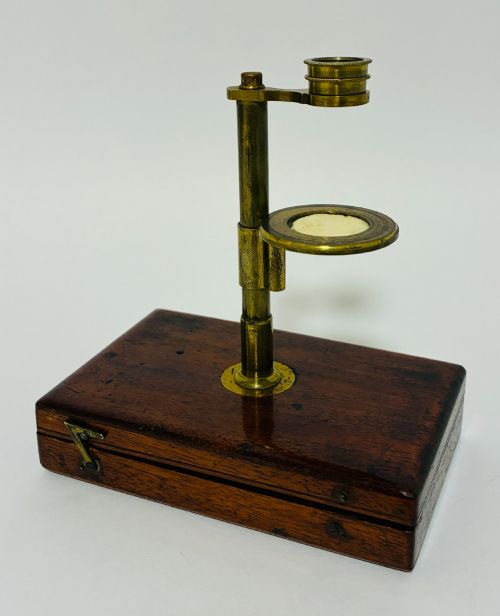
A Victorian brass optical instrument encompasses scientific and navigational devices spanning telescopes, microscopes, opera glasses, and magnifying lenses. These objects served utilitarian functions in navigation, astronomy, and laboratory research, alongside leisurely pursuits in theatre viewing and botanical study.
Most pieces date from the nineteenth century, ranging from early Victorian examples through to later 1900s instruments. English workshops dominate the selection, alongside continental production from Paris and Germany.
Distinctions in Quality and Execution
Quality rests in the precision of the mechanical draw tubes, the clarity and ground quality of the glass lenses, and the crispness of the maker engraving. Superior specimens retain their original fitted wooden boxes and complete lens or accessory complements.
Material selection further defines the grade of a piece, separating standard brass and wood builds from luxury variants featuring gilt brass, mother-of-pearl inlay, and fine leather wraps.
Materials across these listings include brass, glass, leather, mahogany, cast iron, steel, wood, and mother of pearl.
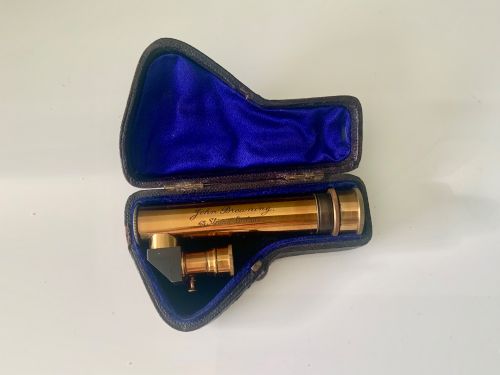
John Browning Strand London·R. and J. Beck London·Thomas Rubergall·H Hughes and Son London·Chadburn Brothers of Sheffield·Francis West·WF Stanley·Ross London·Iris Paris·Broadhurst and Co
The Victorian Brass Optical Instrument Glossary
- Achromatic lens
- An optical lens designed to reduce chromatic and spherical aberration by combining two types of glass with different dispersive properties.
- Spectroscope
- An optical instrument used to measure properties of light over a specific portion of the electromagnetic spectrum, often utilised in chemical analysis.
- Binocular microscope
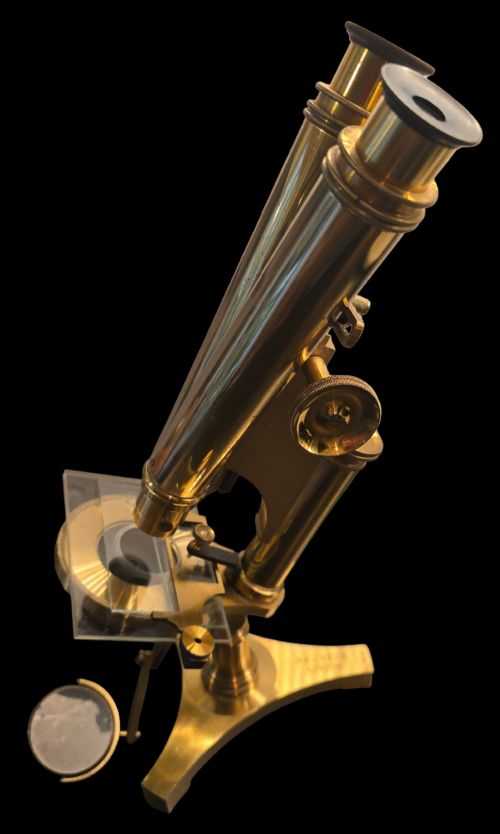
- A microscope configuration utilising two eyepieces for both eyes, providing stereoscopic vision during prolonged laboratory observation.
- Stanhope lens
- A small cylindrical optical device offering high magnification power without requiring precise focusing adjustments from the user.
- Marine telescope
- A portable extending telescope designed for use at sea, typically featuring multiple brass draw tubes housed within a leather or bare metal body.
Victorian Brass Optical Instrument: Frequently Asked Questions
How do I care for brass optics?
Keep brass surfaces dry and dust them gently with a soft cloth to protect the metal finish. Avoid abrasive cleaning compounds that remove aged patination.
Store glass lenses in a stable environment away from extreme humidity and direct sunlight. Clean optics only with dedicated lens tissue and appropriate optical cleaning solutions.
Were these telescopes used at sea?
Many instruments in this category served maritime roles as marine telescopes and officer of the watch viewing tools. Their multi-draw brass construction provided durability in salt air and damp conditions.
Other designs remained land-based, functioning as library, astronomical, or table top telescopes for domestic study.
What is a test glass kit?
Opticians and optometrists utilised test glass and lens kits within fitted wooden cabinets for eye examinations and prescription testing. These collections contain graded optical lenses secured in individual slots.
Such cabinets represent clinical practice during the nineteenth century, differing from domestic viewing instruments.
How do I date a brass telescope?
Examine the barrel engraving for maker names, addresses, and trade titles that correspond to known working dates. The number of draw tubes and the presence of protective sunshades also indicate specific production decades.
Materials such as rosewood cases and specific leather wraps point toward particular Victorian or Edwardian manufacturing periods.