


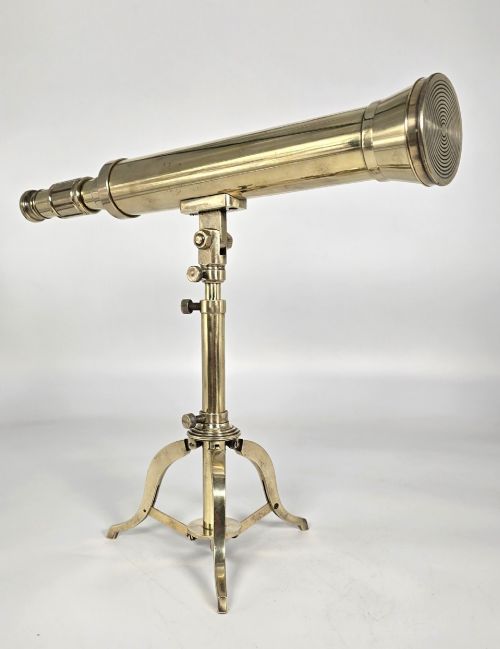


Antique Refractor Telescope
An antique refractor telescope brings the precision of historical optics into a modern room, offering clear terrestrial or astronomical viewing through polished brass and rich mahogany.
Antique Refractor Telescope
An antique refractor telescope is an optical instrument designed to gather light through lenses, typically mounted in draw tubes or resting upon folding floor stands and table tripods. These instruments range from small pocket models intended for marine or day use to large library and astronomical installations.
The most common versions met on this page are multi-draw handheld terrestrial scopes and substantial library instruments originating from the eighteenth and nineteenth centuries. Makers built these for practical navigation, military campaigns, and serious stargazing, combining utility with refined cabinetmaking.
Surviving examples span Georgian, Regency, and Victorian periods, reflecting shifting tastes in materials and mounting solutions. Buyers will find instruments designed for specific environments, from compact pocket tubes covered in leather to heavy brass table-top units.
Materials and construction methods
Makers constructed the optical tubes predominantly from turned brass, often housing draw sections that slide smoothly within one another. Many portable examples incorporate polished mahogany or leather body coverings to protect the metal and provide a secure grip during use.
The primary lenses rely on glass ground to precise curvatures, paired with secondary lenses to correct chromatic aberration in the finer historical tiers. Tripod stands and mounting brackets utilise heavy cast iron and brass to stabilise the heavy barrels during prolonged observation.
The listings show instruments constructed from brass, glass, mahogany, steel, and cast iron across the eighteenth, nineteenth, and early twentieth centuries.
Separating ordinary instruments from exceptional works
Optical clarity and the precision of the lens grinding separate basic utilitarian tubes from masterworks signed by prominent London makers. The quality of the original brass casting, the smoothness of the draw action, and the tightness of the fitted joints indicate the original workshop standard.
A signed maker's inscription on the final draw tube elevates an instrument, confirming the pedigree of renowned opticians such as Dollond or Nairne and Blunt. The inclusion of original fitted mahogany cases, substantive aperture size, and sturdy folding tripods further distinguishes top-tier examples.
Nairne and Blunt·W and T Gilbert·Steward of London·S and B Solomons·G Adams·Broadhurst and Co·Berge·Dollond London·Silberrad Aldgate·Stampa and Son·J Casartelli and Son·C West·Broadhurst Clarkson·T Harris and Son·Banks of London·T Cooke and Sons
The Antique Refractor Telescope Glossary
- Refractor
- An optical telescope that uses lenses to form an image, bending light as it passes through the primary objective lens. This design forms the basis of historical handheld and library spyglasses.
- Draw
- A sliding tube section that collapses into the main barrel to shorten the instrument for storage. Pocket and marine models frequently feature between two and six individual draws.
- Terrestrial
- Designed for viewing distant objects on land, such as ships at sea or distant landscapes. These scopes incorporate erecting lenses to ensure the image appears right side up.
- Achromatic
- An optical configuration utilising multiple lens elements to bring different wavelengths of light to the same focus point. This innovation largely eliminates false colour fringes around bright objects.
- Library telescope
- A large, stable instrument intended for indoor use on a table or dedicated stand rather than handheld observation. These units usually feature substantial objective lenses for broader field viewing.
Antique Refractor Telescope: Frequently Asked Questions
What is the difference between a terrestrial and an astronomical telescope?
Terrestrial telescopes include extra lenses to erect the image so that landscape and maritime views appear right side up. Astronomical models omit these extra erectors to maximise light transmission, leaving the image inverted for star gazing.
Historical makers designed each instrument for its specific viewing environment, ensuring that buyers can match the optical configuration to their intended use.
How do multiple draw tubes function?
Draw tubes slide smoothly out of the main body barrel to extend the focal length required for sharp magnification. Each tube locks into place or relies on friction to maintain alignment during observation.
When packing the instrument away, the draws nest completely inside the protective outer jacket or leather casing for portable transit.
Can I use an antique refractor telescope for modern stargazing?
These instruments function well for observing the Moon, bright planets, and broad star clusters using historical optical standards. Collectors appreciate them for their authentic performance and aesthetic beauty rather than high-power deep-space observation.
Mounting a heavy library scope onto a sturdy tripod ensures steady viewing during extended nighttime stargazing sessions.
How do I identify the maker of an antique telescope?
Makers routinely engraved their workshop names, trading addresses, and optical specifications directly onto the final draw tube near the eyepiece. Examining this text reveals the original maker and helps narrow down the production era.
Signatures from celebrated London opticians confirm the workshop pedigree and provide a reliable anchor for dating the piece.