



Napoleon III Style Cabinet
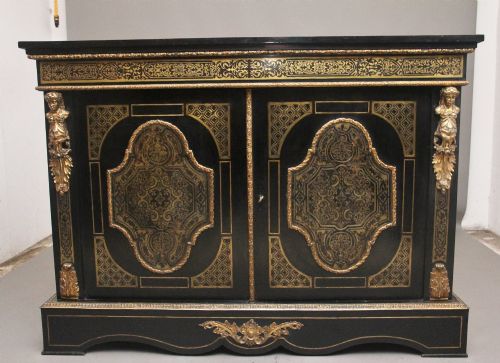
A napoleon iii style cabinet brings grand nineteenth century French display and storage into a room through rich marquetry, stone tops and gilt mounts.
Napoleon III Style Cabinet
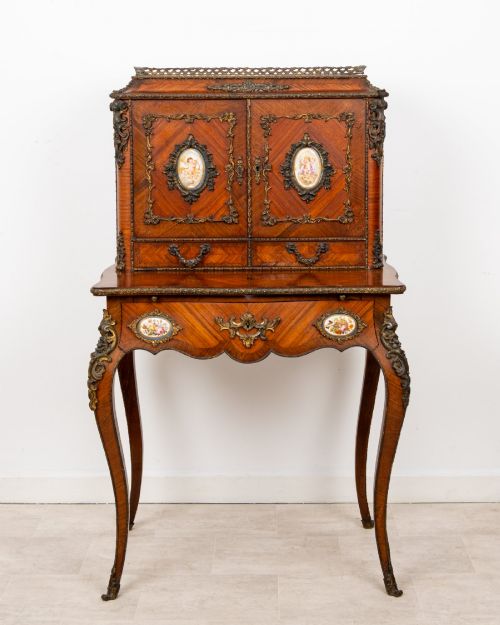
A napoleon iii style cabinet spans side cabinets, display cabinets, credenzas, pier cabinets and writing desks originating in the nineteenth century. The selection leans heavily toward French production, utilising revival aesthetics from the Louis XV and Louis XVI periods alongside Empire designs.
Most pieces date from the mid to late nineteenth century, predominantly between eighteen fifty and nineteen hundred. Side cabinets and credenzas dominate the forms, frequently topped with marble and detailed with intricate brass inlay or porcelain panels.
Makers working in this idiom interpreted earlier royal French furniture for bourgeois and aristocratic interiors. The results combine display utility with dense decorative surfaces suited to formal reception rooms.
Materials and Construction
Makers combined ebonised wood, kingwood, walnut and rosewood as foundational timbers, often applying elaborate floral marquetry or boulle brass inlay. Surfaces frequently feature contrasting veneers arranged in geometric or floral patterns across doors and panels.
Cast ormolu and gilt bronze mounts frame doors, corners and feet, anchoring the structural composition. Marble tops in white and coloured varieties complete the upper surface, while inset porcelain plaques add painted detail.
Listings feature nineteenth century cabinets utilising ebonised wood, kingwood, marble, ormolu and porcelain plaques.
Craftsmanship and Detail
Quality rests in the precision of the marquetry and the crispness of the gilt bronze or ormolu mounts. Finer examples display deeply chased metalwork and meticulously fitted veneers rather than stamped metal and painted substitutes.
The weight and selection of the marble top, along with the complexity of the interior joinery, distinguish standard production from exhibition pieces. Superior workshops invested heavily in hand-chiselled mounts and flawless polished finishes.
Beurdeley·Paul Sormani·Linke·Zweiner
The Napoleon III Style Cabinet Glossary
- Boulle
- Marquetry technique utilising tortoiseshell and brass or copper inlay, developed in France during the seventeenth century and revived in nineteenth century cabinets.
- Ormolu
- Gilt bronze ornamentation applied to furniture corners, mounts and handles, cast and hand-chased for crisp definition.
- Bonheur du jour
- A small light writing desk featuring a tiered superstructure with shelves and small drawers, popular in nineteenth century French rooms.
- Pietra dura
- Inlay technique using cut and fitted polished coloured stones to create pictorial or geometric designs on furniture panels.
- Vernis Martin
- A European lacquer technique mimicking Asian lacquerwork, named after the Martin brothers and used on fine French cabinet panels.
Napoleon III Style Cabinet: Frequently Asked Questions
What rooms suit a napoleon iii style cabinet?
These cabinets suit drawing rooms, dining spaces and studies where their dark woods and gilt mounts contrast with neutral walls. Their polished marble tops and glazed display doors make them useful for holding decorative objects while providing enclosed storage underneath.
Placing one against a plain wall allows the brass inlay and ormolu mounts to catch natural light. They work well alongside both antique furniture and modern minimalist interiors seeking a focal point.
How do I care for marble topped cabinets?
Marble surfaces require regular dusting with a soft dry cloth and immediate cleaning of liquid spills to prevent staining. Acidic substances like wine or fruit juice etch polished stone if left on the surface.
Applying a specialist stone wax periodically protects the polish without darkening the grain. Avoid placing heavy or abrasive objects directly onto the stone without protective pads.
How do I distinguish ebonised wood from black paint?
Ebonised wood involves treating a dense hardwood such as fruitwood or mahogany so the dark colour penetrates the grain rather than sitting on top. Close inspection reveals the natural grain texture beneath the deep black finish.
Painted surfaces often show brush marks or chipping that exposes a lighter timber underneath. True ebonising develops a soft satin sheen rather than a flat painted coat.
What is the difference between a credenza and a pier cabinet?
A credenza is typically a long, low cabinet featuring three or more doors, designed to stand against a primary wall. A pier cabinet is narrower, built specifically to fit the wall space between two windows.
Credenzas often include extensive porcelain plaques and heavy ormolu mounts across their front. Pier cabinets focus their decorative marquetry and gilt details on a single upright glass door.