



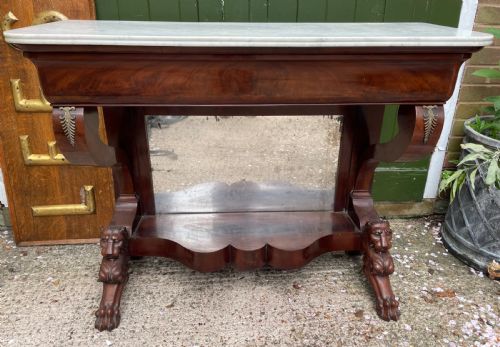

Mirror Back Console Table
A mirror back console table marries heavy timber and cool stone with reflective depth, anchoring a hallway or drawing room with grounded balance.
Mirror Back Console Table
A mirror back console table brings together a wall-anchored table frame and an integrated vertical glass plate, designed to bounce light into darker entertaining spaces and reception halls. The pieces encountered here span the nineteenth century into the twentieth, taking distinct forms from Regency rosewood to French Empire mahogany and decorative revival styles.
Makers and workshops across Britain, Ireland, France, Italy and Germany built these tables to stand against principal walls, frequently pairing heavy timber structures with inset marble slabs. While many survive as single grand statements, matched pairs appear alongside related forms like chiffoniers and washstands sharing the characteristic reflective backing.
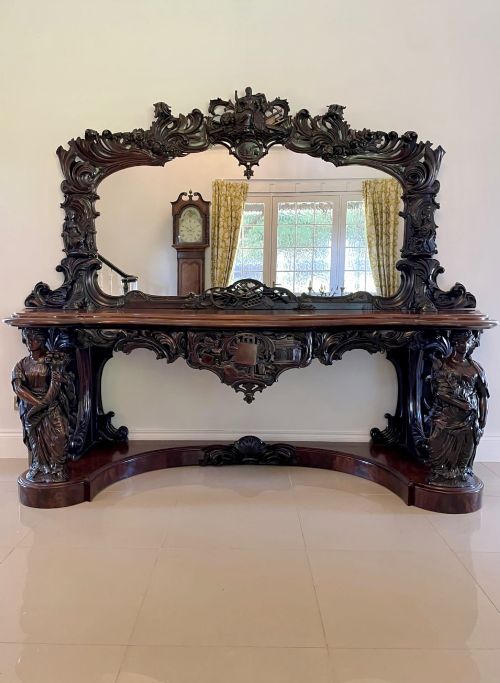
The architectural presence of a mirror back console table relies on the interplay between the cool stone surface below and the tall glass panel rising behind it. Buyers find proportion ranging from restrained Biedermeier maserbirch to exuberant Victorian carved rosewood and giltwood frames.
Materials and Construction
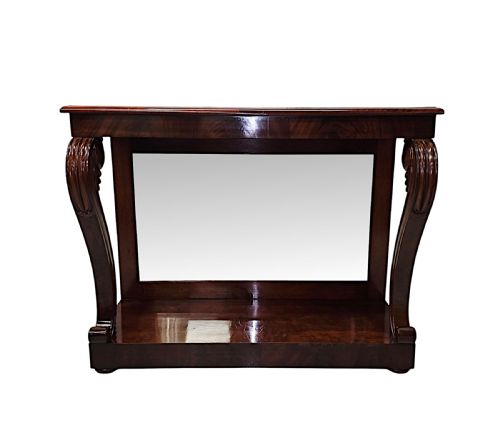
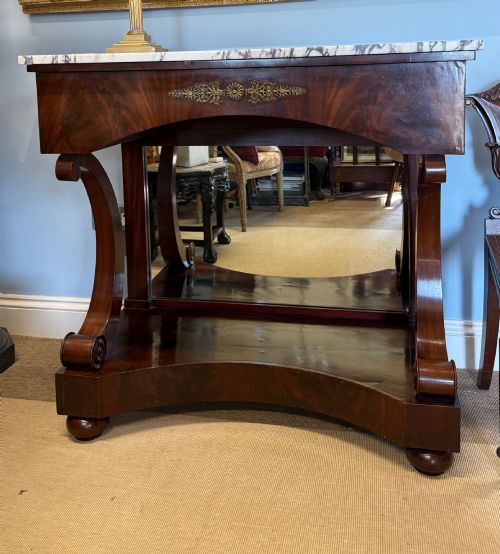
Cabinet makers built the primary carcass of a mirror back console table using dense hardwoods such as mahogany, rosewood, walnut and flame mahogany, frequently selecting veneers to display rich natural grain patterns. Structural frames often incorporate parcel-gilt highlights, brass mounts or intricate marquetry to catch the surrounding light.
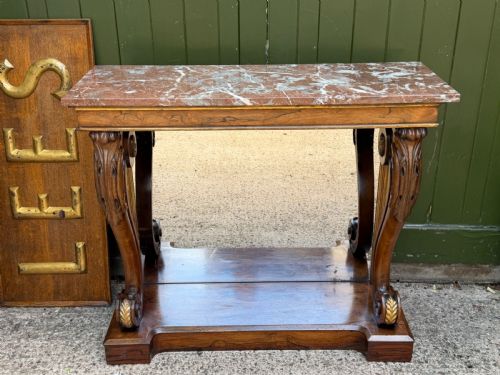
Heavy marble slabs in white carrara or variegated tones form the primary upper surface, resting directly upon the timber base to provide a stable, cool shelf. Integrated mirror glass, housed within carved or gilded wooden frames, completes the superstructure, reflecting the room and the objects displayed upon the stone top.
Dolphin pedestals carved into nineteenth-century Italian timber frames prove that furniture makers occasionally let sea creatures hold up the dinner party.
The Distinction in Execution
Quality in a mirror back console table rests upon the depth of timber selection and the crispness of carved or applied ornament. Superior examples display tightly figured flame mahogany or select rosewood veneers laid with precise symmetry across the frieze and base.
The integration of the mirror glass and its surrounding frame distinguishes workshop standards, with finer pieces maintaining original mercury or early silvered plates that show gentle age without losing their reflective depth. Heavy marble tops fitted flush to the timber carcass without awkward gaps indicate superior bespoke construction rather than hurried batch production.
Gillingtons of Dublin·Pauly et Cie·Donald Ross
The Mirror Back Console Table Glossary
- Console table
- A wall-mounted or heavily bracketed table designed to stand against a vertical surface rather than free in the room. These pieces often feature front legs only, relying on the wall for absolute stability.
- Mirror back
- An upright reflective glass panel attached to the rear of a furniture piece. It serves to amplify ambient light and visually expand the floor space of a reception room.
- Parcel-gilt
- Woodwork partially decorated with thin sheets of gold leaf applied to specific carved details or mouldings. This technique highlights structural lines against a dark timber background.
- Frieze
- The broad horizontal band situated directly beneath the top slab of the table. Cabinet makers frequently decorated this area with veneering, carving, or gilt mounts.
- Carrara marble
- A type of white or blue-grey stone quarried in Italy, prized for its smooth texture and subtle veining. It provides a durable and cooling surface for the tops of these tables.
Mirror Back Console Table: Frequently Asked Questions
Where should I place a mirror back console table?
These tables suit entrance halls, drawing rooms, or dining spaces where a strong architectural focal point is required against a flat wall.
Because the rear glass reflects ambient light, placing the table opposite a window or near a light source maximises its visual impact.
How do I care for the marble top?
Wipe the stone surface using a soft, damp cloth and avoid harsh acidic cleaners that can etch the polished finish.
Use coasters under glassware to prevent moisture rings from penetrating unsealed portions of the stone.
Are these tables completely freestanding?
Many console tables require attachment to the wall for safe support, particularly grander examples carrying heavy marble tops and tall mirror frames.
Check the base construction to see whether the piece relies on rear wall brackets alongside its front legs.
How do I distinguish Regency from Victorian examples?
Regency pieces generally favor restrained classical lines, architectural rosewood veneers, and understated brass or gilt accents inspired by antiquity.
Victorian iterations often display heavier carving, more exuberant scrollwork, and denser mahogany frames reflecting later nineteenth-century tastes.