






Regency Mirror Back Table
A regency mirror back table brings architectural symmetry and reflected light to a room through dark woods and mercury glass.
Regency Mirror Back Table
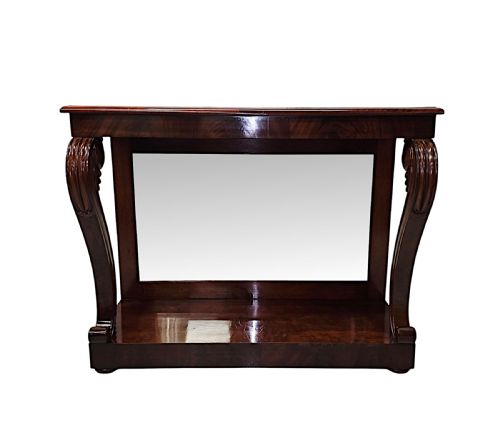
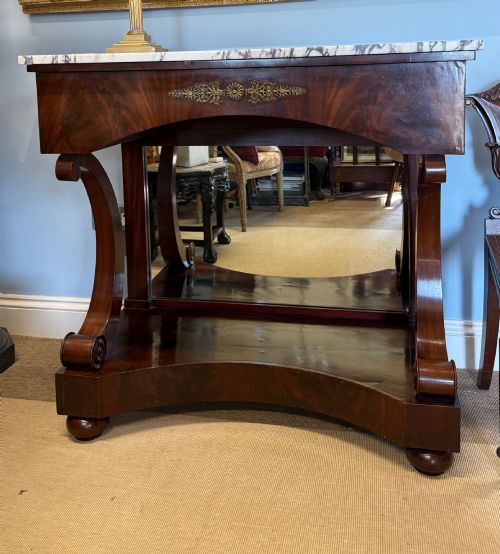
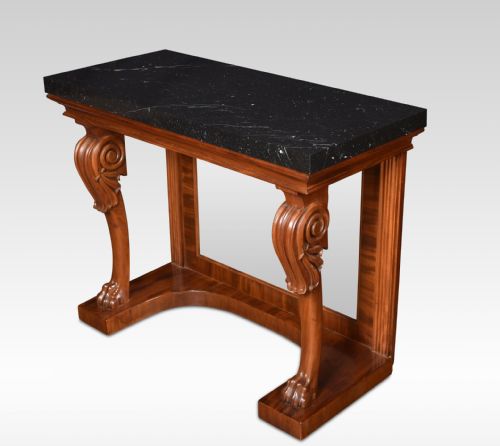
A regency mirror back table stands against the wall as a console, chiffonier or dressing mirror, pairing dense timbers with a fitted vertical glass plate behind the frame.
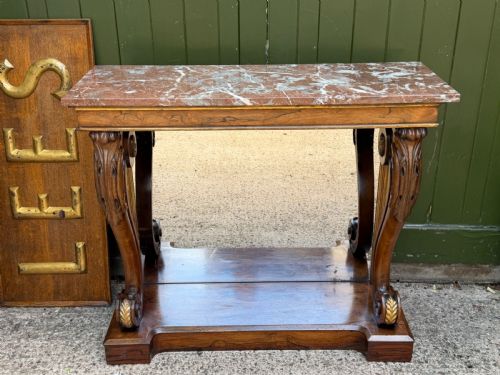
The form draws on Regency, William IV and Irish Regency design idioms from the nineteenth century, deploying marble tops and polished mahogany or rosewood surfaces.
Most examples encountered here belong to the nineteenth century, spanning standard console tables to grander pieces featuring giltwood carving or dolphin supports.
How they were made
Cabinet makers utilised dense tropical hardwoods, selecting figured mahogany, flame mahogany and rosewood veneers laid over sturdy secondary timbers to form the structural carcasses.
Heavy slabs of white or grey marble were cut to fit the upper surface precisely, whilst brass mounts, parcel-gilt details and carved giltwood elements added contrasting metallic sheen.
Silvered mirror glass was set securely into the rear panel behind the console frame, designed to catch and amplify the flickering light of candles and lamps.
What varies in quality
The sophistication of the timber selection dictates the visual appeal, separating simple dark boards from intensely figured flame mahogany and richly grained rosewood matched across the top.
Carving depth and the crispness of parcel-gilt or giltwood enrichment reveal the hand of a skilled workshop rather than a standard commercial production.
Originality of components matters profoundly, particularly the retention of the early mirror glass and the heavy marble slab fitted to the console base.
Gillingtons of Dublin
The Regency Mirror Back Table Glossary
- Console table
- A wall-mounted or pier table supported by front legs or brackets, designed to stand flat against a wall.
- Chiffonier
- A low cabinet or sideboard featuring shelving or enclosed storage beneath the main surface, often incorporating a mirror back.
- Parcel-gilt
- Woodwork or carving partially decorated with a thin layer of gold leaf to highlight specific decorative motifs.
- Flame mahogany
- A distinct timber veneer cut from the branch junction of the tree, producing a dramatic, fiery ripple pattern.
- Giltwood
- Timber carved and subsequently covered in gold leaf, frequently utilised for decorative mounts and console supports during the nineteenth century.
Regency Mirror Back Table: Frequently Asked Questions
Where should I place a regency mirror back table?
These tables suit hallways, living rooms and dining rooms where their wall-hugging proportions do not obstruct movement. The mirrored back panel serves to reflect natural daylight and brighten darker corners of the interior.
Ensure the wall can support the console securely, especially if the heavy marble top rests entirely upon the timber frame without auxiliary wall fixing.
How do I clean the marble top?
Wipe the surface gently with a soft, damp cloth using plain water or a mild, pH-neutral soap solution. Avoid acidic cleaners, vinegar or abrasive scouring pads that will etch and dull the polished stone.
Dry the marble thoroughly afterwards with a soft cloth to prevent water spots and maintain the smooth sheen of the nineteenth-century surface.
Are these tables sturdy enough for daily use?
Nineteenth-century console tables were built from heavy timbers like mahogany and rosewood, offering robust construction designed for holding decorative objects and lamps. The addition of a marble slab adds considerable downward weight to the base.
Avoid dragging the furniture across floors, as the combination of timber legs and heavy stone tops requires careful lifting to protect the joints.
How can I tell a Regency piece from a later copy?
Examine the construction methods, timber patination and the backboards for signs of age, tool marks and construction consistency. Nineteenth-century examples display hand-cut joinery and aged mirror glass with subtle foxing or imperfections.
Later revival pieces from the Victorian era or beyond often utilise machine-sawn timber elements and different finishing techniques that distinguish them from the original period.