

Mid Victorian Desk
A mid victorian desk brings solid timber, leather surfaces and steady proportions to a study, offering a practical workspace shaped by nineteenth-century craftsmanship.
Mid Victorian Desk
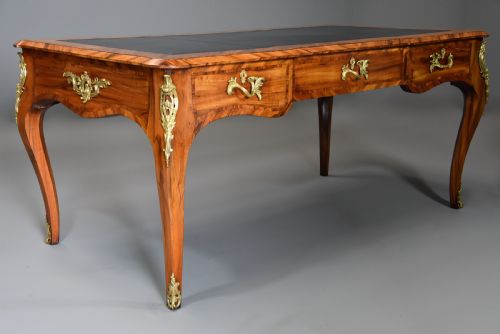
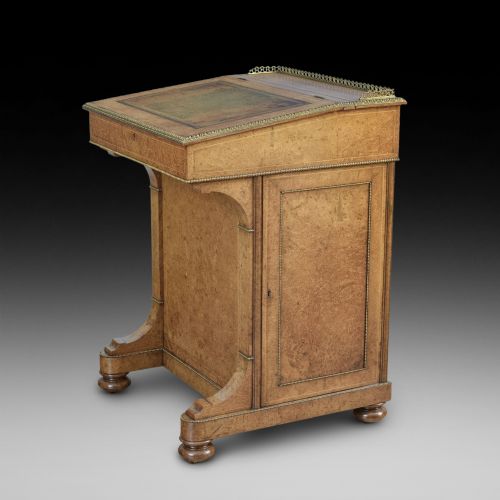
A search for a mid victorian desk brings up heavy timber writing furniture produced across the nineteenth century, most often taking the form of pedestal desks, kneehole desks, and compact writing tables. These pieces range from substantial partners desks designed for two users to smaller ladies writing desks and davenports fitted with sloping writing surfaces.
The examples recorded here display the robust pedestal format with banks of drawers flanking a central opening, alongside writing tables equipped with integrated leather inserts and folio stands. Cabinetmakers of the period also produced specialised forms such as piano front davenports and library tables intended for institutional and domestic studies.
Makers of the era drew on prevailing tastes, constructing pieces in straightforward vernacular timbers as well as highly decorative burr walnut and mahogany veneers. Many surviving items integrate practical compartments, small stationery drawers, and ceramic castors designed to facilitate movement across carpeted floors.
Materials and construction methods
Mid-nineteenth-century desks rely primarily on dense hardwoods such as mahogany, oak, and burr walnut, chosen for structural strength and attractive grain patterns. Workshops frequently incorporated secondary softwoods for internal drawer linings and carcass framing while applying figured veneers to exterior display surfaces.
Hardware played a functional and decorative role, utilising cast brass handles, escutcheons, and hinges that secured drawers and compartments. Leather inserts, often tooled with gilt borders, provided a durable writing surface across pedestal tops and slopefront davenports.
The archive records nineteenth-century writing furniture utilising brass mounts, ceramic castors, and tooled leather inserts.
Distinctions in construction and finish
Quality in these desks rests on the selection of timber veneers, where highly figured burr walnut or well-matched mahogany demonstrates superior cabinetmaking ambition compared to plain secondary woods. The depth of the polished finish and the crispness of carved details reveal the standard of workshop execution.
Internal joinery separates standard production from finer pieces, evident in hand-cut dovetail joints on drawers and the retention of original brass hardware and working locks. Desks retaining fitted satinwood interiors, original leather writing surfaces, and makers' stamps or paper labels achieve a higher level of historical completeness.
Mc Gary·J Spencer·Maples·Negretti and Zambra
The Mid Victorian Desk Glossary
- Pedestal desk
- A freestanding desk consisting of two independent pedestals containing drawers, united by a central writing surface and modesty panel.
- Partners desk
- A large pedestal desk designed to accommodate two users seated opposite one another, featuring matching drawer arrangements on both sides.
- Davenport
- A compact writing desk featuring a sloping lid above a set of side drawers, often incorporating internal stationery compartments.
- Kneehole desk
- A smaller writing desk featuring a recessed central space for the user's legs, flanked by single or multiple columns of drawers.
- Gilt tooled
- A decorative technique applying gold leaf impressions into leather or paper surfaces using heated brass tools.
Mid Victorian Desk: Frequently Asked Questions
What is a davenport desk?
A davenport is a compact nineteenth-century writing cabinet featuring a sloping desk lid that lifts to reveal a small interior storage space.
The main body houses a bank of drawers accessed from the side, often accompanied by small decorative galleries along the top surface.
Are leather desk tops original?
Many desks retain their original leather writing surfaces, though replacement leathers are common due to natural wear from daily writing use over the decades.
Original leathers often exhibit faded gilt tooling and craquelure, while newer replacements appear smooth and clean.
How do I care for a walnut desk?
Walnut surfaces require protection from direct sunlight and excessive heat sources to prevent the timber veneers from drying out and cracking.
Regular dusting with a dry cloth and occasional application of appropriate furniture wax helps preserve the polished finish.