
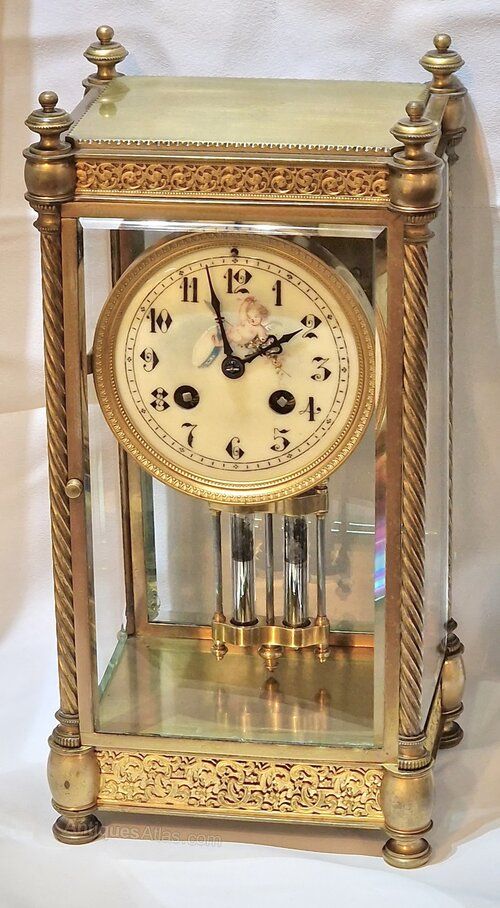
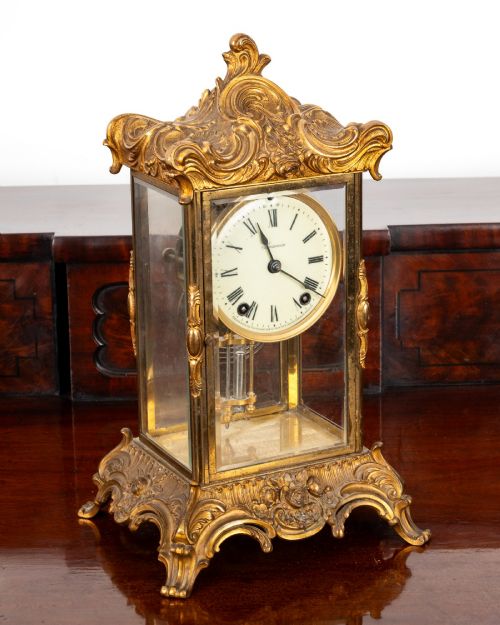
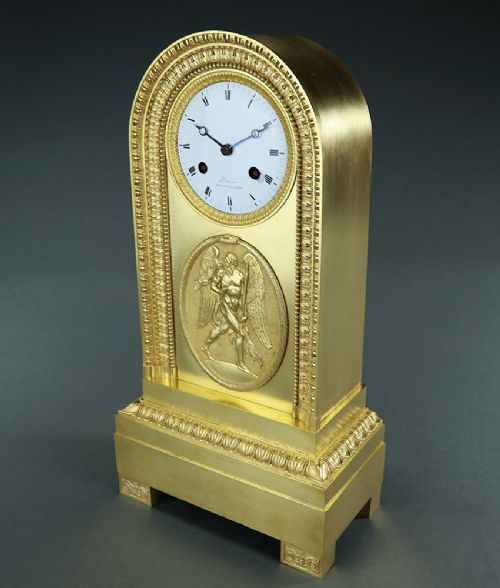


Mercury Pendulum Mantel Clock
These mercury pendulum mantel clocks combine crystal glass panels and gilt brass to regulate time with quiet precision.

Mercury Pendulum Mantel Clock
A mercury pendulum mantel clock sits on a shelf or bracket, framed by bevelled glass panels that reveal the movement within. The pieces seen most often are four glass mantel clocks and crystal regulators dating from the nineteenth century.
Makers from periods such as the Victorian era and the Belle Epoque constructed these timepieces in styles ranging from French Neoclassical and Rococo Revival to French Empire. Many examples originate from French workshops active in the 1880s and 1900s.
The housing typically takes an architectural or oval form, enclosing an enamel dial and a swinging pendulum filled with liquid metal. Alongside standard mantel clocks, variations include clock sets and library clocks with visible escapements.
Indicators of quality
The precision of the casting in the gilt bronze or ormolu mounts separates standard production from finer work, alongside the crispness of engraving on the brass frameworks. Maker attribution also plays a role, with established movement houses commanding attention.
The condition of the enamel dial and the clarity of the bevelled glass panels influence the overall appeal. Clocks retaining specialised movements, such as one-year duration mechanisms or bell striking trains, represent higher tiers of craftsmanship.
Mercury Pendulum Mantel Clock Retail Price Guide 2026
Typical asking prices for mercury pendulum mantel clock among the pieces listed under this phrase on Sellingantiques today, from the lower quarter to the upper quarter. They describe what is for sale here now, not the wider market.
Some nineteenth-century makers built these glass cases so clear that cats reportedly tried to swat the swinging mercury vials.
TIFFANY·SAMUEL MARTI·AD MOUGIN·L EPEE FRANCE
The Mercury Pendulum Mantel Clock Glossary
- Crystal regulator
- A mantel clock featuring glass panels on all sides that expose the mechanical movement. These pieces gained popularity during the late nineteenth century in France.
- Mercury pendulum
- A temperature-compensated pendulum utilising columns of liquid metal to counteract thermal expansion. This design ensures accurate timekeeping across varying room temperatures.
- Ormolu
- Gilt bronze created by applying a mercury and gold amalgam to a bronze base and heating it. The process leaves a durable, rich golden surface finish.
- Escapement
- The mechanism that converts rotational energy into impulsive pendulum swings. Visible versions allow the observer to watch the tick and motion directly.
- Garniture
- A set comprising a central clock flanked by matching decorative objects such as vases or candelabra. These matched assemblies were designed to sit together on a mantelpiece.
Mercury Pendulum Mantel Clock: Frequently Asked Questions
How do these mercury pendulums work?
The liquid metal inside the glass cylinders expands upwards when temperatures rise, keeping the centre of mass at a constant distance from the pivot point.
This physical property compensates for the thermal expansion of the pendulum rod itself, maintaining consistent timekeeping throughout seasonal shifts.
Where should I place a four glass clock?
These clocks require a stable, level surface such as a mantelpiece, sideboard, or sturdy bracket mounted directly to a wall. Avoid placing them in areas subject to heavy vibrations or direct sunlight.
Because glass panels enclose the entire movement, a secure location prevents accidental knocks that might damage the delicate framework.
How do I date a French crystal regulator?
Dating relies on examining the movement backplate for maker stamps, serial numbers, and exhibition medals awarded to the foundry. Stylistic cues such as dial design, brass colour, and case shape also point toward specific decades like the 1880s or 1900s.
French makers often marked their brass plates with specific foundry symbols that trace the production era accurately.
Are these clocks difficult to maintain?
Regular handling requires care due to the heavy bevelled glass panels and exposed mechanical components. Professional servicing every few years ensures the gear trains remain clean and properly lubricated.
Setting up requires patience to ensure the clock rests level and the pendulum beats in an even rhythm.