




Brocot Escapement Mantel Clock
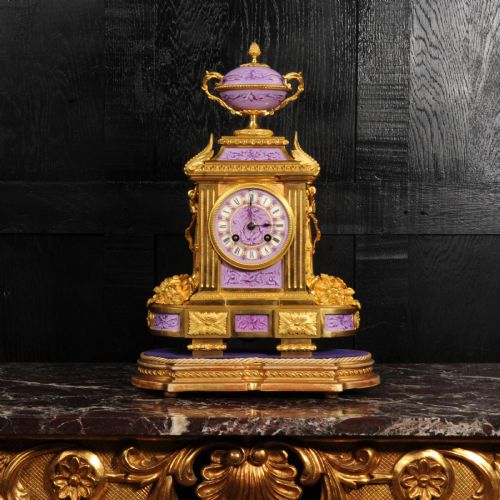
These brocot escapement mantel clock pieces combine precision mechanical engineering with striking nineteenth-century decorative forms.
Brocot Escapement Mantel Clock
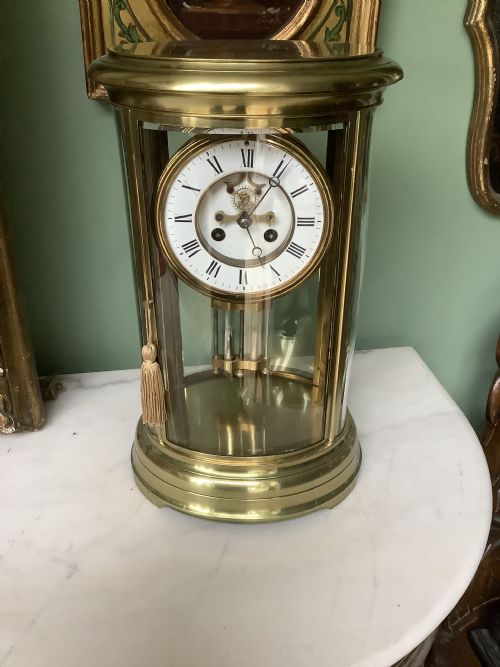
These clocks range from substantial slate and marble architectural cases to delicate gilt brass and four-glass mantel timepieces. Many incorporate visible mechanical complications, such as perpetual calendars, ships wheel pendulums, or Sèvres porcelain panels.
Originating largely from French workshops during the nineteenth century, these pieces reflect the decorative tastes of the Second Empire and Third Republic periods. They serve as both accurate timekeepers and central decorative ornaments for a mantelpiece.
Materials and construction
Makers utilised a combination of heavy structural minerals and cast metals, frequently pairing black slate and marble with gilt brass, ormolu, and gilt bronze. These dense materials provide the stable housing necessary to support precision brass clock movements.
The characteristic four-glass models employ bevelled glass panels held within brass frames to display the internal pendulum and gear trains from all sides. Dial faces are commonly constructed from white enamel with painted numerals, often paired with visible Brocot regulating assemblies.
Quality variations
The division between standard production and exceptional quality lies in the complexity of the movement and the finish of the case. Clocks featuring additional complications such as perpetual calendars or equation of time displays command greater technical respect than basic timepieces.
Case materials also dictate distinction, where finely chased ormolu and heavy architectural marble demonstrate superior craftsmanship compared to simpler slate boxes. Furthermore, the presence of signed dials or specific maker attributions elevates the standing of an individual piece.
Achille Brocot·Brocot
The Brocot Escapement Mantel Clock Glossary
- Brocot escapement
- A visible pin-pallet escapement invented by Louis-Gabriel Brocot that allows regulation of the pendulum directly from the dial face. This mechanism is characteristic of many fine nineteenth-century French clocks.
- Four-glass clock
- A mantel clock housed in a brass frame with four bevelled glass panels. This design exposes the movement and mercury or gridiron pendulum to view from every angle.
- Ormolu
- Gilt bronze created by applying a finely ground high-carat gold mercury amalgam to a bronze object. The technique produces a rich golden finish seen on high-end French decorative cases.
- Slate
- A fine-grained metamorphic rock used extensively for Victorian mantel clock cases. It is often polished to a deep black finish and combined with contrasting marble inlays.
- Second Empire
- A French artistic and architectural style spanning the mid-to-late nineteenth century. Clocks from this period often display eclectic, ornate revivalist details.
Brocot Escapement Mantel Clock: Frequently Asked Questions
How do I wind a brocot escapement mantel clock?
Wind the clock using the appropriate key inserted into the winding arbors on the enamel dial face. Take care not to over-wind the mainsprings, stopping as soon as resistance is felt.
Ensure that you turn the key in the correct direction designated for each specific train, whether for timekeeping or striking. Regular, careful winding preserves the tension of the original springs.
How does the Brocot regulation work?
The regulation square is positioned on the dial, usually just above the twelve o'clock numeral. Turning this square with a small key adjusts the suspension spring directly, raising or lowering the pendulum slightly to alter the speed.
This system allows fine-tuning of the timekeeping without needing to open the back case or access the pendulum itself. Small adjustments made over twenty-four hours help achieve optimal accuracy.
Where should I place my mantel clock?
Position the clock on a stable, level surface such as a mantelpiece, sideboard, or heavy table. A level foundation is essential to ensure the pendulum swings evenly and the escapement ticks with a regular beat.
Avoid placing the clock in areas subject to excessive vibrations, direct sunlight, or severe temperature fluctuations. Stable indoor conditions protect both the metal movement and the glass panels.
How do I date a French slate clock?
Examine the style of the case, the materials used for inlay, and the typography on the enamel dial. Architectural slate and marble designs became particularly popular during the Victorian period and the French Second Empire.
Signatures on the movement backplate or dial can also provide specific maker details or registration dates. Comparing the escapement type and casting quality helps narrow down the production era to the mid-to-late nineteenth century.