
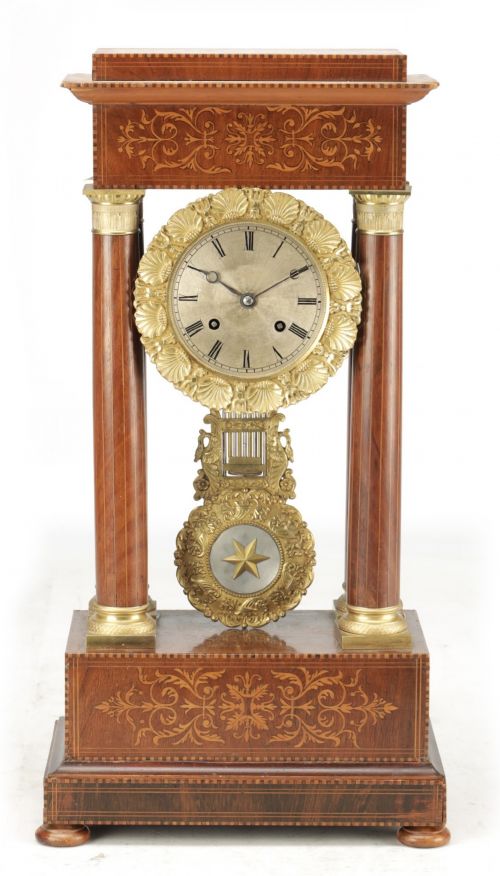
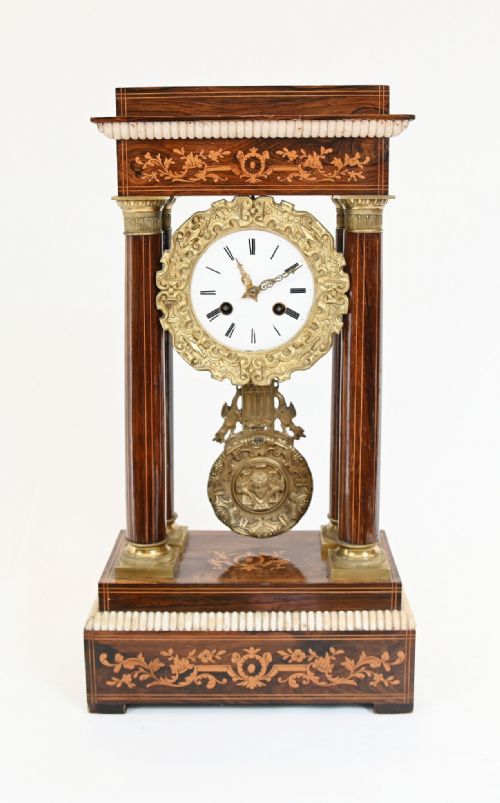
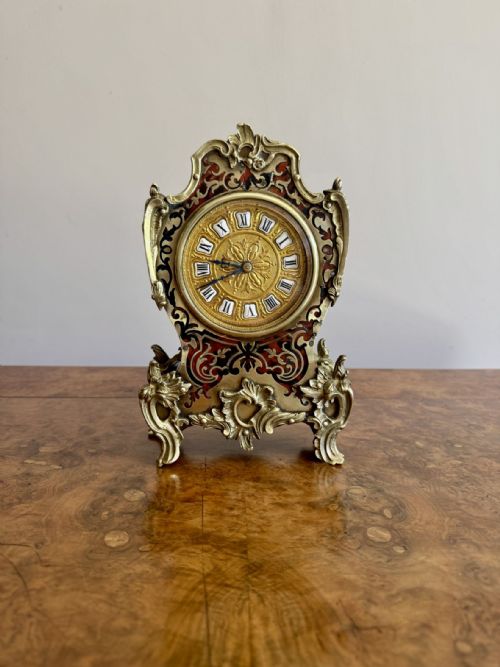


Marquetry Mantle Clock
A marquetry mantle clock brings intricate wood inlay and reliable timekeeping to a room, ranging from Edwardian mahogany to French Boulle designs.
Marquetry Mantle Clock
A marquetry mantle clock is a decorative timekeeper designed to sit on a mantelpiece, shelf, or bracket, distinguished by patterned wood veneers or tortoiseshell and brass inlay. These pieces serve both a practical timekeeping function and act as ornamental focal points for a room.
The selections available span several distinct periods, most frequently appearing in Edwardian and Victorian iterations, alongside earlier 18th century and Regency examples. Forms vary from traditional arched and dome top cases to balloon shaped bodies and architectural portico designs.
Origin is primarily divided between British domestic production, often utilising mahogany, oak, or rosewood with delicate floral or fan inlay, and continental French workshops producing elaborate Boulle work or Louis XV revival styles. Buyers encounter both simple eight day timepieces and chiming movements.
How they were made
Cases were constructed from foundational timbers such as mahogany, oak, rosewood, or ebonised wood, onto which decorative veneers were meticulously applied. Artisans then cut intricate patterns using contrasting woods, brass, or tortoiseshell to create the characteristic surface decoration.
Movements were typically housed within brass and glass bezels, often featuring white enamel dials with Roman or Arabic numerals. Gilt bronze mounts, known as ormolu, were frequently added to French and revival pieces to accent the corners, feet, and bezels of the clock.
Materials span brass, enamel, glass, mahogany, ormolu, rosewood, tortoiseshell, and ebonised wood across Victorian, Edwardian, and earlier 19th century periods.
What varies in quality
Quality is dictated by the precision of the veneer work and the complexity of the materials used in the case construction. Clocks featuring fine tortoiseshell and brass inlay or detailed pictorial wood marquetry represent a higher standard of craftsmanship than simpler banded or plain inlaid examples.
Thomas A Paris·Seikosha Seiko·Tiffany
The Marquetry Mantle Clock Glossary
- Marquetry
- The art of applying decorative veneer pieces to a structure to form intricate designs. This technique utilises various woods and metals to create pictorial surfaces.
- Ormolu
- Gilt bronze mounts used to decorate furniture and clock cases. These cast metal ornaments provide metallic contrast to the timber surface.
- Portico clock
- An architectural clock design supported by columns. These classical French pieces often feature central pendulums swinging within the frame.
- Balloon clock
- A mantel clock featuring a rounded, swelling case shape reminiscent of a hot air balloon. This silhouette is common in Edwardian designs.
Marquetry Mantle Clock: Frequently Asked Questions
How do I wind my mantle clock?
Most mechanical models utilise a key inserted into the dial to tension the spring within the movement. Care must be taken not to overwind the mainspring.
Eighty day movements require attention weekly, while simpler timepieces may have different winding intervals depending on the specific gear train.
Where should I place a marquetry clock?
These clocks are designed for stable horizontal surfaces such as mantelpieces, shelves, or dedicated wall brackets. Positioning them away from direct heat sources and damp environments protects the wood veneer.
A level surface ensures the pendulum swings evenly and the movement keeps accurate time.
What is the difference between French and Edwardian styles?
French examples from the 19th century often feature ornate Boulle work, tortoiseshell, and cast ormolu mounts inspired by earlier revival periods. They tend to have highly decorative, architectural, or serpentine cases.
Edwardian pieces generally favour British timbers like mahogany or oak, accented with subtle fan marquetry and simpler geometric or balloon shapes.
How do I care for wood inlay?
Maintenance involves dusting with a soft, dry cloth and avoiding harsh chemical polishes that can lift delicate veneers. Keeping the clock away from direct sunlight prevents the inlaid woods from fading.
Occasional waxing with appropriate furniture care helps preserve the sheen of the rosewood or mahogany.