
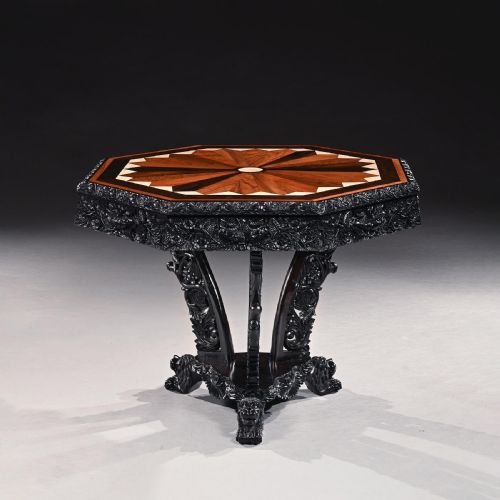
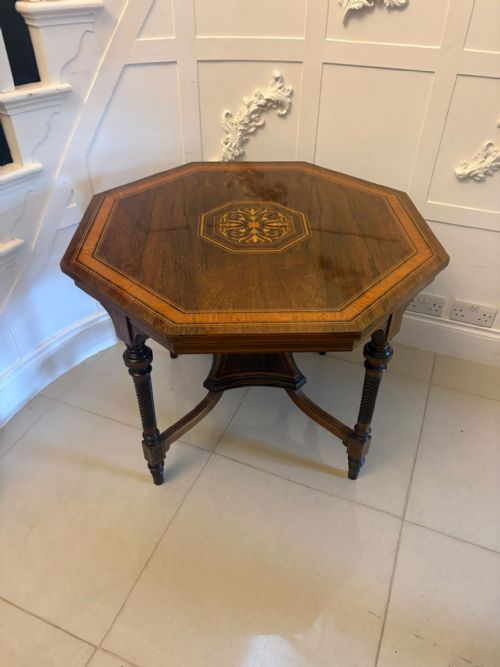
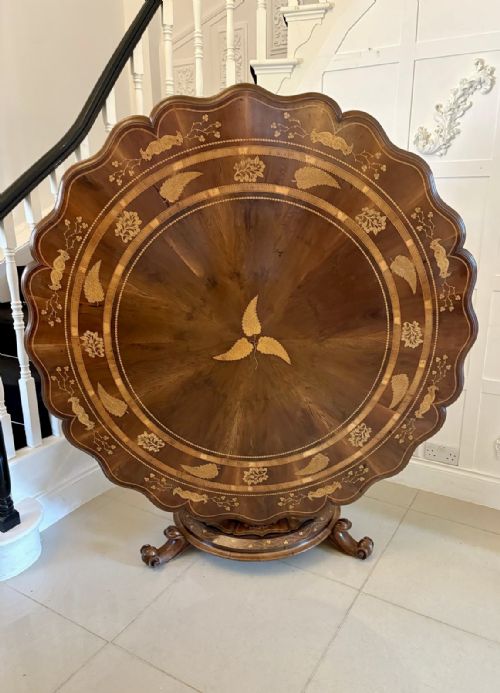


Marquetry Foyer Table
A marquetry foyer table brings intricate wood inlay and presence to an entrance hall, offering surface space and distinct period character.
Marquetry Foyer Table
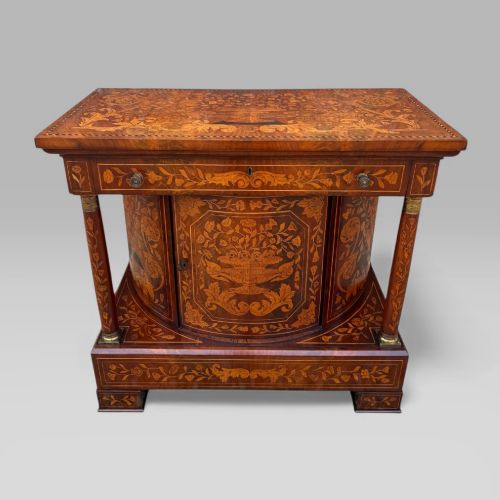
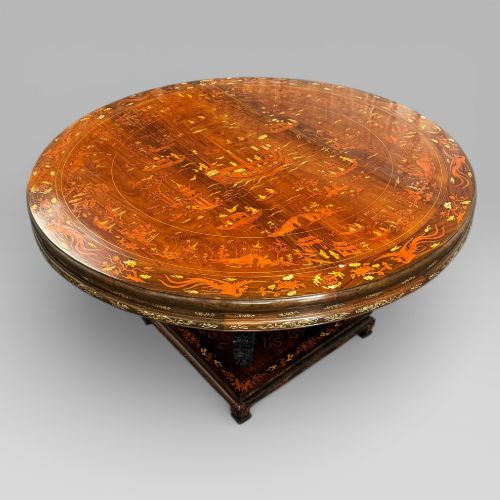
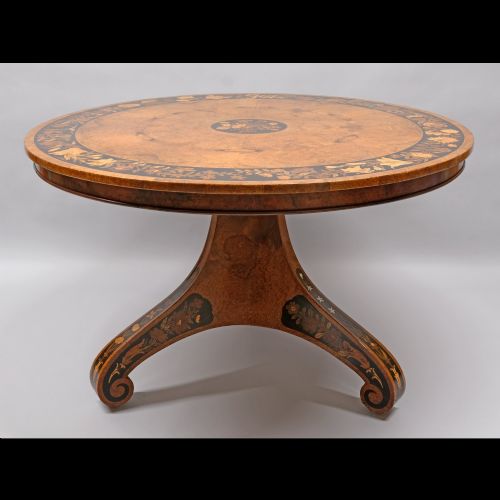
A marquetry foyer table functions as a decorative and functional centrepiece for an entrance hall, taking the form of round, oval, octagonal, or console tables.
The selections span the nineteenth century into the early twentieth century, encompassing Victorian, Edwardian, Regency, and Art Deco periods alongside regional styles such as Dutch Baroque, Anglo-Indian Colonial, and Sheraton Revival.
Buyers most commonly encounter walnut, rosewood, and mahogany examples inlaid with contrasting woods, serving as focal points upon entry into a home.
How they were made
Craftsmen built these tables using robust timber foundations of walnut, mahogany, rosewood, burr walnut, or satinwood, often enhanced by elaborate marquetry inlay and parquetry.
Details incorporate boxwood, brass, or gilt bronze mounts, alongside marble tops on specific French and Italian pieces.
Workshops utilised specialised cutting techniques to fit diverse veneers into pictorial or geometric surface patterns.
Marquetry Foyer Table Retail Price Guide 2026
Typical asking prices for marquetry foyer table among the pieces listed under this phrase on Sellingantiques today, from the lower quarter to the upper quarter. They describe what is for sale here now, not the wider market.
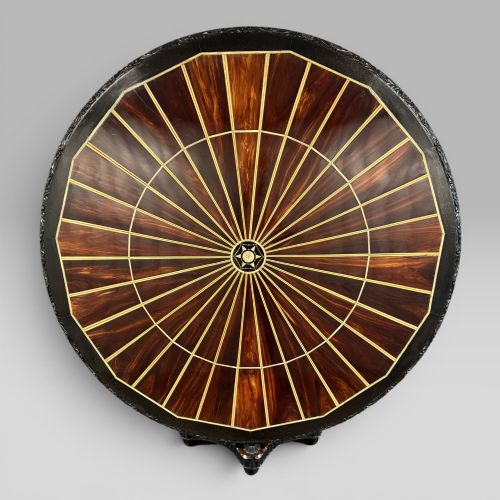
Several tables hail from the Galle District in Ceylonese workshops, proving that nineteenth-century interior style travelled quite far for a nice bit of ebony.
What varies in quality
Quality rests upon the precision of the veneer work and the choice of primary and secondary timbers, where burr walnut, satinwood, and amboyna command greater visual depth.
Execution of the carved elements, ormolu mounts, and structural stability separate standard production from exhibition pieces associated with notable makers.
The integrity of the timber ground and the complexity of the inlaid motifs determine the overall distinction of a piece.
Edwards & Roberts·Holmes Baldock·Egan Workshop·Holland & Sons·James Winter
The Marquetry Foyer Table Glossary
- Marquetry inlay
- Decorative patterns formed by fitting contrasting veneers into a prepared wooden ground. This technique creates pictorial designs across table tops.
- Centre table
- A freestanding table designed to be viewed from all sides rather than pushed against a wall. These occupy the middle of an entrance hall or principal room.
- Satinwood
- A pale, lustrous timber native to India and Ceylon, frequently used in Sheraton Revival and Edwardian pieces for bright contrasting surfaces.
- Ormolu
- Gilded bronze used for decorative mounts and feet on nineteenth-century French furniture. It adds metallic contrast to dark woods like rosewood and mahogany.
- Demilune
- Half-moon shaped furniture designed to stand flush against a wall. Demilune tables serve well in narrow hallways and foyers.
Marquetry Foyer Table: Frequently Asked Questions
Where should a foyer table go?
These tables are placed centrally in large entrance halls or positioned flat against a wall if the form is a console or demilune. They provide a surface for lighting, flowers, or incoming post.
Freestanding centre tables require adequate clearance around all sides to allow proper movement and visibility of the inlaid top.
How do I identify Victorian marquetry?
Victorian examples frequently employ walnut, burr walnut, or rosewood as a dark ground for floral or geometric boxwood and satinwood inlay. Construction methods from this era often include solid mahogany or oak secondary framing beneath the veneers.
Looking underneath reveals the age of the timber and the hand-cut joinery characteristic of nineteenth-century workshop production.
What is the difference between marquetry and parquetry?
Marquetry involves arranging various veneers to create pictorial or curvilinear designs such as flowers, scrolls, and landscapes. Parquetry constructs geometric or repeating patterns like chessboards and cubes using angular pieces of wood.
Both techniques appear on table tops across the Victorian and Regency periods.
How do I care for antique wood tables?
Keep wooden furniture away from direct heat sources and strong sunlight to prevent the veneers from drying, lifting, or fading. Dust regularly with a dry cloth and apply appropriate wax sparingly to maintain the polish.
Avoid placing damp items directly onto polished surfaces to protect the historic finish.