
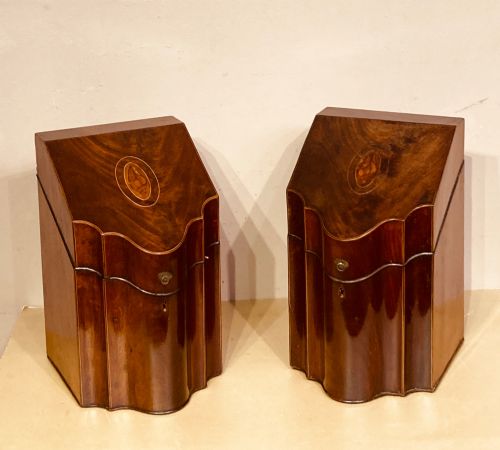


Marquetry Cutlery Box
A marquetry cutlery box is a finely figured receptacle designed to keep silver safe, bringing period craftsmanship straight to the sideboard.
Marquetry Cutlery Box
When you search for a marquetry cutlery box, you are looking at specialised containers designed to hold flatware, appearing in formats like knife boxes, hanging boxes, stationery boxes, and desk accessories. The examples you are most likely to meet on this page hail from the eighteenth century, the Georgian era, and the nineteenth century.
These pieces primarily take the form of knife boxes, alongside occasional hanging boxes and letter holders. They trace their origins through Georgian, George III, and nineteenth-century country styles, reflecting the domestic habits of earlier centuries.
The selection ranges from pairs of mahogany knife boxes to individual walnut canteens with fitted interiors. Such items served dining rooms well before fitted sideboards became common, keeping sharp blades away from damp air.
How they were made
Maker's workshops built these boxes using solid and veneered timbers, predominantly employing mahogany, walnut, and oak. Cabinetmakers added contrasting details in boxwood and satinwood to create decorative wood inlay patterns across the surfaces.
Many examples incorporate fitted interiors designed specifically for cutlery, alongside durable brass hinges, escutcheons, and carrying handles. The skilful application of inlaid wood transforms plain timber carcases into highly decorative storage objects.
What varies in quality
Quality rests heavily on the crispness of the wood inlay and the choice of timbers like figured mahogany or walnut. Boxes that retain their original brass hardware and fitted internal compartments stand apart from those altered or stripped later.
The sophistication of the joinery and the precision of the sloping lids dictate the overall standard. Finer specimens display balanced proportions and careful timber selection that survive centuries of handling.
The Marquetry Cutlery Box Glossary
- Marquetry
- Decorative veneer work arranged in patterns using various coloured woods. It transforms plain surfaces into pictorial or geometric designs.
- Canteen
- A fitted case or chest designed to hold a set of cutlery. These interiors keep individual blades and spoons secure.
- Escutcheon
- A flat plate surrounding a keyhole, often made from brass. It protects the surrounding wood from wear caused by the key.
- Satinwood
- A durable, lustrous timber from tropical trees, utilised for bright contrasting inlay. It brings a golden glow to eighteenth-century box lids.
- Boxwood
- A dense, pale yellow wood favoured for fine stringing and inlay details. Cabinetmakers used it to outline panels and geometric motifs.
Marquetry Cutlery Box: Frequently Asked Questions
What were knife boxes used for?
These boxes stored dining knives and forks upright on side tables during the eighteenth and nineteenth centuries.
Servants retrieved the cutlery when setting formal dining tables for meals.
How do I date a Georgian box?
Examine the timber species, construction methods inside the lid, and the style of the brass hardware.
Georgian pieces often feature mahogany carcases with hand-cut dovetails and subtle wood inlay.
Are these boxes still suitable for cutlery?
Many retain fitted internal dividers that accommodate modern or antique flatware safely.
Collectors frequently repurpose them to hold letters, stationery, or trinkets instead of knives.
What is the difference between George III and country styles?
George III pieces display refined proportions, sophisticated veneer work, and polished brass mounts.
Nineteenth-century country versions utilise sturdier timbers like oak with simpler construction.