

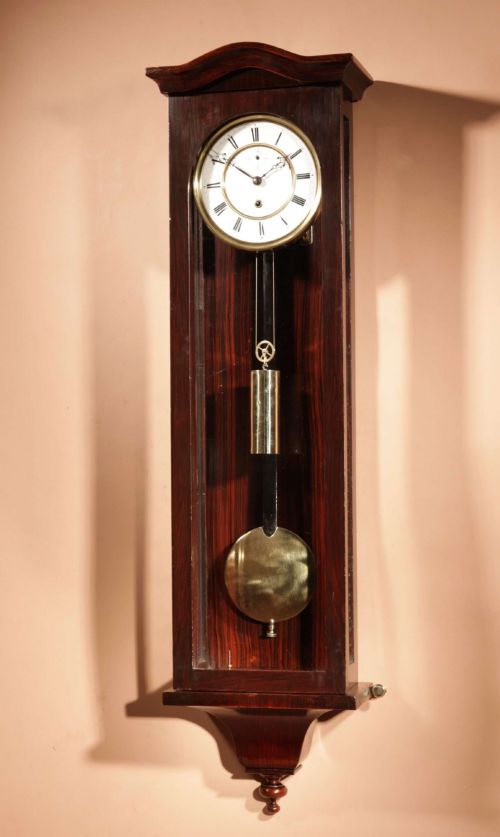

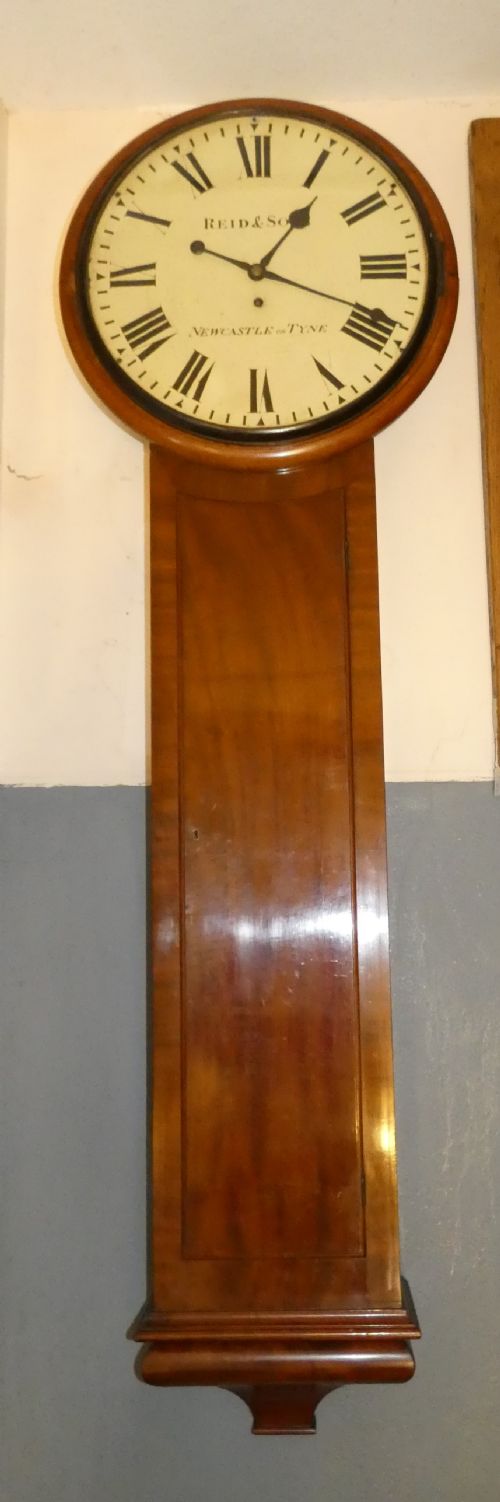


Mahogany Regulator Wall Clock
These mahogany regulator wall clocks are precision timepieces designed to hang in prominent rooms, offering a blend of fine cabinet-making and accurate mechanical movement.
Mahogany Regulator Wall Clock
A mahogany regulator wall clock represents a specialised group of accurate timekeepers, designed primarily for precision rather than simple domestic use. When you search for a mahogany regulator wall clock, you encounter variations spanning the Georgian, Regency, Victorian, and Edwardian periods.
The pieces listed on this page include examples from English makers such as John Walker, alongside continental interpretations from Vienna, France, and the Black Forest. Forms range from double fusee cases and drop dials to twin-weight Vienna wall clocks.
You are most likely to meet mid-to-late nineteenth-century examples influenced by the Vienna style, housed in rich timber cases with glass viewing panels. These clocks combine utilitarian precision with the decorative presence characteristic of their respective eras.
How they were made
Makers utilised dense mahogany and walnut for the construction of the wall cases, ensuring the timber remained stable to house the heavy precision movements securely. Glass panels were fitted into the doors to protect the delicate enamel or porcelain dials while allowing a clear view of the swinging pendulum.
The mechanical interiors incorporated brass components and pinwheel escapements, driven by twin weights or double fusee systems designed to maintain uniform tension. Dial faces typically featured white enamel or porcelain with bold numerals, paired with finely shaped hands for accurate reading.
Mahogany Regulator Wall Clock Retail Price Guide 2026
Typical asking prices for mahogany regulator wall clock among the pieces listed under this phrase on Sellingantiques today, from the lower quarter to the upper quarter. They describe what is for sale here now, not the wider market.
Some of these clocks ticked away in French and Austrian parlours before finding their way onto modern walls.
What varies in quality
Quality in these clocks rests heavily on the sophistication of the movement and the fidelity of the cabinet-making. Pieces featuring complex mechanisms like twin weights or pinwheel escapements stand apart from simpler hanging clocks.
The choice of timber and the crispness of the case moulding also dictate the tier of the piece. Richly figured mahogany and well-proportioned architectural or drop dial cases separate standard domestic examples from workshop creations by established makers.
John Walker·Gustav Becker·Valiant Paris
The Mahogany Regulator Wall Clock Glossary
- Regulator wall clock
- A precision timekeeper designed to mount on a wall, built for exceptional accuracy with a clean dial layout. These clocks were often used as time standards in offices and substantial homes.
- Double fusee
- A mechanical system using a cone and chain or cord to equalise the pull of the mainspring as it unwinds. This ensures consistent power delivery to the gear train for better timekeeping.
- Pinwheel escapement
- A specialised clock escapement featuring pins on the escape wheel instead of traditional teeth. It reduces friction and allows for a more precise transfer of impulse to the pendulum.
- Drop dial
- A clock case design where the dial sits above an extended wooden box that houses the hanging pendulum. This form became popular in English hallways and public rooms during the nineteenth century.
- Vienna regulator
- A style of weight-driven wall clock originating in Austria, known for its refined case design and visible pendulum. These pieces prioritise accuracy and slender vertical proportions.
Mahogany Regulator Wall Clock: Frequently Asked Questions
Where should I hang a wall clock?
Choose a sturdy interior wall away from direct sunlight, dampness, and heavy vibrations to protect the mechanical movement.
Ensure the wall is strong enough to support the weight of the timber case and hanging mechanism securely.
How do weight-driven clocks operate?
Weight-driven movements rely on suspended metal weights that descend slowly as gravity pulls them downward, turning the internal gears.
When the weights reach the bottom of the case, they are manually wound back up using a key or crank.
How do I date a clock case?
Examine the timber species, construction methods, and stylistic cues such as mouldings, brass fittings, and dial materials. Comparing these details against known period styles helps narrow the decade of origin.
Signatures or inscriptions on the dial or movement backplate also provide direct historical markers.
What is a fusee movement?
A fusee movement uses a conical pulley connected to the mainspring by a cord or chain to regulate power delivery. As the spring loses tension, the leverage shifts to compensate.
This clever mechanical design prevents the clock from losing speed as it runs down between windings.