
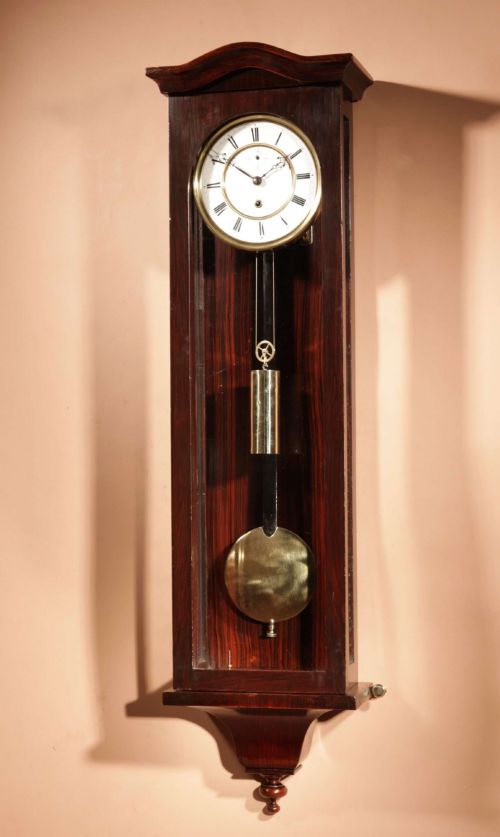


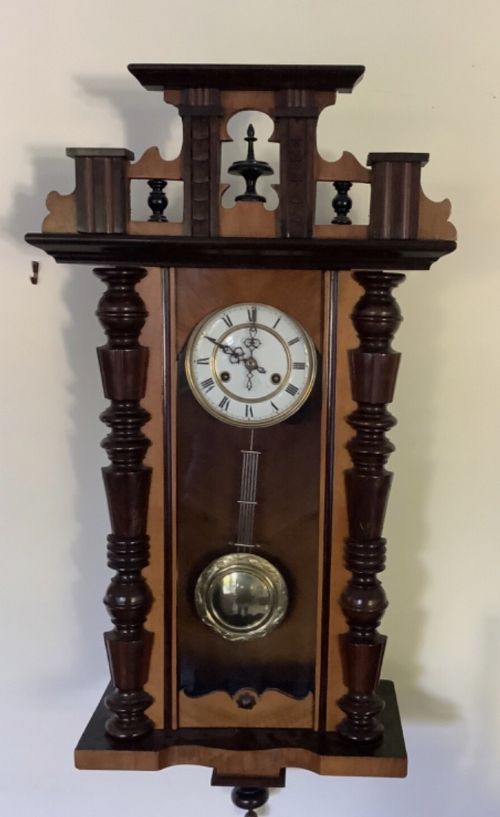


Enamel Dial Wall Clock
These enamel dial wall clock pieces are timekeepers of brass, glass, and rich timber that anchor a room with steady mechanical presence.
Understanding enamel dial wall clock examples
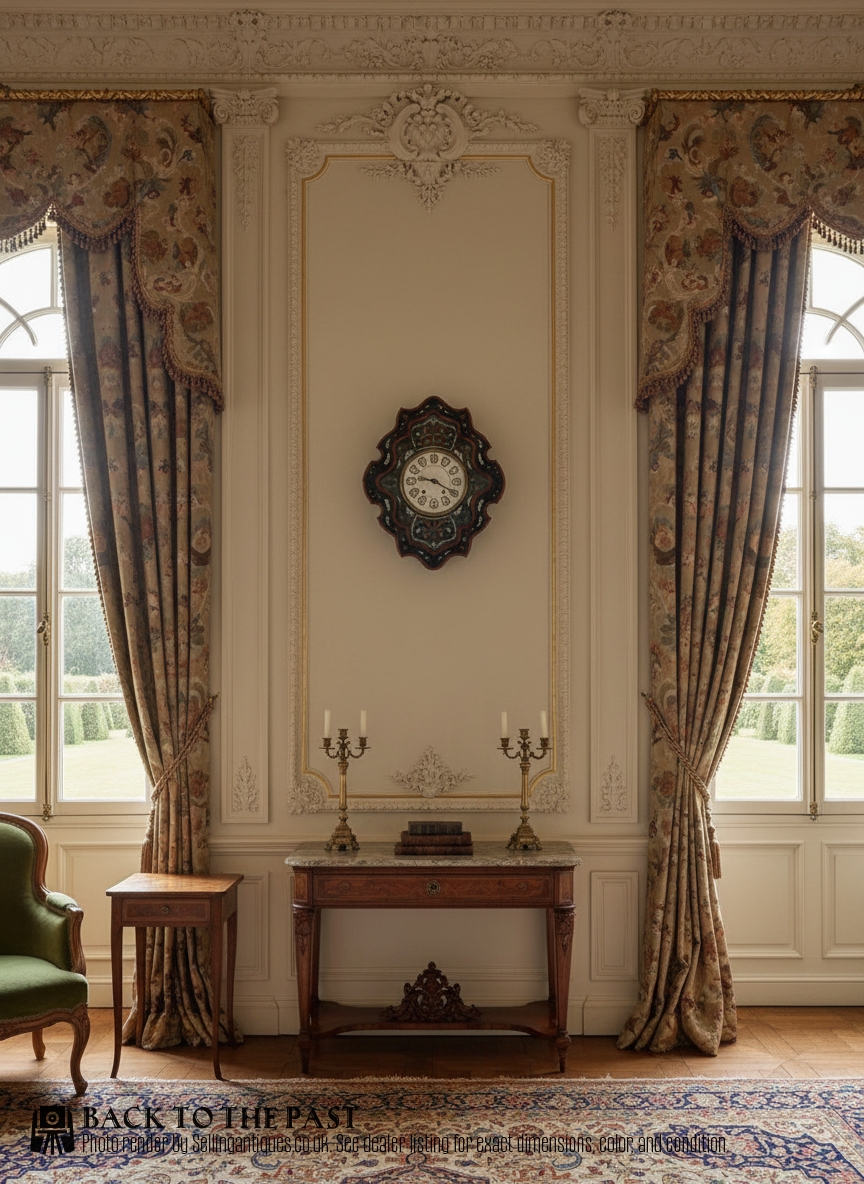
An enamel dial wall clock brings together domestic utility and decorative restraint across several distinct regional traditions. You encounter Vienna regulators, French Napoleon III designs, and Victorian pieces that span from the mid nineteenth century into the turn of the twentieth.
The most frequent form on this page is the regulator or picture frame style, housed in ebonised wood, mahogany, or walnut. These movements rely on pendulums and range from miniature formats up to substantial German and Austrian wall clocks.
Construction and materials
Casework relies on timber such as mahogany, walnut, and ebonised wood, shaped to house brass movements and glass viewing panels. Enamel provides a crisp, durable surface for the numerals, often protected behind a glazed bezel.
Makers integrated brass gears and pendulums within the timber frames, sometimes incorporating mother of pearl details to catch the light. The combination of heavy glass, polished brass, and dense wood creates a robust domestic object.
Retail Price Guide 2026
Typical UK retail prices for enamel dial wall clock, calculated from the Sellingantiques database of over a million retail prices indexed since 2003. This retail price guide relies exclusively on Sellingantiques data; no external sources or auction records are used, so the figures do not describe the wider market.
The listings span from the nineteenth century into 1900, incorporating brass, glass, enamel, ebonised wood, mahogany, walnut, and mother of pearl.
Judging quality and character
Superior examples show refined timber selection and precise execution in the enamel dial and brass movement. Finer Vienna regulators and Victorian French pieces exhibit careful balance between the case joinery and the mechanical works.
Quality rests in the harmony of the materials, where the weight of the mahogany or walnut case complements the clarity of the enamel face. Lesser examples lack the crispness in the dial lettering and the considered proportion in the wood framing.
William Evill
The Enamel Dial Wall Clock Glossary
- Enamel dial
- A metal face fused with powdered glass to create a smooth, white background for painted numerals. This surface resists tarnishing over decades.
- Vienna Regulator
- A precise weight or spring driven wall clock originating in Austria, known for clean lines and visible pendulums. These pieces prioritise exact timekeeping.
- Ebonised wood
- Timber treated to resemble ebony through staining and polishing, providing a deep black finish. It offers a strong contrast against brass and white enamel.
- Two train
- A mechanical movement featuring two separate gear trains, one to drive the time and another for the strike. This configuration requires a key for winding.
Frequently Asked Questions
How do I wind an enamel dial wall clock?
Wind the clock using the appropriate key inserted into the winding holes on the enamel face. Turn gently until resistance is felt, taking care not to overwind the mainspring.
Ensure the pendulum is hanging straight and the beat is even before leaving the clock to run. Modern handling requires steady patience to maintain the historic brass mechanism inside.
Where should I hang a wall clock?
Choose a sturdy interior wall away from direct sunlight, dampness, and heavy vibrations. Masonry walls provide the most stable support for heavier timber cases.
Ensure the clock hangs completely plumb so the pendulum swings freely without catching the case sides. Proper placement keeps the movement running reliably.
What woods were used for the cases?
Makers utilised mahogany, walnut, and ebonised wood to build the structural housings. These dense timbers protected the delicate brass movements from dust and damage.
The choice of wood often reflects the period and regional style, ranging from dark Victorian finishes to the warmer grain of mid nineteenth century examples.
How do I identify a Vienna regulator?
Vienna regulators feature long glazed doors, visible pendulums, and prominent enamel dials set within architectural timber frames. Their design focuses on mechanical clarity and accurate timekeeping.
These pieces typically date from the nineteenth century and reflect the high standards of Austrian and German clockmaking traditions.