
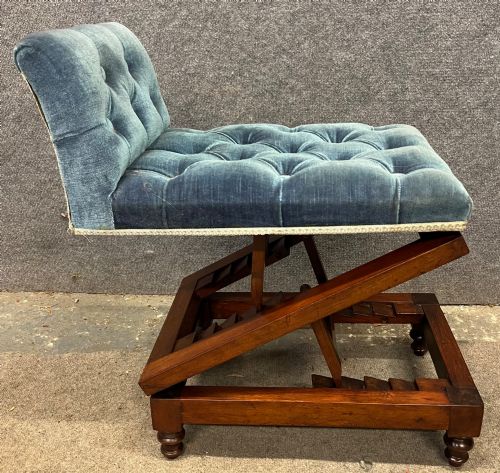
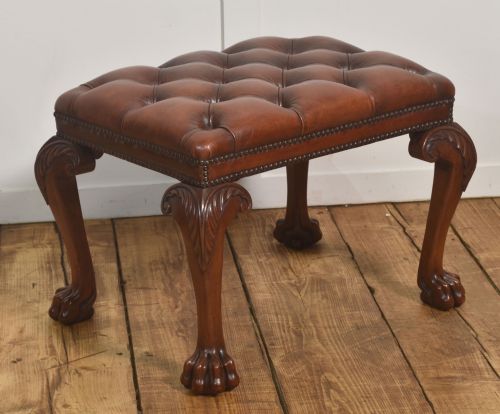
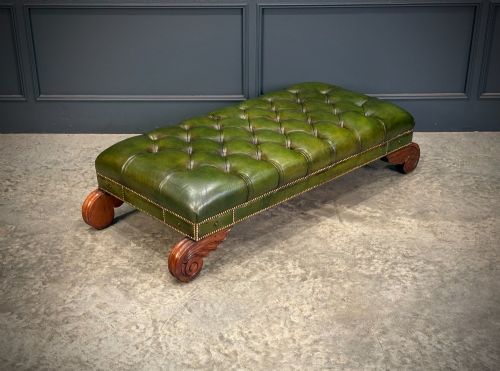
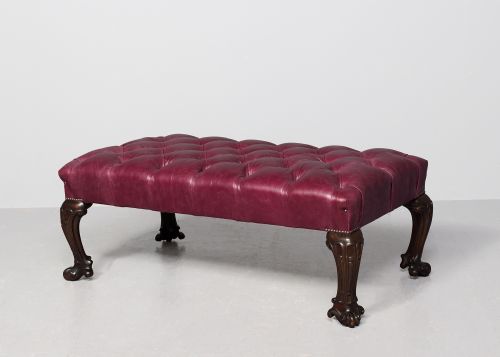




Mahogany Buttoned Footstool
A mahogany buttoned footstool brings traditional seating and rich timber frames together, offering a practical touch of historical comfort for a room.
Mahogany Buttoned Footstool
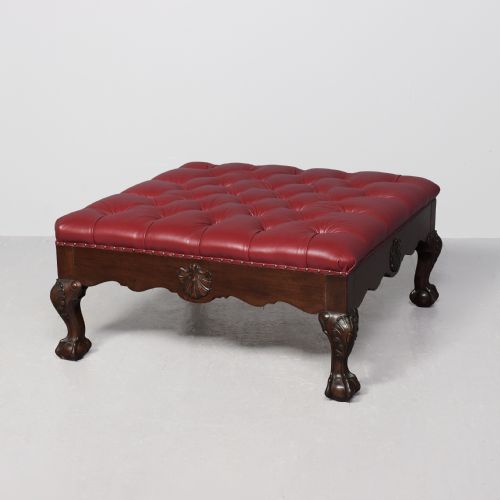
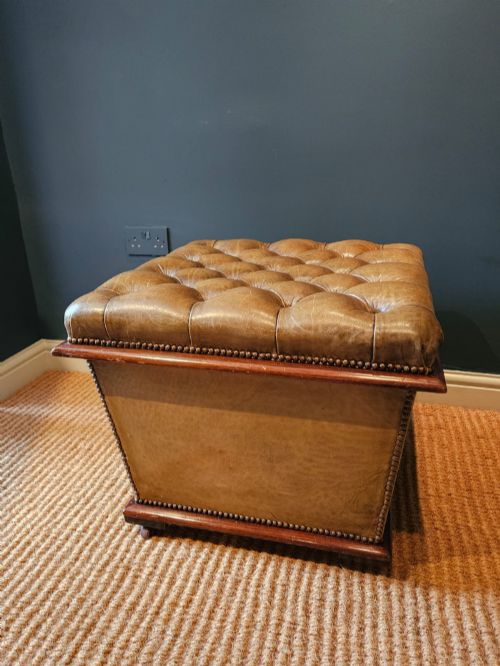
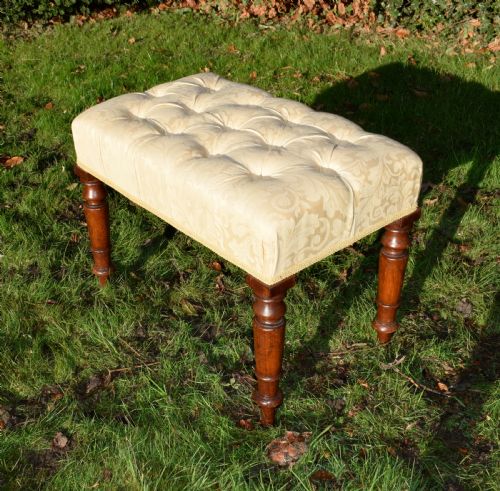
A mahogany buttoned footstool is a low seat designed to support feet or serve as a low centre stool, appearing across Victorian, Regency, and Georgian-style periods. These pieces combine a solid wood framework with padded upholstery secured by deep buttoning and occasional brass studding.
The versions most commonly met on this page span the nineteenth century and later revivals, featuring sturdy mahogany structures paired with leather, hide, velvet, or damask coverings. Forms range from compact square stools to long ottomans fitted with castors or cabriole legs.
How they were made
The frames are constructed from solid mahogany, occasionally supported by walnut or general wood elements, shaped into revival styles such as Chippendale and George III. Artisans formed structural supports including cabriole legs and integrated castors for mobility.
Upholstery relies on traditional textiles like leather, hide, velvet, damask, and general fabric, secured via deep buttoning techniques and sometimes finished with brass studs.
Some stools come equipped with castors, ready to roll away the moment feet grow tired of resting.
What varies in quality
The distinction between standard and superior pieces rests on the weight and finish of the mahogany frame, alongside the depth and precision of the buttoning work. Better examples utilise substantial timber sections and high-grade leather or hide rather than plain fabric.
Proportion and scale also define the hierarchy, with larger, exceptionally proportioned frames carrying more decorative presence than modest utility stools.
The Mahogany Buttoned Footstool Glossary
- Buttoned
- Upholstery pulled tight and secured with recessed buttons to create a diamond pattern across the padded surface. This technique provides both structural tension and decorative depth.
- Cabriole leg
- A furniture leg that curves outward and then tapers inward, mimicking an animal's limb. It appears frequently on period seating frameworks.
- Ottoman
- A low, upholstered seat or footstool without a back or arms, designed for resting feet or serving as a central table. Larger versions often incorporate internal storage or extensive length.
- Brass-studded
- Upholstery finished with individual metal tacks hammered along the edge of the fabric or leather. This detail secures the material while adding a metallic trim.
Mahogany Buttoned Footstool: Frequently Asked Questions
What periods do these footstools come from?
The listings include pieces originating from the Regency and Victorian eras, alongside nineteenth-century examples and later revival styles such as George III and Chippendale.
Craftsmanship and materials often reflect these specific historical movements, ranging from formal Regency designs to robust Victorian proportions.
What materials were used for the upholstery?
Original and replacement coverings include leather, red and burgundy hide, velvet, damask, and general fabric.
Many examples feature deep buttoning and brass-studded borders that secure the upholstery to the solid mahogany frame.
How were these stools used historically?
These pieces served primarily as footstools alongside armchairs or as low centre stools within sitting rooms and drawing rooms.
Longer variants and ottomans also functioned as flexible seating options for multiple occupants in formal interiors.
Are these footstools fitted with castors?
Certain examples incorporate castors beneath the legs to allow for smooth movement across carpets and floorboards.
This addition was particularly common on larger Victorian and nineteenth-century stools that required repositioning within a room.