


Locking Decanter Set
A locking decanter set keeps fine spirits safe under lock and key, offering Victorian engineering and handsome display in equal measure.
Locking Decanter Set
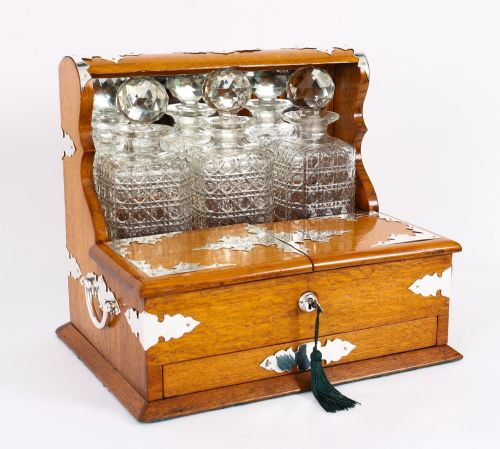
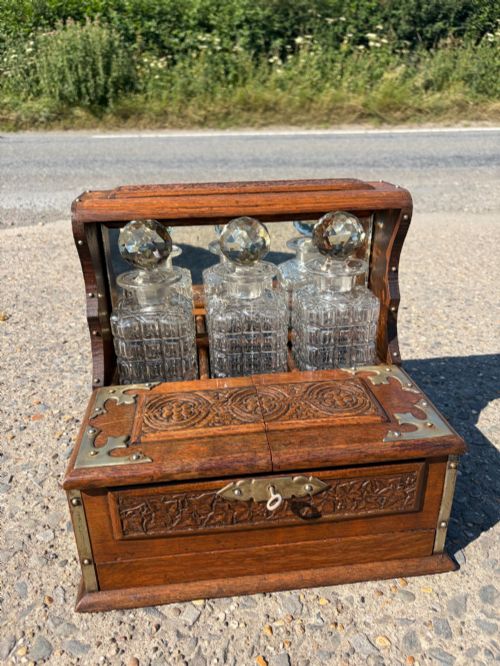
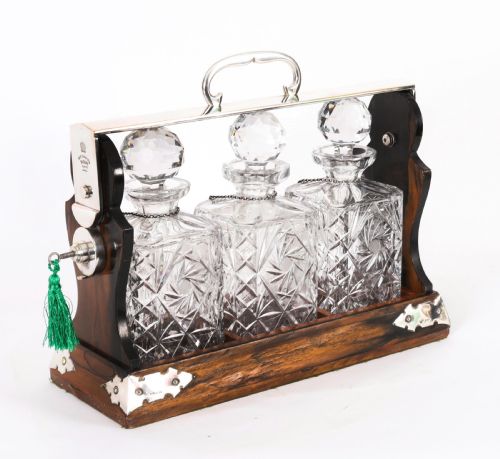
A locking decanter set, often known as a tantalus, houses crystal decanters within a secure wooden frame fitted with a functional lock. These pieces emerged to keep household staff or guests away from the master's private spirits.
Most examples found here date from the Victorian and Edwardian periods, constructed to hold either two or three cut glass decanters. Oak is the primary timber met on this page, alongside decorative woods such as coromandel and walnut.
Beyond straightforward spirit storage, larger versions frequently incorporate games compendiums or after-dinner compartments. The locking mechanism itself forms the mechanical heart of the object, sliding a metal bar across the stoppers to prevent removal until a key is turned.
Judging quality in locking sets
The distinction between standard production pieces and the finest examples rests on the secondary functions and the choice of cabinetry. Sets incorporating coromandel wood veneer or integrated games compendiums represent the more ambitious end of the maker's output.
Hardware weight and engraving depth indicate higher workshop standards. Solid brass mounts, fully functioning locks with original keys, and heavy cut crystal decanters mark out superior pieces from simpler oak-cased versions.
Object forms on this page range from single-bottle cased tantalus boxes to three-decater sets combined with games compendiums.
Betjemann’s·Hukin and Heath
The Locking Decanter Set Glossary
- Coromandel wood
- A heavy, dense exotic timber imported from Asia, featuring rich brown colour with dark streaks. Cabinetmakers utilised it for luxury boxes and high-end tantalus frames during the nineteenth century.
- Games compendium
- A fitted box containing equipment for multiple parlour games such as cards, dominoes, and chess. These are frequently built into the base of larger nineteenth-century spirit cabinets.
- Silver plate
- A layer of silver fused to a base metal, commonly used for the locking bars, handles, and mounts on Edwardian and late Victorian barware.
Locking Decanter Set: Frequently Asked Questions
How does a locking decanter set work?
A metal retaining bar engages with the glass stoppers to block them from being pulled upward. Turning a key in the lock releases the mechanism so the bar can slide aside.
Without the key, the decanters remain firmly trapped in the wooden base, protecting the contents from unauthorized access.
Are original keys usually included?
Some pieces retain their original working keys, while others have replacement keys or locks that have been professionally adjusted over the decades. Finding a set with a fully operational original lock adds significantly to the historical interest.
Working mechanisms are tested and noted in individual descriptions where present.
What is the difference between a tantalus and a decanter set?
A standard decanter set consists of bottles resting on a tray or inside an open caddy without physical restraints. A tantalus incorporates a locking metal framework specifically designed to secure the bottles against the wood.
Both serve after-dinner drinks, but the locking version provides an extra layer of mechanical security.
How do I date a Victorian locking set?
Dating relies on the timber used, the style of the brass hardware, and registration marks or maker stamps on the lock plate. Oak frames with heavy brass mounts are typical of the late nineteenth century.
Earlier examples often feature exotic veneers like coromandel, while later twentieth-century pieces adopt simpler geometric lines.