


Victorian Spirit Caddy
A victorian spirit caddy organises your decanters behind a secure lock, holding your fine liqueurs in sturdy oak or gleaming silver plate.
Victorian Spirit Caddy
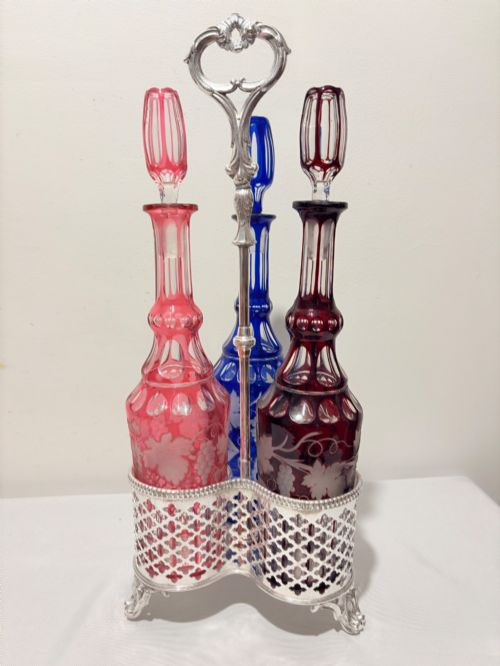
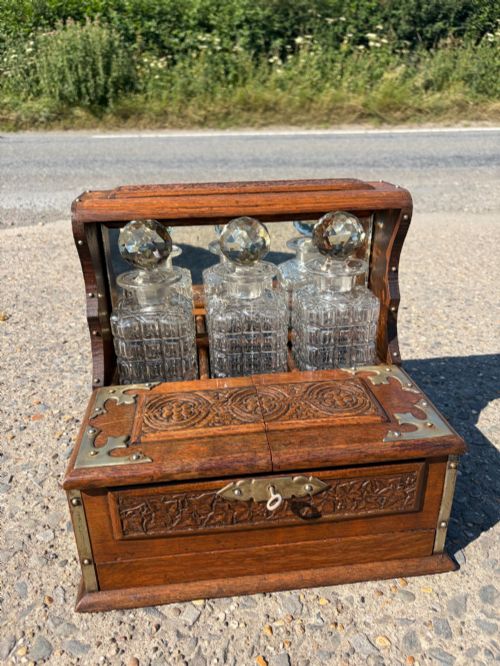
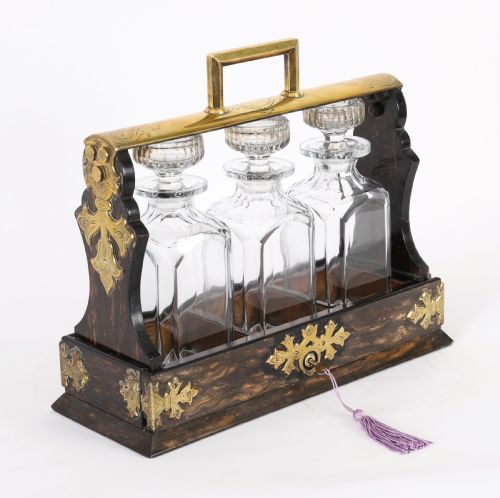
A victorian spirit caddy brings together the forms of the tantalus, decanter stand, and drink dispenser across the Victorian and Edwardian periods. You will most frequently meet solid oak or coromandel wood frames fitted with cut crystal decanters and secured by locking mechanisms.
These pieces encompass portable leather cases, ornate metal frames, and ceramic whisky carafes designed to house liquor bottles securely. The selection on this page demonstrates how domestic entertaining evolved through the nineteenth century into the early twentieth century.
Makers utilised Sheraton Revival styles alongside standard Victorian aesthetics to create functional pieces for the dining room or study. The form ranges from simple two-bottle stands to elaborate three-bottle tantalus sets complete with games compartments.
What varies in quality
Quality rests in the choice of cabinet timbers, such as figured coromandel or substantial quarter-sawn oak, paired with thick-walled cut crystal. Superior examples integrate functioning lock and key mechanisms that secure the metal retaining bars effectively over the decanter stoppers.
The refinement of the cast brass mounts, the precision of any wood inlay, and the clarity of the cut crystal separate standard production from finer exhibition pieces. Elaborate additions like integrated games drawers or multiple frosted crystal barrel dispensers elevate the execution of the design.
Listings feature periods spanning the Victorian and Edwardian eras, with materials including oak, coromandel, silver plate, and cut crystal.
The Victorian Spirit Caddy Glossary
- Tantalus
- A locking drink stand that holds decanters in place by their stoppers so they cannot be removed without a key. This clever device kept household spirits safe from unauthorised access.
- Coromandel Wood
- A heavy, dark decorative timber with contrasting lighter grain, imported from Asia and utilised for luxury Victorian boxes and caddies. It provides a striking striped appearance.
- Silver Plate
- A thin layer of silver fused to a base metal, commonly used to manufacture bright frames and mounts during the nineteenth century. It offered the appearance of solid silver at a lower cost.
- Cut Crystal
- Glass containing lead that is faceted by grinding and polishing to create sharp geometric patterns. This material refracts light brilliantly when filled with amber liqueurs.
- Sheraton Revival
- A late nineteenth-century design style drawing on the neoclassical furniture forms of Thomas Sheraton. It incorporates delicate inlay, symmetry, and polished mahogany or satinwood.
Victorian Spirit Caddy: Frequently Asked Questions
How does a tantalus lock work?
A metal bar runs across the top of the decanter stoppers and fastens into a locking mechanism at the end of the wooden frame. Turning the key releases the bar upward so the bottles can be lifted free.
When the bar is locked down, the stoppers cannot be removed, preventing the decanters from being tilted or emptied while stored in the caddy.
Were these caddies meant for travel?
Certain compact leather cases and framed stands were built for portability, housing securely strapped bottles for journeys. Partner's models and heavy oak tantalus sets were designed to stay stationary on sideboards.
Heavier wood and glass constructions required stable placement in a dining room or study rather than frequent transit.
What is the difference between a stand and a tantalus?
A decanter stand holds bottles in an open frame or tray without necessarily restricting access to the contents. A tantalus adds a physical locking bar over the stoppers to restrict the liquor.
Both forms belong to the broader category of nineteenth-century spirit caddies and barware.
How do I date a piece?
Dating relies on stylistic clues like Sheraton Revival motifs, the presence of late Victorian oak framing, or specific material combinations like coromandel and cut crystal. Patent dates or maker inscriptions on the hardware occasionally provide a narrower window.
Pieces originating from the 1860s through to the Edwardian era display shifts from ornate silver-plated frames toward sturdy oak constructions.