


Brass Mounted Tantalus
A brass mounted tantalus is a secure Victorian drinks cabinet designed to lock away fine spirits while still displaying them through heavy glass.
What they are
When you search for a brass mounted tantalus, you encounter nineteenth-century decanter sets and barware housed in robust wooden boxes fitted with metal locking bars. These pieces originate predominantly from the Victorian period, spanning the late nineteenth century from around eighteen seventy to nineteen hundred.
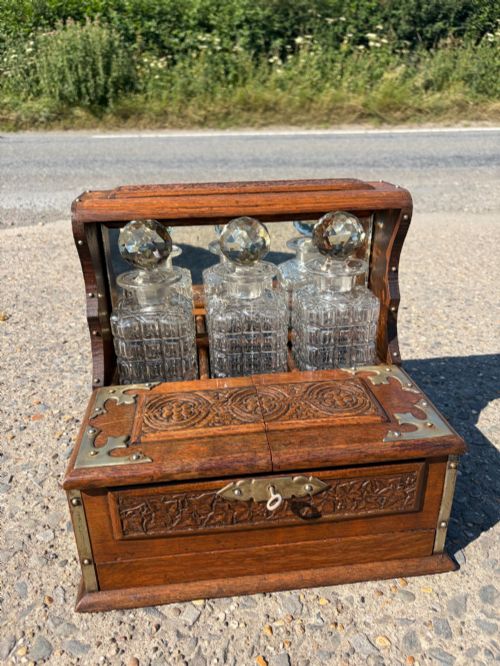
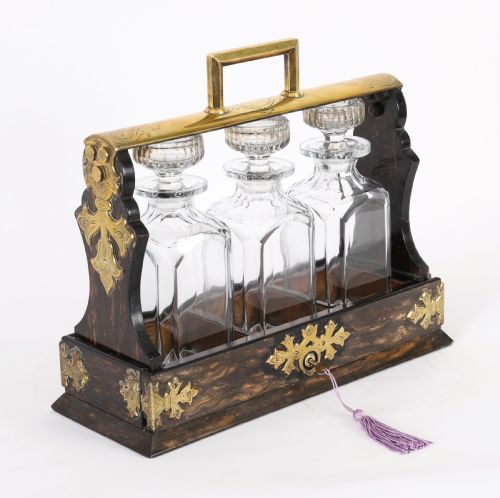
The dominant examples on this page are constructed from solid oak or exotic coromandel wood, frequently designed to hold three cut crystal decanters. Alongside traditional tantalus frames, related forms include decanter boxes and integrated games compacts that combine barware with storage for leisure items.
Originating in the Victorian era, these locking frames were created to protect household spirits from unauthorized consumption by servants or guests. The ingenious mechanism uses a hinged metal bar running across the stoppers, secured by a lock that prevents the removal of the bottles until the key is turned.
How they were made
Cabinet makers utilised dense timbers such as quarter-sawn oak and richly figured coromandel wood to build the structural boxes, often reinforcing the corners and edges with heavy cast brass mounts. The exterior woodwork was meticulously planed, joined, and polished to highlight the natural grain of the timber before the metal hardware was fitted.
The accompanying vessels consist of heavy cut crystal or glass decanters, shaped with deep geometric facets that catch the light. Inside the box, mirrored glass panels are sometimes integrated into the backplate to reflect the brilliance of the crystal and the amber hues of the stored spirits.
Retail Price Guide 2026
Typical UK retail prices for brass mounted tantalus, calculated from the Sellingantiques database of over a million retail prices indexed since 2003. This retail price guide relies exclusively on Sellingantiques data; no external sources or auction records are used, so the figures do not describe the wider market.
What varies in quality
Quality in a brass mounted tantalus rests on the choice of cabinet wood and the intricacy of the internal fittings. Exemplary pieces employ highly figured coromandel timber or substantial oak combined with finely cast brass mechanisms rather than simple plated iron.
The refinement of the glassware further separates standard examples from superior ones. Heavy, deeply cut crystal decanters matching the exact proportions of the frame indicate a higher grade of original manufacture than plain or mismatched glass replacements.
The Brass Mounted Tantalus Glossary
- Coromandel wood
- A dense, heavily figured exotic timber imported from Asia, prized for its dark brown colour and contrasting black stripes. Cabinet makers reserved this expensive material for luxury Victorian boxes.
- Cut crystal
- Glassware shaped with sharp, precise facets ground into the surface to refract light. This heavy material was standard for nineteenth-century decanters.
- Decanter box
- A partitioned wooden case designed to hold spirit bottles without the external locking bar mechanism found on a standard tantalus. These portable cellarets protected fragile glassware during travel or storage.
Frequently Asked Questions
What is a brass mounted tantalus?
A brass mounted tantalus is a Victorian locking drinks cabinet that holds decanters securely beneath a metal bar.
It allows hosts to display expensive spirits while preventing unauthorized access to the bottles.
How do you open a tantalus?
Opening the mechanism requires a matching key inserted into the brass lock to release the hinged retaining bar.
Once unlocked, the bar pivots upward or drops away, freeing the decanter stoppers so the bottles can be lifted out.
What woods were used for these boxes?
Victorian makers typically constructed these cabinets from durable oak or exotic coromandel timber.
Oak provides a sturdy, traditional finish, while coromandel offers rich figuring and deep contrasting grain patterns.
How many decanters do they hold?
Most examples from this period are configured to accommodate three matched crystal decanters.
The interior layout includes fitted wooden partitions to keep each heavy glass vessel stable within the box.
Are the locks original?
Many surviving pieces retain their working brass locks, though keys are frequently replaced over time.
Inspect the surrounding wood and brass escutcheon to see if the hardware has remained undisturbed since the nineteenth century.