

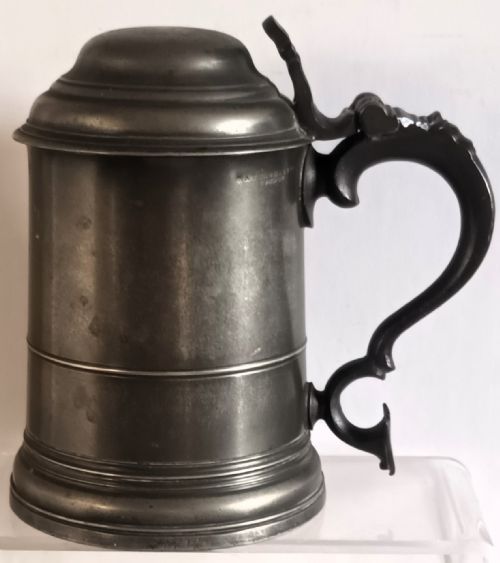
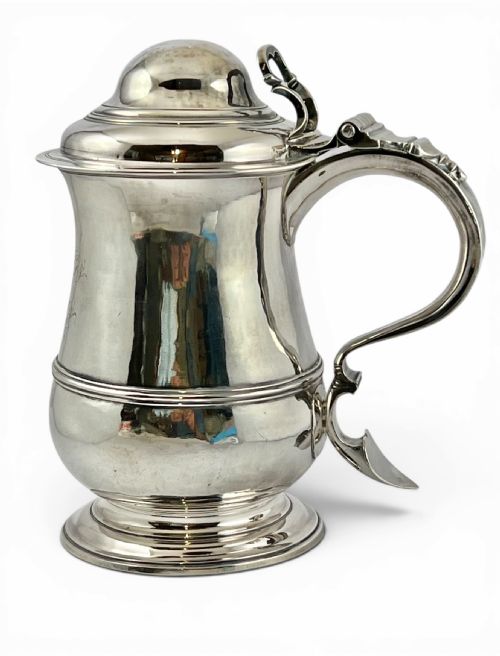


Lidded Beer Mug
When you search for a lidded beer mug, you enter a world of heavy metal and stoneware drinking vessels designed to keep ale secure.
Lidded Beer Mug
A lidded beer mug, often called a tankard, flagon or stein, combines a cylindrical drinking vessel with a hinged lid operated by a thumbpiece. The form evolved to keep insects and debris out of the brew while retaining the head.
Examples on this page span from the seventeenth century through the Georgian and Victorian eras, alongside Arts and Crafts creations and continental European pieces. Pewter and Old Sheffield Plate appear frequently among the English items.
German and continental pieces bring stoneware, faience and cobalt salt-glazed surfaces into the mix, often decorated with historicist or baroque motifs. Glass bodies mounted in silver also emerge across the nineteenth-century selections.
Materials and construction methods
Metal vessels rely on casting, hammering and soldering, with pewter, sterling silver and copper forming sturdy walls secured to heavy flat or domed lids. Old Sheffield Plate fuses a thin layer of silver onto a copper base, visible where the edges meet.
Stoneware and faience pieces use high-fired clay shapes finished with cobalt pigment or polychrome glazes before kiln firing. Lids on these ceramic steins typically employ cast pewter mounts attached with a hinge pin.
Glass-bodied vessels integrate mounted silver rims and hinged covers, demanding precise metalwork to secure the glass without fracture. Handles are soldered or riveted firmly to the main body to support the weight of a full measure.
Lidded Beer Mug Retail Price Guide 2026
Typical asking prices for lidded beer mug among the pieces listed under this phrase on Sellingantiques today, from the lower quarter to the upper quarter. They describe what is for sale here now, not the wider market.
Several heavy pewter tankards carry glass bottoms, said to let drinkers keep an eye on press gangs while downing their ale.
Assessing quality in historical drinking vessels
Quality rests upon the crispness of the maker's marks, the balance of the handle against the heavy body, and the alignment of the hinged lid. Superior metalwork shows smooth seams and well-proportioned thumbpieces that operate without strain.
In plated items, the preservation of the silver layer over the copper core dictates the grade. For ceramics, the clarity of the cobalt transfer or hand-painted polychrome glaze separates standard production from finer output.
Watts & Harton·John Payne·Archibald Knox for Liberty & Co·Burgum & Catcott of Bristol
The Lidded Beer Mug Glossary
- Tankard
- A tall, cylindrical drinking vessel with a single handle and a hinged lid. They appear in silver, pewter and plated metals.
- Old Sheffield Plate
- A fused metal composite where a thin sheet of silver is applied to a copper base. This technique preceded modern electroplating.
- Westerwald
- A German region renowned for salt-glazed stoneware decorated with cobalt blue incisions. Pieces from here often feature distinct grey and blue surfaces.
- Thumbpiece
- The small lever attached to the hinge of a lidded mug. It allows the drinker to flip the lid open with a single thumb.
- Pewter
- An alloy of tin mixed with copper, antimony or bismuth. It provides a durable, weighty material for historical drinking vessels.
Lidded Beer Mug: Frequently Asked Questions
What is a lidded beer mug used for?
These vessels serve for holding and consuming ale, beer or cider. The hinged lid originally helped keep outdoor pests away from the liquid.
Today they function equally well as display objects, mantle pieces or traditional vessels for actual use during gatherings.
How do I clean antique pewter?
Pewter requires gentle washing in warm soapy water followed by thorough drying with a soft cloth. Avoid aggressive metal polishes that remove the aged surface.
Leaving a dark patina intact preserves the historical appearance and character of older pieces.
How do I date a silver tankard?
English silver carries hallmarks indicating the assay office, the specific year letter and the maker's mark. Comparing these stamps against official registers reveals the exact year of production.
Stylistic cues such as flat-topped lids or scroll handles also point toward specific decades like the Georgian or Stuart periods.
Can I drink from Old Sheffield Plate?
Old Sheffield Plate items made from silver fused to copper are generally safe for cold drinks if the interior remains clean. Check that the underlying copper is not exposed on drinking surfaces.
Modern buyers often use them for display or special toasts rather than daily hydration.