
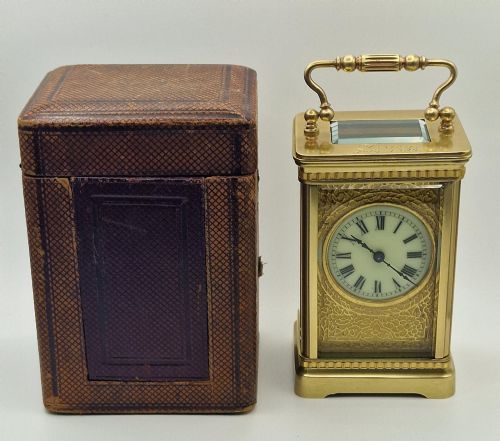
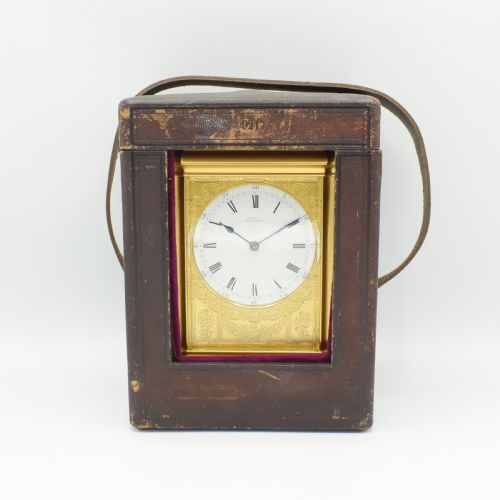
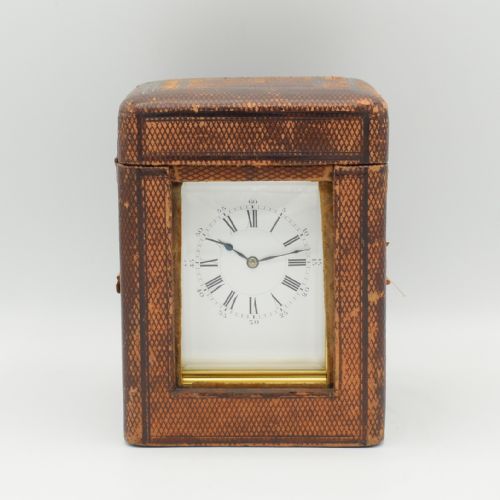


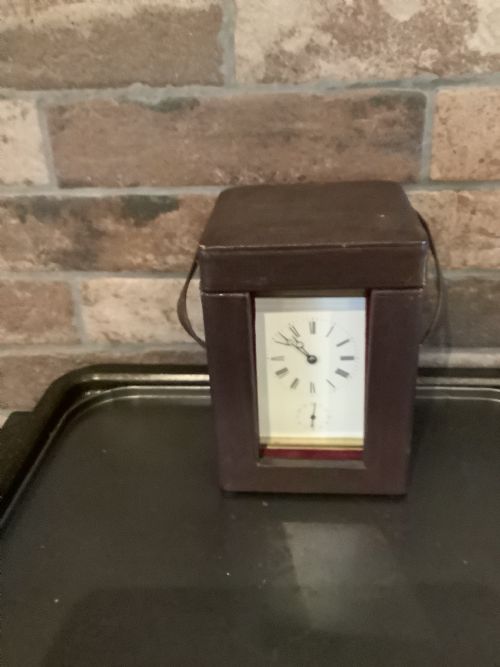


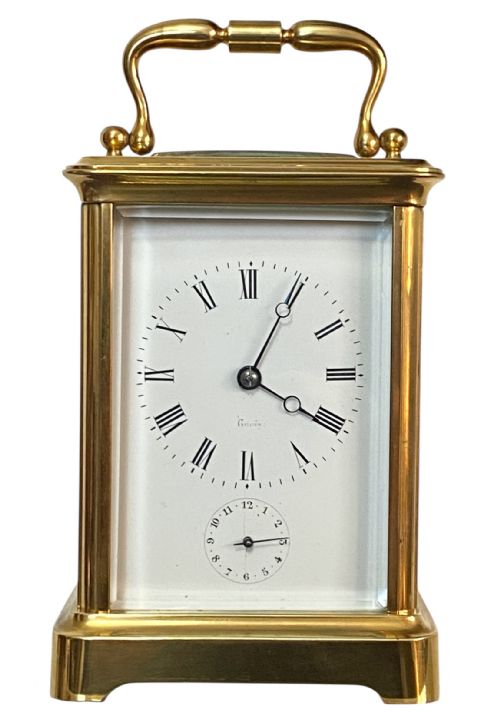

Leather Cased Carriage Clock
A leather cased carriage clock is a portable mechanical timekeeper housed in a protective outer box, combining precision brass work with durable travel housing for the discerning collector.
Leather Cased Carriage Clock
A leather cased carriage clock brings together heavy brass movement framing, bevelled glass panels, and a fitted protective outer case designed for travel. When exploring this selection, buyers encounter examples spanning the nineteenth century alongside Edwardian pieces.
The dominant forms on this page include French and Swiss travelling timepieces, miniature boudoir models, and grand sonnerie striking clocks. Many retain their original leather or red Morocco travel boxes alongside keys and winding components.
Origins stretch across Victorian and Edwardian periods, featuring both plain brass gorge cases and fully engraved gilt surfaces. The presence of the original case marks a significant point of interest for collectors seeking complete historical units.
Construction and materials
Makers constructed the structural framework of each carriage clock from heavy brass, frequently applying a gilt finish to the metal surfaces. Bevelled glass windows were fitted into the top and sides to reveal the escapement and gear trains within.
Listings feature brass, gilt, sterling silver, and guilloche enamel materials across Victorian and Edwardian periods.
Evaluating quality and merit
Quality in a leather cased carriage clock rests upon the complexity of the movement, such as eight-day striking, repeating mechanisms, or alarm complications. Simpler timepieces contrast with grand sonnerie examples that sound the hours and quarters automatically.
The crispness of hand engraving across the brass mask and case distinguishes finer workshops from standard production pieces. Furthermore, the survival and condition of the original leather travel case significantly enhance the integrity of the ensemble.
Henri Jacot·Hunt and Roskell·Alfred Hollinge·Dent
The Leather Cased Carriage Clock Glossary
- Carriage clock
- A portable spring-driven timekeeper developed for travel during the nineteenth century. These clocks typically feature a rectangular brass case with glass panels and a swing handle.
- Gorge case
- A distinct rectangular brass carriage clock case style characterised by stepped mouldings at the top and base. It represents one of the standard architectural housings for French movements.
- Guilloche enamel
- Decorative metalwork covered in translucent enamel over an engine-turned geometric pattern. This technique appears on dials and panels of finer boudoir pieces.
- Grand Sonnerie
- A complex striking train mechanism that sounds both the hours and the passing quarters automatically. It is found in more sophisticated nineteenth-century French and Swiss clocks.
- Escape movement
- The internal mechanism regulating the release of power from the mainspring to the gear train. In better pieces, this often includes a visible platform escapement.
Leather Cased Carriage Clock: Frequently Asked Questions
How do I wind a carriage clock?
Most models use a dedicated key applied to arbours on the backplate of the movement. Care must be taken not to overwind the mainspring.
Striking and alarm trains require separate winding squares alongside the timekeeping train.
Why do some clocks have original boxes?
Travel cases were manufactured specifically to protect the brass and glass housing during transit across Europe or domestic journeys. Surviving boxes preserve the clock from surface scuffs.
Finding a matching leather case adds historical completeness to the piece.
What is a repeating carriage clock?
A repeating mechanism allows the owner to press a button on the top case to sound the last elapsed hour and quarter at will. This function was essential during the dark before electric lighting.
It requires a secondary hammer and gong arrangement inside the brass frame.
How are nineteenth century French and English pieces told apart?
French makers produced the vast majority of carriage clock movements during the Victorian era, often marking their backplates with maker stamps. English retailers such as Dent frequently retailed these imported movements.
Stylistic cues in the engraving and case geometry offer further clues to origin.
What is a boudoir timepiece?
A boudoir timepiece is a smaller, more delicate version of the standard carriage clock designed for domestic bedroom use rather than heavy travel. These examples often feature silver or enamel decoration.
They generally omit striking trains to maintain a quieter operation.