

Serpentine Carriage Clock
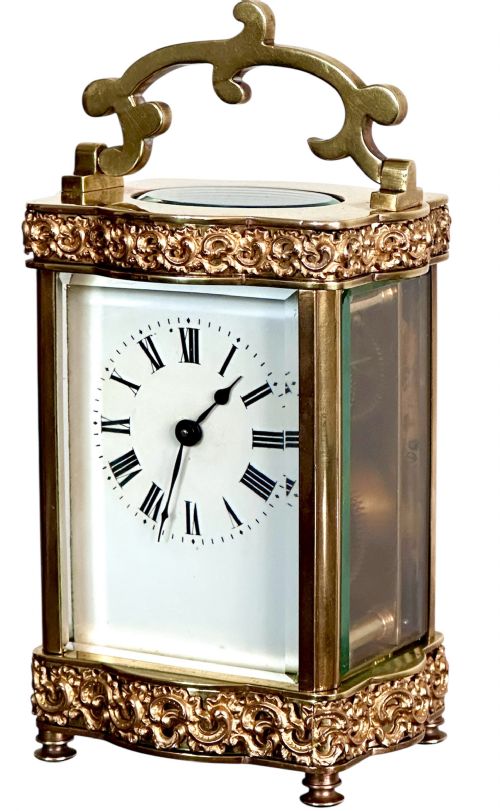
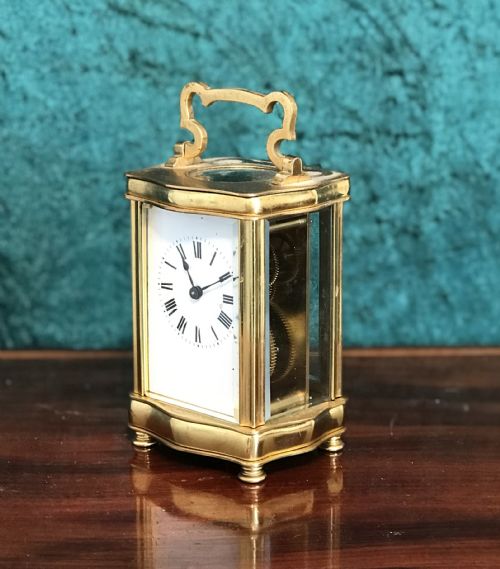
A serpentine carriage clock brings architectural movement to desk timekeeping through its distinctively curved case.
Identifying serpentine carriage clocks
A serpentine carriage clock is a portable timepiece housed in a brass and glass case with undulating, wavy sides. These pieces belong predominantly to the Victorian, Edwardian, and Art Nouveau periods around the turn of the twentieth century, originating mostly from French workshops.
The form departs from the standard rectangular brass box by softening the profile into gentle curves. Both standard timepieces and alarm variations appear in the record, sometimes accompanied by travel cases.
Makers such as Duverdrey and Bloquel produced these items, alongside other French and English workshops. Buyers encounter brass frames holding bevelled glass panels that reveal the mechanical movement within.
Materials and construction
Construction relies heavily on cast brass, which is shaped to form the curved serpentine outlines of the case. Bevelled glass panels fit snugly into the brass framework to protect the dial and expose the escapement.
Dials frequently feature white enamel with painted numerals, often paired with contrasting inner scales or subsidiary alarm rings. Brass components receive polished or gilt finishes to catch the light from multiple angles.
Listings for serpentine carriage clocks span the Victorian and Edwardian periods, utilising brass, glass, and enamel materials.
Judging quality in construction
Quality separates ordinary brass casting from finer, crisper execution where the curved serpentine lines flow with deliberate precision. The weight of the brass case and the clarity of the bevelled glass panes indicate the standard of manufacture.
The sophistication of the movement inside dictates the upper tier of pieces, particularly when complications like alarms are integrated smoothly into the undulating brass housing.
Duverdrey and Bloquel
The Serpentine Carriage Clock Glossary
- Serpentine case
- A housing characterised by a wavy outline featuring alternating concave and convex curves. This shape requires precise casting and fitting of the glass panels.
- Carriage clock
- A small, spring-driven portable timepiece designed for travel during the nineteenth and early twentieth centuries. They typically feature a swinging handle on top.
- Enamel dial
- A fused glass surface applied to a metal base, providing a smooth white background for painted clock numerals. It offers durability and a clean aesthetic.
- Bevelled glass
- Glass panels with edges cut and polished at an angle, allowing them to catch light and fit securely into the brass frame.
Frequently Asked Questions
How do I wind a serpentine carriage clock?
Wind the clock using a matching key inserted into the winding arbors located on the backplate of the movement. Turn gently until resistance indicates full tension.
Avoid over-winding to protect the internal springs and maintain accurate timekeeping for daily use.
What period are most serpentine carriage clocks from?
Most examples date from the late nineteenth and early twentieth centuries, spanning the Victorian and Edwardian eras. French makers produced a large share of these curved brass timepieces.
Stylistic cues like enamel dials and brass finishing help place them securely within this period.
Do these clocks include travel cases?
Some pieces come with fitted leather travel cases designed to protect the brass and glass exterior during journeys. These cases often feature hinged lids and interior linings tailored to the clock dimensions.
Travel cases add context to the portable nature of nineteenth-century timekeeping.
How do I set the alarm on an alarm carriage clock?
Set the alarm by turning the small hand on the subsidiary dial to the desired wake time using the back setting arbor. Ensure the alarm spring is wound alongside the main time train.
When the hour arrives, an internal hammer strikes a bell or gong within the brass case.