


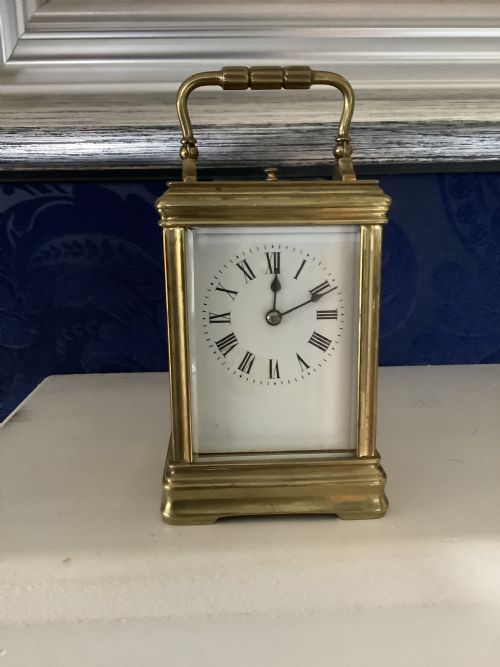


French Miniature Cased Clock
These french miniature cased clock examples pack heavy architectural brass and glass into palm-sized travel pieces that collectors prize for their intricate mechanics.
French Miniature Cased Clock
A french miniature cased clock brings precision horology into a compact format designed for travel or bedside use. These pieces span the nineteenth century, nineteen hundred, and Edwardian periods, frequently appearing in Victorian and Rococo Revival styles.
The most common form on this page is the miniature carriage clock in brass or gilt brass, often complete with its original travelling case. You will also encounter boudoir timepieces and single chain fusee mantel clocks in bronze and ormolu.
Objects range from simple timepieces to eight-day movements with alarms and full engraving. Smaller examples measure under three inches in height, maintaining the robust build of their larger counterparts in a fraction of the space.
Materials and construction methods
Heavy brass and gilt brass form the structural framework for these cased pieces, enclosing bevelled glass panels that reveal the escapement within. Makers frequently housed these delicate mechanisms in leather travelling cases to protect the polished metal during journeys.
More decorative examples incorporate sterling silver, bronze, and ormolu, alongside intricate guilloche enamel and floral enamelled details. The dials and bezels often feature finely engraved scrollwork executed by hand to catch the light.
Listings span the nineteenth century up to nineteen ten, featuring brass, silver, enamel, and bronze construction.
Judging quality and execution
The distinction between standard and superior pieces rests on the crispness of the brass casting and the depth of the hand engraving. Fully engraved gilt brass frames demand significantly greater skill than plain polished surfaces.
Movement complexity further separates the range, moving from basic timepieces to eight-day mechanisms with operational alarms and chain fusee systems. The presence of a matching leather travelling case elevates the completeness of the object.
Richard co maker
The French Miniature Cased Clock Glossary
- Carriage clock
- A portable spring-driven timepiece developed for travellers, usually featuring a rectangular brass case with glass panels and a handle on top.
- Guilloche enamel
- A decorative technique where a precise geometric pattern is機械 engraved beneath a translucent enamel layer.
- Fusee
- A conical pulley used in clock movements to maintain even tension on the gear train as the mainspring unwinds.
- Ormolu
- Gilded bronze ornamentation applied to furniture and clock cases, popular in nineteenth-century French design.
- Boudoir timepiece
- A small clock designed for a private sitting room or bedroom, prioritising elegant decoration over complex striking functions.
French Miniature Cased Clock: Frequently Asked Questions
What is a french miniature cased clock?
It is a compact portable timepiece enclosed in a metal and glass case, often accompanied by a protective travelling leather outer box.
These pieces were engineered to provide accurate timekeeping for nineteenth-century travellers without sacrificing decorative elegance.
How do I wind these clocks?
Most examples utilise a dedicated winding key that fits onto arbors on the backplate or dial depending on the movement design.
Care must be taken not to overwind the mainspring, particularly on eight-day movements and single chain fusee models.
Why do some have leather cases?
The fitted leather cases were manufactured specifically to shield the polished brass frames and delicate glass panels from the rigours of carriage and rail travel.
Surviving cases add historical context and protection to the miniature timepiece inside.
How do I distinguish periods?
Nineteenth-century pieces often rely on heavy architectural brass and restrained engraving, whereas later Victorian and Edwardian examples occasionally introduce floral enamel and guilloche work.
Stylistic cues like Rococo Revival scrolls point towards specific decorative revivals during the Victorian era.