
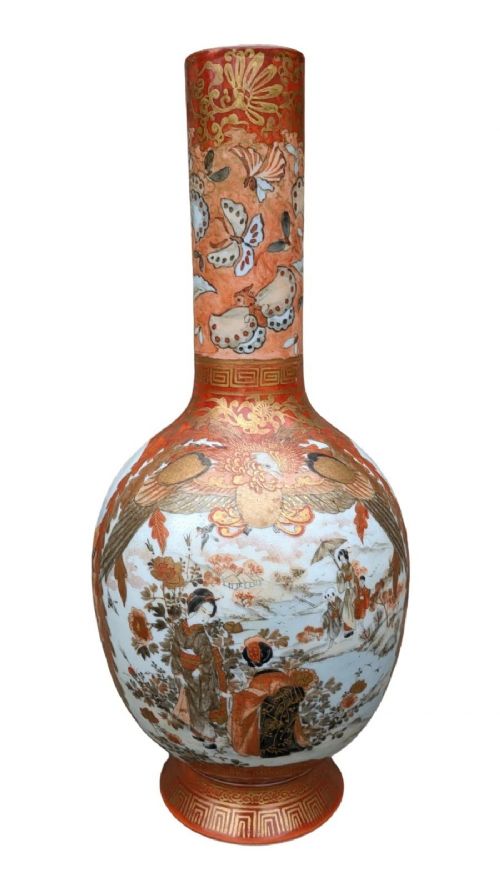


Large Kutani Urn
A large kutani urn brings the disciplined hand of the Meiji period into a room through generous proportions and rich enamel painting.
Large Kutani Urn
When you search for a large kutani urn, you are looking at substantial Japanese porcelain vessels created during the nineteenth century. These pieces arrive in forms such as floor vases, flare neck vases, and vases with lion handles, often accompanied by wood stands.
The versions you are most likely to meet on this page date from the Meiji period, specifically spanning the decades around eighteen eighty and eighteen ninety. They represent Japanese export production designed to command space through sheer scale and decorative weight.
How they were made
Potters shaped these vessels from porcelain before applying complex glaze and enamel work by hand. Artisans utilised gold leaf and gilt to highlight intricate surface patterns.
Techniques such as moriage built up raised enamel details that give the decoration tangible depth. Wood was worked separately to supply fitted display stands for the larger vases.
Materials appearing across the inventory include enamel, gold leaf, glaze, gilt, and wood.
What varies in quality
The distinction between ordinary and exceptional pieces rests upon the precision of the hand-painting and the complexity of the enamel palette. Stronger examples display disciplined brushwork within dense floral or figural compositions rather than hurried application.
Proportion and the handling of raised moriage details also dictate the standing of a piece. Finer examples maintain crisp definition in the gilt and gold leaf highlights across their generous surfaces.
The Large Kutani Urn Glossary
- Kutani
- Japanese porcelain traditionally characterised by vibrant enamel painting and extensive use of colour. This ware developed distinct regional styles across the nineteenth century.
- Meiji Period
- The era in Japanese history spanning from eighteen sixty-eight to nineteen twelve. Work from this time often catered to Western export markets.
- Moriage
- A ceramic technique where slip is piped onto the surface to create raised decorative patterns. This adds a tactile element beneath the glaze and enamel.
- Gilt
- A thin layer of gold applied to the surface of the porcelain or enamel. It catches the light and frames the painted scenes.
Large Kutani Urn: Frequently Asked Questions
What is a large kutani urn?
These pieces are nineteenth-century Japanese porcelain vases created during the Meiji period for export. They take forms including floor vases and flare neck vessels, often featuring hand-painted enamels.
Such vessels were made to stand on the floor or on dedicated wood stands. Their substantial scale allows them to function as focal points in a room.
How do I date a large kutani urn?
Dating relies on stylistic markers associated with the Meiji period and specific decades like eighteen eighty or eighteen ninety. Hand-painted details and export characteristics help place them in this nineteenth-century window.
Moriage techniques and specific handle designs also point toward the later decades of the nineteenth century. Comparing the enamel palette to documented pieces confirms the era.
How were these urns used?
Export workshops produced these large vessels primarily for Western domestic interiors during the late nineteenth century. They served as decorative focal points in grand reception rooms and halls.
Their sheer size meant they sat directly on the floor or on custom wood stands. They demonstrated an interior's engagement with Japanese aesthetics.
How do I live with a large kutani urn?
Position these substantial porcelain pieces in spaces where their scale and colour can be appreciated without obstruction. Placing them on their appropriate wood stands protects both the base and the floor.
Keep them away from heavy foot traffic to safeguard the raised enamel and gilt surfaces. Gentle dusting with a dry cloth is sufficient for maintenance.