
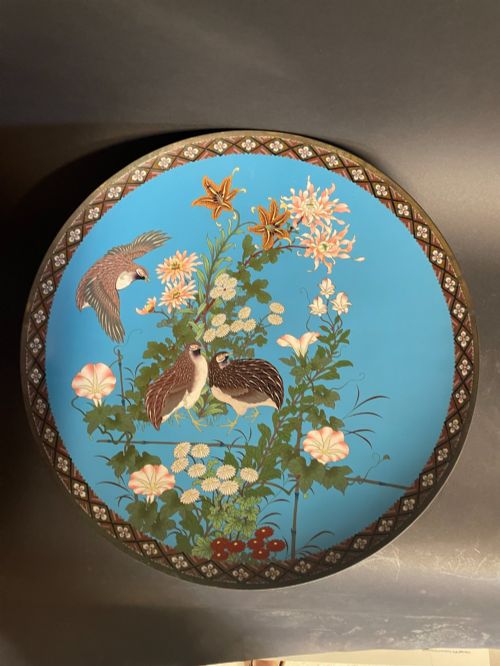


Large Cloisonne Wall Charger
A large cloisonne wall charger brings striking Meiji and Edo period Japanese artistry into a room through vibrant enamelwork and sweeping scale.
Large Cloisonne Wall Charger
A large cloisonne wall charger is a substantial decorative plate or dish designed for display, originating primarily from nineteenth century Japan. When you search for a large cloisonne wall charger, you encounter circular vessels spanning up to fifty-one centimetres in diameter, dominated by Japanese Meiji and Edo period aesthetics.
The versions most likely to meet you on this page include nineteenth century pieces featuring intricate depictions of dragons, birds such as the phoenix and owl, koi fish, Buddha figures, and landscapes. These items function as focal points on walls, executed through traditional Far Eastern decorative techniques.
Makers utilised various ceramic and porcelain cores alongside copper bases, applying detailed enamel motifs that span periods from the 1860s to the 1890s. Each large cloisonne wall charger represents the culmination of specialised metalwork and glazing traditions.
Materials and construction methods
Artisans formed the foundation of each charger using copper or brass, occasionally employing ceramic or porcelain bases for specific variations like Totai Shippo and cinnabar lacquer combinations. Fine copper and brass wires were then bent and soldered onto the metal surface to outline elaborate motifs of dragons, birds, and scenery.
The resulting cellular compartments, or cloisons, were meticulously filled with coloured enamel pastes before undergoing multiple firings in a kiln to vitrify the glass powders. Craftsmen subsequently ground and polished the surface to achieve a smooth finish where the thin metal wire outlines remained crisp and prominent against the coloured background.
Current listings span the 1860s through the 1890s, covering both the Edo and Meiji periods with copper, brass, and porcelain material bases.
Distinctions in craftsmanship and design
Quality in these pieces rests upon the precision of the wirework and the complexity of the pictorial subject matter, such as detailed leaping koi or multi-coloured dragons. Pieces featuring signed panels or specialised techniques like Totai Shippo tree bark effects demonstrate superior artistry compared to standard decorative plates.
The depth of the enamel colour, the absence of firing flaws, and the overall scale - ranging from thirty-six to over fifty centimetres - distinguish high-end examples. Masterpiece classifications often align with late Edo and early Meiji period specimens that maintain exceptional pictorial clarity and structural integrity.
The Large Cloisonne Wall Charger Glossary
- Cloisonne
- Enamelwork in which coloured pastes are separated by thin metal wires soldered to a metal backing. This technique creates intricate pictorial designs across the face of a charger.
- Totai Shippo
- A variation of cloisonne where the enamel is applied over a ceramic or porcelain body rather than solid metal. It frequently incorporates textured elements like simulated tree bark.
- Charger
- A large decorative plate or platter traditionally used for display on walls or sideboards. These items measure significantly larger than standard tableware.
- Meiji Period
- The era in Japanese history spanning from 1868 to 1912, noted for a surge in ornate metalwork and enamel production directed at export markets.
Large Cloisonne Wall Charger: Frequently Asked Questions
How do I hang a heavy charger safely?
These substantial pieces require sturdy wall fixings that support the full weight of the metal and enamel body without gripping the rim too tightly.
Utilise coated wire display hangers designed specifically for heavy plates, ensuring the tension distributes evenly across the back rim.
What is Totai Shippo?
Totai Shippo describes wire-inlaid enamel work applied over a ceramic or porcelain core rather than a standard copper foundation.
This method allows the charger to combine traditional porcelain bodies with textured surface effects like simulated tree bark.
How do I clean an antique enamel charger?
Dust the surface gently with a dry, soft microfiber cloth to prevent any accumulation of particles within the fine wire crevices.
Avoid using water, chemical cleaners, or abrasive polishes, as moisture can penetrate hairline fractures in the old enamel or tarnish exposed wires.
Are these pieces signed?
Certain examples feature maker signatures or workshop marks integrated into the design, usually found on the base or within the enamel field.
These signatures help identify the period and the specific studio responsible for the intricate wirework and glazing.