



Kinkozan Satsuma Pottery
Kinkozan Satsuma pottery comprises finely painted Kyoto earthenwares from the Meiji period, prized by collectors for intricate enamel and gilt detailing.

Kinkozan Satsuma Pottery
Kinkozan Satsuma pottery encompasses items produced in Kyoto during the 19th century and around 1900, spanning the Meiji period and Edwardian era. When you explore this selection, you encounter diverse forms created by this renowned workshop.
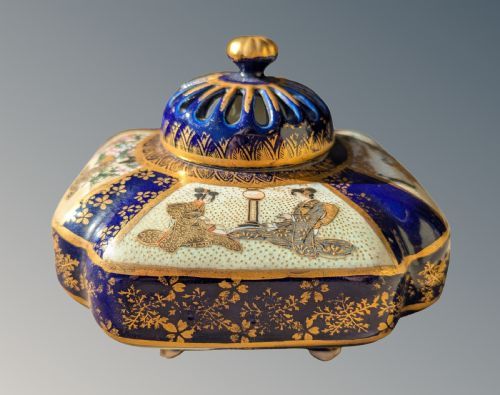
Vases dominate the offerings, ranging from globular shapes and bamboo-handle forms to pairs of large decorative vases. Beyond vessels, the inventory includes incense burners, baskets, plates, and decorative bowls.
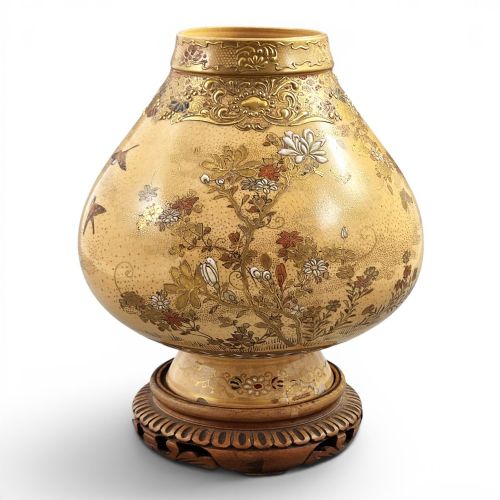
Many examples showcase specific themes such as samurai figures, moonlit battle scenes, and dense floral patterns like the thousand flowerhead design. The pieces originate from the Kyoto workshop associated with the Kinkozan name.
Materials and methods
These pieces are constructed from earthenware, providing a porous ceramic body suited for detailed surface decoration. Artisans applied elaborate enamel work across the vessels to build up complex figurative and botanical scenes.
Gilt and gold leaf embellish the surfaces, often combined with cobalt blue grounds to create high-contrast panels. Wood elements occasionally appear alongside the ceramic bodies, particularly in associated display components.
The workshops utilised precise hand-painting techniques characteristic of Kyoto production during the Meiji period. Signatures and mon symbols, such as the Shimazu family crest, were frequently incorporated into the final glaze.
Judging the work
The distinction between standard output and the finest pieces rests upon the density and precision of the enamel painting. Elaborate compositions featuring numerous figures, such as samurai scenes, require superior brushwork compared to simpler floral motifs.
The integration of gold leaf and cobalt blue defines the visual impact of the upper tier. Mastery in applying gilt accents without crowding the underlying ceramic body elevates certain vases and bowls above simpler production.
Attribution and signature clarity further distinguish the examples. Pieces bearing clear signatures from the Kinkozan workshop or established circles command greater attention from collectors than unsigned or generic counterparts.
Kinkozan Workshop·Kinkozan Circle·Kinkozan Kyoto
The Kinkozan Satsuma Pottery Glossary
- Satsuma
- Earthenware pottery originating from Satsuma province, though later largely produced in Kyoto by workshops such as Kinkozan. It is typically characterised by a crackle glaze and detailed enamel painting.
- Meiji Period
- The era of Japanese history lasting from 1868 to 1912, corresponding with the majority of the Kinkozan pieces seen here. This period saw a massive expansion in decorative ceramics made for export.
- Shimazu Mon
- The heraldic badge or crest of the Shimazu clan, rulers of the Satsuma domain. This crest frequently appears on pottery associated with Satsuma production.
- Millefleur
- A decorative pattern translating to a thousand flowers, covering the entire surface of a vase or bowl in dense floral detail. In Japanese ceramics, this style is also known as the thousand flowerhead design.
Kinkozan Satsuma Pottery: Frequently Asked Questions
What is Kinkozan Satsuma pottery?
Kinkozan Satsuma pottery refers to ceramic wares made by the Kinkozan family and workshop in Kyoto, primarily during the Meiji period. These items are distinct for their fine earthenware bodies and elaborate polychrome enamel and gilt decoration.
The workshop produced a wide array of decorative objects for export and domestic markets. Collectors value them for their intricate depictions of figures, landscapes, and floral patterns.
How do I identify a Kinkozan piece?
Identification relies on finding painted or impressed signatures associated with the Kinkozan workshop on the base of the vessel. The style often combines a characteristic crackle glaze with dense enamel painting and heavy gilding.
Motifs such as samurai figures, cobalt blue panels, and the Shimazu mon further help connect specific objects to this Kyoto tradition. Comparing the brushwork quality to documented examples confirms the attribution.
What forms do these ceramics take?
The inventory of Kinkozan Satsuma works includes various decorative vessel forms, most notably vases, decorative bowls, and incense burners. You may also encounter less common shapes like baskets, plates, and specialised handle designs.
Scale ranges from small cabinet pieces to monumental bowls and tall pairs of vases. Each form serves primarily as a canvas for the detailed pictorial narratives painted across the surface.