
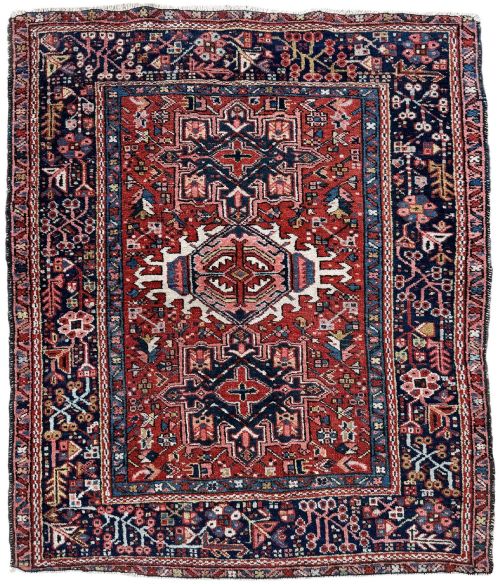
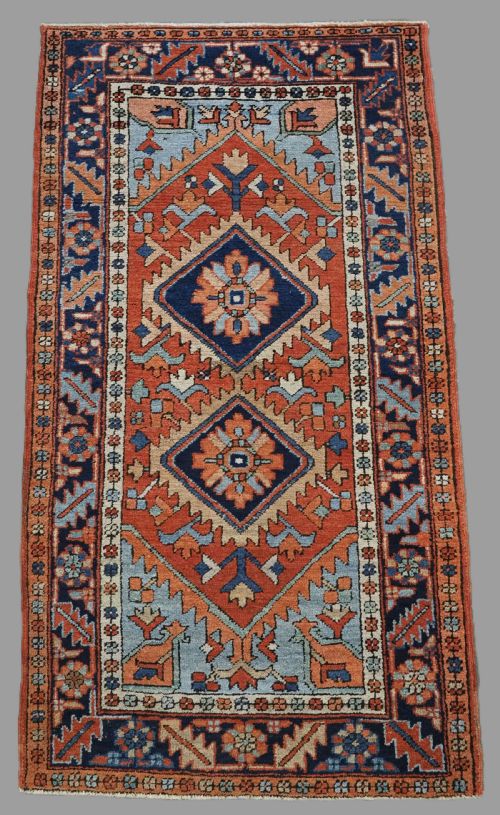


Karaja Medallion Carpet
A karaja medallion carpet brings robust North-West Persian village weaving into a room, prized for bold geometric designs and rich natural wool.
Karaja Medallion Carpet
A karaja medallion carpet forms part of a distinctive group of village and town floor coverings originating from the North-West of Persia. When searching for a karaja medallion carpet, buyers encounter pieces that span from the late nineteenth century through to the early decades of the twentieth century. These textiles frequently appear as smaller rugs, long narrow runners, or larger format carpets displaying traditional Persian and tribal characteristics.
The objects available on this page encompass various formats including area rugs, runners, and carpets from the Heriz region. Dating across these listings ranges from the 1870s up to 1920, capturing late nineteenth-century weaving traditions. Buyers will find that the smaller rug format and the elongated runner are the most common configurations encountered within this selection.
How they were made
Every karaja medallion carpet relies on hand-knotted wool construction set upon a cotton foundation. Artisans in the North-West Persian region utilised resilient wool piles to ensure the floor coverings could withstand heavy domestic use while retaining flexibility.
Weavers employed traditional techniques passed down through generations in Persian village workshops. The structure combines hand-tied knots with sturdy warp and weft threads, resulting in the dense, durable fabric characteristic of nineteenth-century and early twentieth-century production.
Even narrow runners manage to squeeze in enough geometric attitude to boss an entire hallway.
What varies in quality
The standard of a karaja medallion carpet depends primarily on the fineness of the knotting and the clarity of the geometric design. Finer examples display precise execution of the central medallion and crisper delineation of the surrounding motifs.
Condition and scale also define the hierarchy within these Persian weavings. Early pieces from the nineteenth century that maintain strong pile integrity and uncompromised structural foundations occupy the upper tier of the range.
The Karaja Medallion Carpet Glossary
- Medallion
- A central ornamental design motif placed in the field of the carpet. It forms the focal point of the composition in many traditional Persian village weavings.
- Runner
- A long, narrow format of carpet designed specifically for hallways, corridors, or staircases. These pieces measure significantly longer than they are wide.
- Warp
- The stationary vertical strings stretched on the loom upon which the knots are tied. Cotton serves as the primary material for this foundational structure.
- Weft
- The horizontal threads passed through the warps after each row of knots to secure them in place. This contributes to the overall firmness of the textile.
- Pile
- The vertical or diagonal surface of yarn formed by the cut ends of knots. Wool constitutes this soft upper layer on traditional Persian floor coverings.
Karaja Medallion Carpet: Frequently Asked Questions
Where were karaja medallion carpets made?
These floor coverings originate from the North-West region of Persia, specifically associated with the town of Karaja and the broader Heriz district.
Weavers in these village communities produced distinctive geometric carpets and runners during the nineteenth and early twentieth centuries.
How do I care for an antique wool carpet?
Regular gentle vacuuming without a rotating brush roll helps remove grit from the wool pile. Professional cleaning tailored for antique textiles preserves the natural fibres.
Keeping the carpet out of direct strong sunlight prevents the vegetable and natural dyes from fading prematurely over the years.
What is the difference between a rug and a runner?
A rug typically presents a balanced proportions format suited to open floor spaces or seating areas. Rugs are often square or moderately rectangular.
In contrast, a runner is elongated and narrow, engineered for corridors, passageways, or long narrow gallery spaces.
How can I tell the age of a Persian carpet?
Dating relies on assessing the structural materials, the style of the design, and the characteristics of the wool pile. Nineteenth-century examples often display specific regional palettes and knot densities.
Comparing construction traits with documented pieces from periods such as the 1870s or 1900 helps establish an approximate timeframe.