

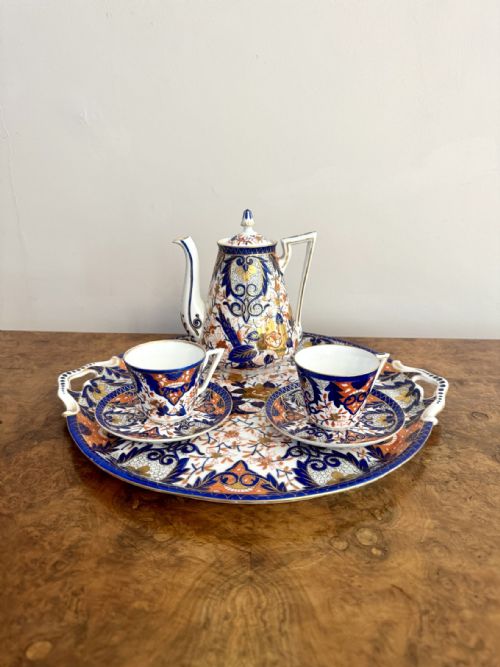
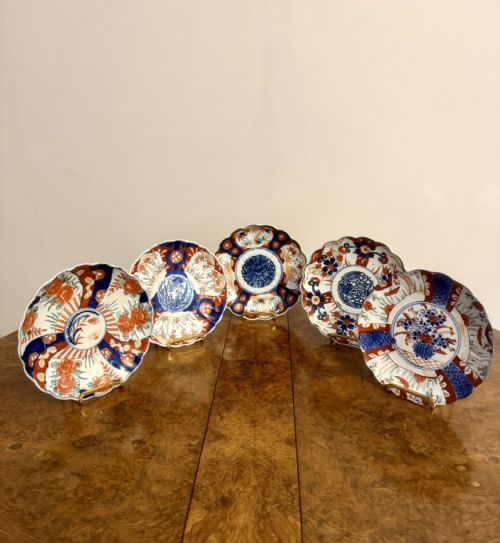


Japanese Imari Ceramic Set
These Japanese imari ceramic sets bring striking cobalt and iron red palettes to your table, offering centuries of hand-painted artistry.
Japanese Imari Ceramic Set
A japanese imari ceramic set typically comprises groups of matching plates, dishes, vases, or coffee wares united by their distinctive regional style and palette. You will encounter arrangements spanning from the late seventeenth century through to the Meiji period and the twentieth century, reflecting both Japanese origins and European adaptations.
The configurations vary from small collections of four or five plates to larger garnitures of three lidded vases and matching bowls. Many pieces demonstrate traditional forms alongside European-influenced shapes produced for export during the nineteenth century.
What varies in quality
The crispness of the cobalt blue underglaze and the precision of the overglaze enamel work dictate the visual strength of each set. Higher grade pieces display meticulous brushwork and careful application of gold leaf rather than rushed or muddy pigment placement.
Harmony across the group separates uniform sets from assembled collections, as matching glaze tones and consistent body thickness indicate coordinated workshop production.
Listings feature porcelain and earthenware formed into plates, dishes, vases, and coffee sets across the eighteenth, nineteenth, and twentieth centuries.
The Japanese Imari Ceramic Set Glossary
- Imari palette
- A decorative scheme utilising cobalt blue, iron red, and gilt highlights on a white ceramic base. This combination originated in Japan and influenced subsequent European porcelain production.
- Garniture
- A set of matching vases or vessels designed to be displayed together on a mantelpiece or cabinet. These groupings typically consist of three or five graduated pieces.
- Edo period
- The historical era in Japan lasting from 1603 to 1868, characterised by economic growth and the flourishing of ceramic arts. Pieces from this time form the earlier tier of available sets.
- Meiji period
- The era spanning from 1868 to 1912, noted for increased export trade and highly detailed decorative techniques. Many plates and vases date from the latter portion of this timeline.
Japanese Imari Ceramic Set: Frequently Asked Questions
How do I display a ceramic set?
Arranging a matching group of plates or vases together creates a focal point on a sideboard or within a display cabinet. Keeping garnitures balanced across a mantelpiece highlights their original decorative purpose.
Ensure pieces are secure and kept away from high-traffic edges to protect the overglaze enamels and gold leaf from accidental knocks.
Can I use these sets for dining?
Antique porcelain and earthenware require careful handling, so modern daily use is generally discouraged in favour of display or occasional service. Hand washing in lukewarm water without harsh detergents preserves the delicate iron red and gilt surface details.
Sudden temperature changes should be avoided to protect the historic glaze and ceramic body from stress fractures.
How are different periods identified?
Dating relies on stylistic clues, the weight and texture of the porcelain body, and the specific vibrancy of the cobalt and enamel colours. Earlier pieces often display robust potting, while Meiji items can show greater elaboration in shaped contours and gilding.
Comparing glaze characteristics against documented examples helps narrow down whether a set originates from the eighteenth or nineteenth century.
What does Black Ship decoration mean?
This specific imagery references the arrival of Western vessels in Japan, capturing historical maritime subjects on the ceramic surface. Plates featuring this motif document a distinct period of cross-cultural trade and exchange.
Such sets are distinguished by narrative scenes incorporating ships alongside traditional floral or geometric borders.