


Japanese Cloisonne Vases
Japanese cloisonne vases bring intricate metalwork and vibrant enamel into interiors from the Victorian era onward.

The Nature of Japanese Cloisonne Vases
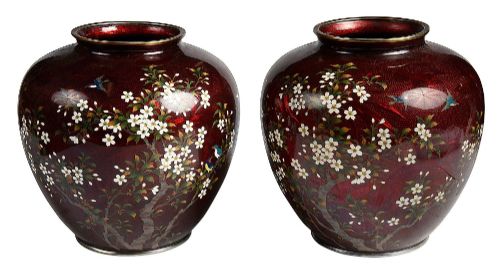
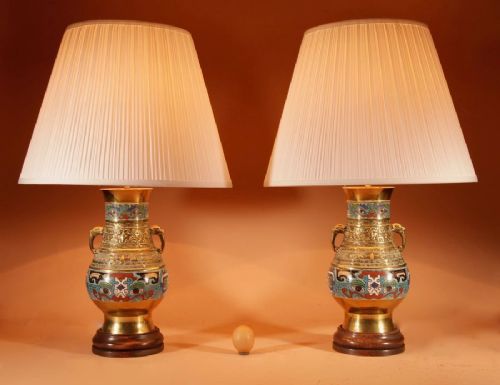
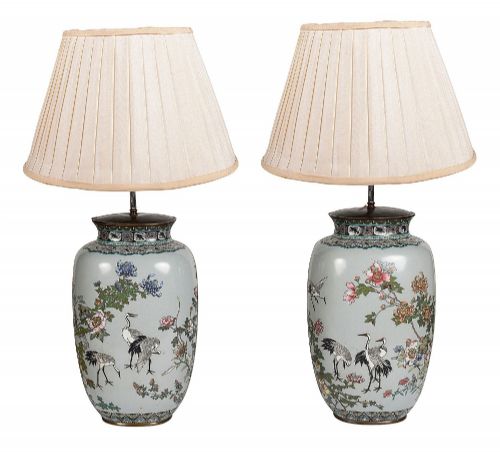
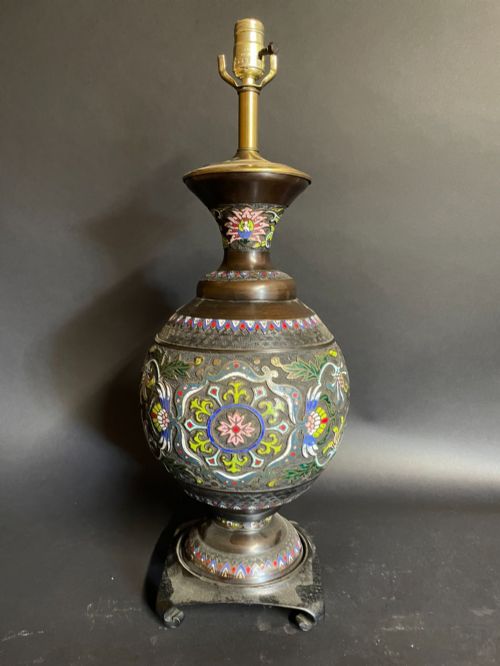
Japanese cloisonne vases appear predominantly as pairs, spanning the Meiji period, Victorian era, and early twentieth century. These decorative vessels range from small cabinet pieces to large baluster forms and flower urns.
The designs draw heavily from the natural world, displaying birds, blossoms, and floral motifs across the enamel surface. Collectors encounter both standard wirework and specialised techniques like ginbari and moriage.
Materials and Construction
Artisans form these vessels using copper, brass, or bronze as a base metal body. Fine wires of silver or gold are soldered onto this metal foundation to create the outlines of the design.
Coloured enamel paste fills the compartments created by the wire cells. The piece is then fired in a kiln and polished to achieve a smooth finish.
Listings feature copper, brass, and bronze as base metals across Victorian and Meiji period pieces.
Distinguishing Quality
Quality rests on the fineness of the wirework and the control of the enamel during firing. The thinnest wires and the most precise cell divisions separate workshop output from ordinary production.
Attribution to known makers elevates a piece, as does the complexity of the ground, such as transparent enamel over textured foil in ginbari work.
Ando Company·Hayashi Kodenji·Hirosuke Gonda
The Japanese Cloisonne Vases Glossary
- Cloisonne
- Enamel decoration in which metal wire forms raised barriers to hold coloured pastes before firing. This technique creates detailed patterns across the metal body.
- Meiji Period
- The era in Japanese history spanning from 1868 to 1912, noted for a peak in decorative arts production. Many surviving vases date from this time.
- Ginbari
- A translucent enamel technique applied over a patterned or foiled background. It produces a textured, shimmering effect beneath the coloured glass.
- Moriage
- A style of decorative relief work applied to the surface of ceramics or enamel. This method builds up raised details that stand proud of the main body.
- Baluster
- A vase form characterised by a bulbous lower portion tapering to a narrower neck. This shape appears frequently among antique examples.
Frequently Asked Questions
What metals form the base of these vases?
Makers use copper, brass, and bronze to construct the foundational body of each vessel. These metals provide a stable substrate for the wire cells and enamel.
Heavier bronze elements often appear in larger urns, while copper serves standard baluster forms.
Were these vases made as pairs?
Surviving examples frequently occur in matched pairs designed for symmetrical display on mantelpieces or cabinets. Individual single pieces also appear.
Pairs often share identical floral or bird motifs executed in matching wirework.
How do I care for antique enamel?
Keep these vessels away from direct sunlight and sudden temperature changes to protect the metal and glass. Dust them gently with a soft, dry cloth.
Avoid using liquid cleaners or polishing agents on the cloisonne surface.